

In a way, the films of Elaine May — A New Leaf, The Heartbreak Kid, Mikey and Nicky, the much and unfairly maligned Ishtar — are about acting. That concept makes sense for a writer-director who is also herself an actor, but that doesn’t entirely explain the particular facility she has in her direction of actors; the manner in which her films accommodate the performances within them. The following fact may offer some help: before acting in Hollywood comedies — before co-writing scripts for Otto Preminger, Warren Beatty, Sydney Pollack and others — May was part of the Chicago-based improv group The Compass Players, and later half of a comedy duo with Mike Nichols. May’s penchant for improvisation constantly set her in opposition to studio bosses: both A New Leaf and Mikey and Nicky were taken away from her by Paramount, and edited without her approval. Yet the film of which May suffered the least interference, The Heartbreak Kid, still contains her inimitable directorial touch. It helps that May worked with a cast that collectively tapped into her primary mode — one of excruciation by prolongation — and it doubly helps that her direction is focused on the expressive resources of a great comedic actor: Charles Grodin.
There’s something inherently funny — I say this with all love — about Grodin’s face. That blank expression he wears throughout The Heartbreak Kid, and the way it can flit within seconds to a dumb wide-smiling happiness or scrunched-up phony rage, is at first tickling; but it’s the earliest warning that not all is as it seems to be. Reading Grodin’s performance is a challenge because every facial movement, gesture and line reading exposes only the black hole of his character’s desire. Grodin plays Lenny Cantrow, a salesman, who meets Lila (Jeannie Berlin, May’s daughter) and marries her. They honeymoon in Florida, only for Lenny to meet Kelly (Cybil Shepherd), and fall in love with her. For one connection to the centrality of acting in May’s films, this scenario looks like May’s riposte to The Graduate, directed by her former comedy partner, Mike Nichols. Grodin provides another connection: he studied under Lee Strasberg and Uta Hagen in New York; in Mikey and Nicky, the mob boss Dave Reznick is played by Sanford Meisner of the Meisner technique fame. In order to apprehend the registers and effects of Grodin’s performance, and the way in which the microscope of May’s direction observes him, I want to structure the following as a series of scene-analyses: this way, the work of Grodin and his scene partners can be seen in concert and conflict, and in terms of what their performances are in service of — to display, with hyaline clarity, the destructiveness of Lenny’s possessive determination.
The first scene I want to discuss is the first argument between Lila and Lenny. On their second night of driving through from New York to Florida, they stop at a motel. This is the second time they have sex. Immediately, the characterizations of the two actors provide a sense of a breach between the couple: Lila is talkative, she likes to reiterate, and Lenny does not. Sex is interrupted when Lenny loses his temper because of the chatter. This is intimated on the first night, when Lenny is chagrined by Lila’s drawing circles in his chest hair: an act of simple intimacy which Lenny denies. The contrast between Lila’s honest affection and Lenny’s indifference is expressed in that single act, revealing an elemental divergence of temperaments. And yet it’s only going to get worse.
Read More at VV — Soundtracks of Television: ‘Inventing Anna’

On both occasions, Grodin assumes a blank expression — the same that’s visible when he knows he’s not being looked at; the expression that suggests there’s little to nothing going on behind his eyes. Lila’s taken aback by his paroxysm, but she calmly explains something that will place a wedge between any potential future the two of them night share: she wants to reassure and be reassured, and, as she’s fond of saying, this is what’s needed to sustain a relationship for the next 40 or 50 years. “I married a grouch,” Lila tells him, affecting a teasing tone. Berlin’s sympathetic gaze is not returned; Grodin’s face, and its refusal to emote in the light of her gentle entreaty, is callow. Lenny tries to hide the blankness with a forced smile from time to time, which Lila unfortunately doesn’t see through. The man’s expression is blank because he himself is. Lelia hasn’t married a grouch — she’s married a blank.
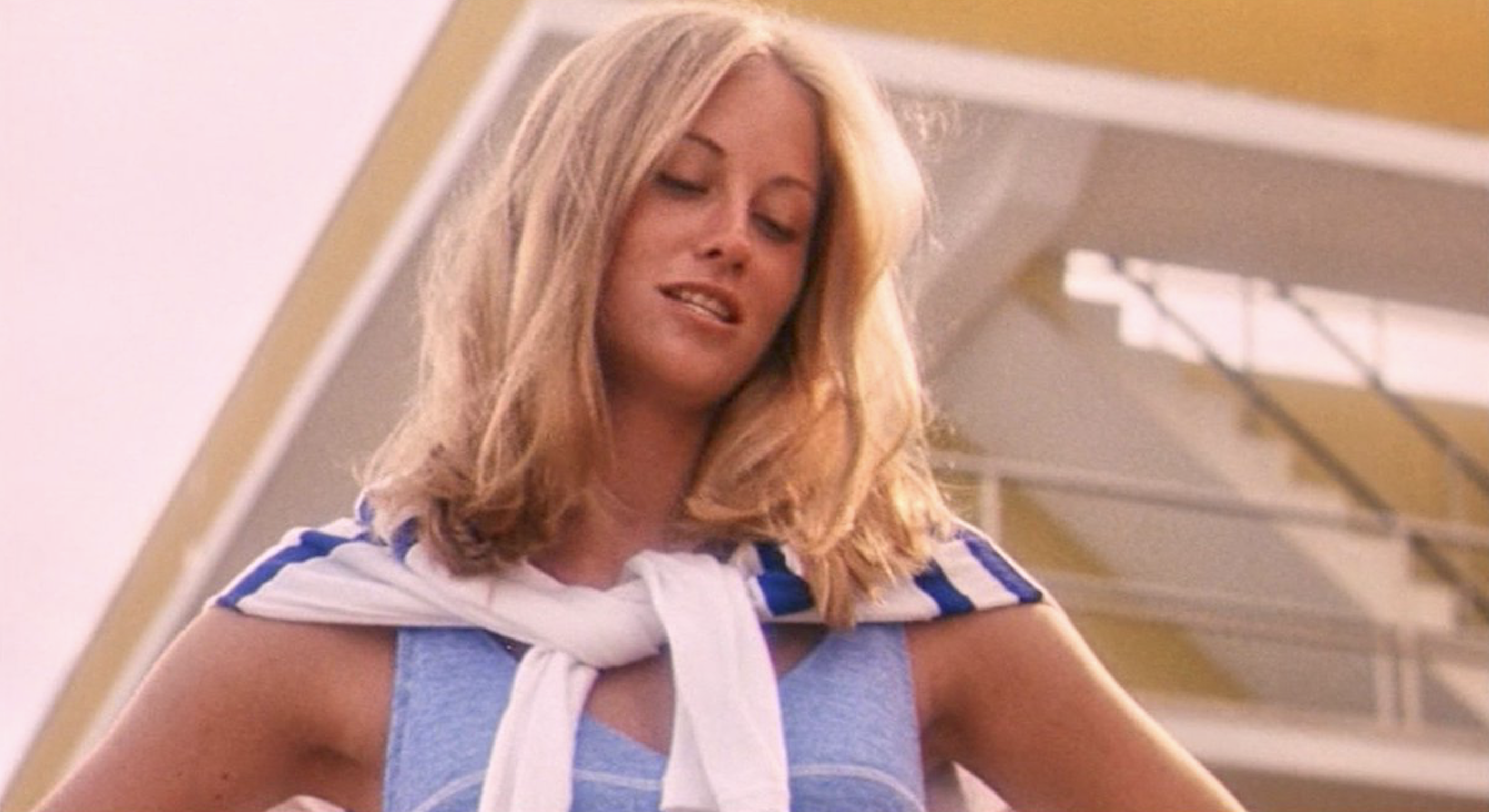
The second scene I want to isolate is important for the way it pits Grodin against an actor with an entirely different, more testing expressive temperature: Shepherd’s Kelly. Once the newlyweds arrive in Miami Beach, the rift widens: Lenny wants to get down to the beach immediately, whereas Lila spends more time than he can warrant backcombing her hair in the mirror. Lenny goes down without her, and while indulging in the heat, Kelly, a beautiful WASP college student also staying at the hotel, speaks to him briefly. Lila eventually joins him, but is badly sunburnt. Lenny meets Kelly again in the hotel bar, arranging to go the next morning for an early swim. After the swim, the two sit chatting by the hotel pool.
In Kelly’s every interaction with Lenny, she diminishes him. Kelly refers to him as a “teddy bear,” and calls Lila his “little wife.” She also makes reference to rules. “That’s my spot,” Kelly says as she sees him on the beach for the first time; later, in the bar, she says “that’s my stool.” Verbally and non-verbally, Kelly engages in a routine, a game of flirtation. But for her, it’s exactly that — a game; something that passes the hours in the daytime before another dinner with her rich parents and their rich friends. For Lenny, it’s supposedly life-changing. But Kelly flirts in micro-doses — a wide smile for an instant; then a stern look of reproach. After one more of her verbal diminutions, she then takes Lenny’s hand, and begins what she calls a scratch test: the kind of intimacy Lenny rejected from Lila. Shepherd has a habit of changing the angle from which she looks at Grodin, as if Kelly is scrutinizing whether this is worth her time, sizing up this “teddy bear.” Grodin excels at scene-work in which his characters try to come across as uber-agreeable while being subjected to pressure in conversation, as in Albert Brooks’ Real Life, during which the neurosis of Brooks as a performing opponent gets the better of Grodin’s polite resistance. If, in the first scene discussed, it’s Grodin’s facial blankness that is most noteworthy, here, it’s his exaggerated smile, his desperate rolling laugh at every one of Kelly’s ironic sentences. True enough, for someone he first saw as if emerging from out of the sun, Lenny melts in Kelly’s presence.
Read More at VV — Soundtracks of Television: ‘Winning Time: The Rise of the Lakers Dynasty’
In between this scene with Kelly and the next crucial juncture in terms of Grodin’s performance, there are a handful of scenes in which Lenny resorts to narrative-making so that Lila remains unaware of his rendezvous with Kelly. The stories he fashions are slippery, quick-study tales, light as air: he ran into an old army buddy; when he doesn’t return to Lila later than evening, it’s because there were in an accident together; he disguises his day on a yacht belonging to one of Kelly’s parents’ friends in the form of a long wait to deal with the resulting lawsuit, following the imaginary car crash, in the stifling bureaucracy of Florida’s courts. In his book Acting in the Cinema, James Naremore writes,” Ordinary living usually requires us to maintain expressive coherence, assuring others of our sincerity,” but acting itself is lying, and Grodin’s character is himself a dissembler. In these scenes, therefore, Grodin creates, in Naremore’s term, an “expressive incoherence,” appropriate for a character whose motivating desires are also incoherent. So while Lenny produces those mendacious words, a few expressive ticks take over in Grodin’s performance. In his line readings, he elongates his vowels; when Lila presses him, he raises his voice to a breathy shout, a shout in which all his aspirants are emphasized. Not only in these scenes, but throughout The Heartbreak Kid, viewers are clued into the fact that when Lenny sounds like this, he’s either panicking, bullshitting or a gloupy admixture of both.
Comic films, writes Naremore, “which often provoke alienated styles of performance, depend on exaggerated forms of bodily incoherence, often resulting in a sort of expressive anarchy.” This can be studied in the next scene I want to cover, Lenny’s protracted break-up with Lila. This occurs directly after the disastrous encounter with Kelly’s parents (played by Audra Lindley and Eddie Albert), in which he admits to loving their daughter — and that he’s also, somewhat inconveniently, on his honeymoon. After neglecting his wife for the duration of the stay, they go out for dinner at a seafood restaurant Lenny has been bigging up for its famous pecan pie. In the midst of this, he will try to let her know that he’s breaking up with her. The scene as played is, inevitably, a devastation. May’s filmography contains a couple of scenes as markedly painful (though for different reasons) as this one, but only a couple: May and Walter Matthau’s attempt to put on her Grecian nightgown in A New Leaf; Peter Falk’s disbelief at John Cassavetes’ indecisions during the ill-advised cemetery trip in Mikey and Nicky. But both of those films feel as painful as they do because of a precise meeting of actorly improvisation with May’s patient long-takes. During the filming of The Heartbreak Kid, according to Maya Montañez Smukler’s book Liberating Hollywood, Neil Simon, the playwright who wrote the script, “was possessive of his dialogue and had it in his contract that no lines could be changed unless discussed with him.” And yet this scene feels improvisatory, as do many other moments throughout The Heartbreak Kid. May was allowed to improvise as rehearsal (and polish the script with Simon’s approval), and her usual method does manage to find itself as a feeling in the scene, even if no actual improvisation occured as part of the final cut, mainly through the gestures Grodin and Berlin perform.
The Heartbreak Kid scene begins happily enough: this is probably the longest period of time they have spent together in the whole vacation, and they messily tuck into their lobsters. But Lenny has no patience; he’s desperately trying to chart a course through their conversation: he knows where he would like to end up, but has no idea how to travel the distance. He’s frantic: his vocal cords stretch and his tones change from pained to news anchor-like. He finds a diversion: there’s only one piece of pecan pie left, the kindly waiter informs them, eliciting from Lenny a splenetic reply, which turns every head in the place towards their table. Lenny’s breathy, hushed shout returns, which is not good news. All the time, Lila is receptive, encouraging and good-humored, but she can’t make much sense of Lenny. After he issues some A-Grade nonsense to her about life’s uncertainties, Lila, still not seeing, because Lenny hasn’t made himself clear as to what’s about to happen, commends him: “You’re so deep, Lenny!” Even worse, after a few moments more, she misconstrues that he’s terminally ill. The editing worsens the mood: each time May changes angle or uses a new set-up in The Heartbreak Kid, Lenny’s shame only seems to get bigger — May communes with the cruel spectacle of Lenny’s evasiveness. Finally, after flailing and gesticulating wildly, Lenny tells Lila that he wants out of the marriage. Berlin’s face becomes rigid; her eyes widen; the cry she emits is like a squawk. It’s an instance of genuine, inarticulate pain, and what Berlin, winded and shivering from the surprise, occasions from Grodin is a return — perhaps a solidification — of that blank callowness from earlier, mixed with relief: the tonal genius of this performance has reached its highest pitch, just as it seems there are no more depths to which his character can sink.
But, as the final scene examined here will attest, Lenny’s self-abnegation is inexhaustible. The last scene on which I want to focus is the escalating confrontation between Lenny and Mr. Corcoran, but I can’t help luxuriating in the chaos of the dinner preceding it. Having divorced Lila and relocated to Minnesota, Lenny proves his devotion to Kelly by way of one of her desire-tests; deeply against her father’s wishes, she, with an imploring tilt of the head, gets them to arrange a dinner with Lenny. During the meal, Lenny stretches his tolerability beyond all reasonable boundaries. He’s prepared a bit about returning to the soil, working on the land, which, as Mrs. Corcoran points out, was the substance of a local newspaper’s editorial that very day. Even worse are his attempts to gain favor in The Heartbreak Kid (this is the apex of Simon’s delicious writing): “This is honest food,” Lenny intones in a manner feigned and unctuous, “there’s no lying that beef, there’s no insincerity in those potatoes, there’s no deceit in the cauliflower.” Mr. Corcoran hasn’t said a word throughout dinner, but asks to speak alone with Lenny. The two walk slowly through to his office. And it begins.
Read More at VV — Soundtracks of Cinema: ‘Fresh’

Two camera set-ups: one angle, aligned with Lenny’s perspective, frames Mr. Corcoran behind his desk, a picture of Kelly between them; the reverse angle looks at Lenny pincered between Mr. Cocoran’s head and a lamp to his right. Everything is clear: he is trapped. Mr. Corcoran speaks; Albert’s line readings are slow, drawn out, full of deliberation. He’s building up to something good. Lowering his eyes, clasping his hands together, raising the pressure of his voice just a note, Mr. Corcoran comments on Lenny’s performance at the dinner table: “I have never heard such a crock of horse shit in my life.” Mr. Corcoran does now what he did during Lenny’s confession of love for Kelly earlier in The Heartbreak Kid: he narrows his gaze, edges forward as though moving into position to better look through the sight of a rifle, readying himself to abolish the life of the helpless deer caught in his eyeline. In other Grodin performances, it’s a pleasure watching him play the foil: the way he remains at a slight ironizing remove from Jill Clayburgh’s character’s emotional life in Claudia Weill’s It’s My Turn; how he plays stoically calm opposite Robert De Niro’s verbal brashnes in Martin Brest’s Midnight Run. In The Heartbreak Kid, there’s no such balance: Mr. Corcoran means to obliterate Lenny in the conversation and henceforth from Kelly’s life.
Each of the scenes analysed demonstrates how Grodin uses a different means of expression to put flesh to Lenny’s obstinately gormless, incoherent self. In the aforementioned scene with Albert, a viewer should pay ceaseless attention to the line readings: towards its conclusion, Grodin unleashes an all-timer. Mr. Corcoran, seeing his chance to remove Lenny totally from his preoccupations, tries to buy him off — being a banker, this looks easy enough. Through the conversation, the sum offered rises. Mr. Corcoran, referring to himself repeatedly as “a brick wall,” ends up furiously dangling $25,000 above Lenny’s head. Grodin’s character replies, referencing his time spent in the army and his incessant determination, with a grimace: “I fought every goddamn minute of those three years… unfortunately, not overseas because of a minor back injury.” At that second part, Lenny turns inward, catching himself before laughing at his own words, as if even he cannot believe he’s saying this, knowing how outrageous this act is. In their performances, Grodin and Albert have waged a rhetorical and expressive conflict — but both their characters have only grown smaller in stature over the conversation’s unhappy duration. The pair look at each other numbly. May cuts to The Heartbreak Kid’s second wedding .
As farce, the cinema of Elaine May — with the exception of Ishtar — bears the mark of fusing comedy and tragedy together, until the two are of one voice. Matthau’s Henry, in A New Leaf , preening and cruel, looks to May’s Henrietta for a way out of destitution, but with the intentions of a Bluebeard; Falk and Cassavetes, who enact a kind of war of performances in Mikey and Nicky, pound frenziedly on each other’s confidence until they reach a breaking point. The Heartbreak Kid, while not explicitly “tragic,” still feels of a piece with these other examples, not least in the tremendous sadness of the final shot. The men in May’s films dance to the vicious rhythms of their own unknowable desires. In American films of the period, only Barbara Loden’s Wanda, Cassavetes’ own Husbands, Joan Micklin Silver’s Chilly Scenes of Winter and Brooks’ Modern Romance can hold a candle to May’s monitoring of her male characters’ pernicious lack of solicitude. Under May’s stare in The Heartbreak Kid, and through the provocations of scene partners, Grodin creates a character of rare stature: a horrifying, stone-dumb genius.
Marc Nelson (@MarcDNelson) is a film critic and bookseller based in Edinburgh, Scotland. He writes for Take One Cinema and The Wee Review. Marc also blogs at theworldentire.com.
Categories: 1970s, 2020 Film Essays, Comedy, Drama, Film Essays, Romance
3 replies »