

The pivotal moment of Carlito’s Way arrives when Carlito Brigante (Al Pacino) is presented with the chance to kill Benny Blanco (John Leguizamo), the garish new gangster making a name for himself in the streets. He knows for sure that he should kill Benny without a second thought, snuffing out the burgeoning threat of a brat who thinks that he can carve his name into street folklore by claiming the scalp of a legendary figure. Carlito the drug dealing legend — the motherfucker-to-the-max — would’ve done what needed to be done, but this is Carlito the man, who’s vowed to reinvent himself, having spent the last five years in prison. All Carlito wants to do is stay out of trouble, and make enough money to retire to the Bahamas. An escape to paradise is within his grasp. “That ain’t me now,” Carlito says as he walks away, leaving Benny unharmed.
It’s an error that costs Carlito dearly. He never quite manages to elude his criminal past, and he never makes it out of New York. Carlito must pay for his act of clemency, murdered by Benny just as he’s about to board the train that would’ve taken him to freedom. Significantly, Carlito’s demise opens the film — a structural detail upon which the entire thematic weight of the narrative hinges. A more conventional and predictable film would use this set-up to portray how fate conspires to doom Carlito from the very beginning, how his quixotic hopes of transformation are crushed beneath inexorable powers over which he has no influence. A colder and more detached film would establish Carlito as an ineffectual victim, and then show the pieces of his undoing fall into their predetermined places.
But Carlito’s Way, adapted for the screen by David Koepp from the novels of Edwin Torres, and directed by the great Brian De Palma, is a film that has no interest at all in impersonal notions of fate. This is a film that’s interested purely in the personal ethics and emotions of its protagonist — his principles, his urges, his loves, his hates, his dreams. Carlito is a victim of nothing apart from his own particular value system, and Carlito’s Way clarifies this by having Pacino’s character narrate the events of his final days from the brink of death, lucidly reflecting upon every judgement and action with warmth and humour. This is a story that’s driven at all times by self-examination — it’s Carlito’s story told on Carlito’s terms, more intimate and more contemplative than a straightforward downfall narrative.
More by Cian Tsang: ‘A Hidden Life’ Shows Terrence Malick at His Most Inquisitive and Incisive

In fact, De Palma deliberately defies the idea of a downfall from the first frame. Carlito’s Way begins and ends with the murder of its hero, but — in both sequences — the imagery is dizzily ethereal. This isn’t Tony Montana at the climax of Scarface, covered in cocaine and shot to pieces, plummeting from the top of the stairs with one final shrieking spasm. As Carlito’s body hits the ground, De Palma’s camera begins to levitate and swirl in a graceful slow-motion shot that suggests transcendence, as if Carlito is ascending towards the afterlife in a sublime pirouette. This isn’t a fall at all, but a rise. And then, as if to dispel any possible remaining sense of ambiguity, De Palma emphatically pushes in on the dying man’s eyes, brimming in extreme close-up not with sadness or anger, but with contentedness.
If that all comes across as unusually sweet and hopeful for De Palma, whose filmography is saturated with despair, that’s because it is. De Palma’s heroes are so often plagued by a sense of helplessness, but Carlito is just the opposite — a man who believes that he can, and has, become a new and improved version of himself. Of course, nobody else believes in Carlito, not really. There’s mistrust and contempt etched into the face of the judge who hears his pledge to become a better man. His old comrades react with incredulity at the news of his early retirement. Dave Kleinfeld (Sean Penn), his best friend and lawyer, snorts with laughter when Carlito lays out his plan to start a new legitimate life. Even Gail (Penelope Ann Miller), the melancholy dancer who loves Carlito ardently, can’t help but let out a small giggle when she first imagines him renting cars in the Bahamas.
None of that scepticism ever bleeds into Carlito himself, though. What both Pacino and De Palma vividly convey throughout the film is that there’s absolutely nothing dubious or spurious about Carlito’s conviction in his ability to evolve. Pacino’s performance in particular is so unaffected, so clearly free from pretence or posturing, that it almost seems inconceivable that anybody wouldn’t take Carlito seriously. You can see it in the ecstatic rhythm of his feet as he takes his first strides back in the world of free men; in the tipsy gentleness with which he kisses his best friend; in the nervousness of his eyes as he sits across from his lover, like a schoolboy stealing glances at his crush; in the volcanic fury that contorts his features when he’s wronged or falsely accused. Every bodily gesture — every facial expression, every word spoken — feels utterly truthful.
More by Cian Tsang: The Heroic Horror of ‘Return to Oz’
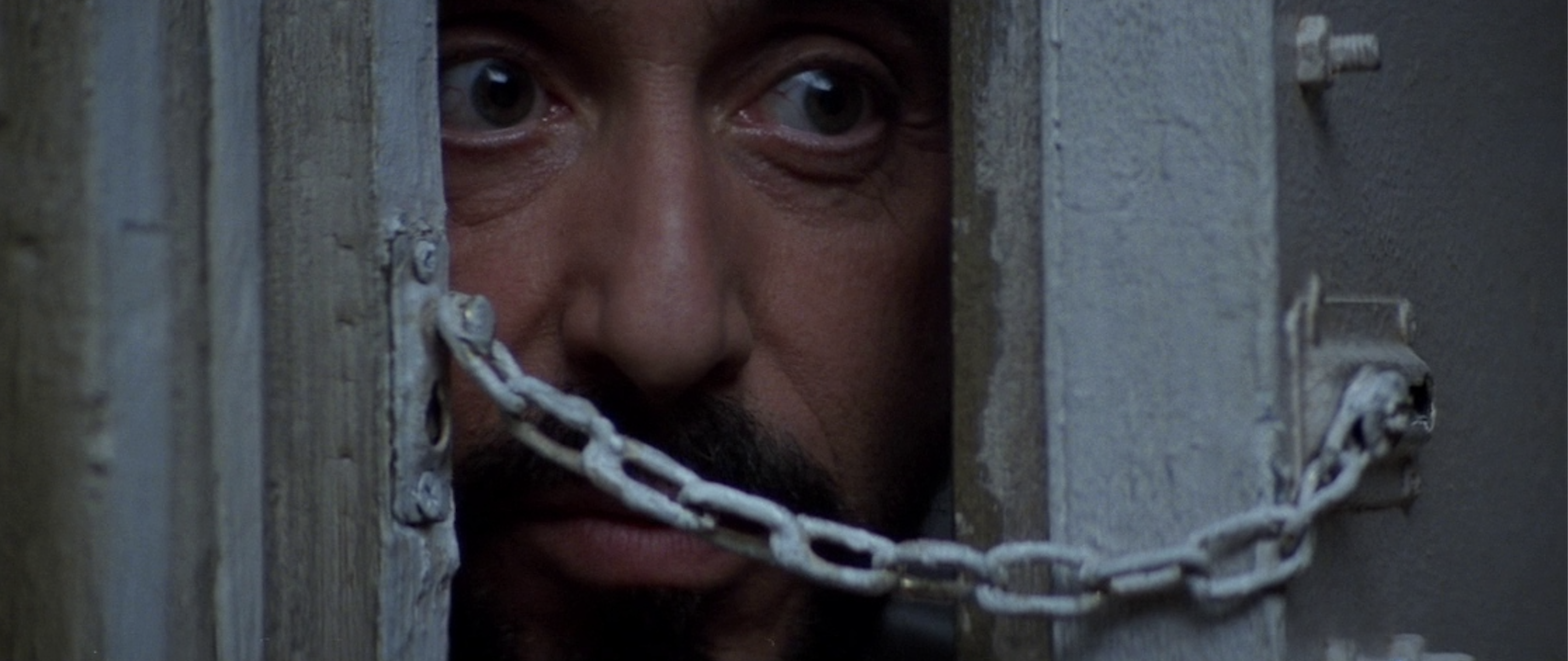
Carlito is so sincere because he knows that he has nothing to prove to anybody other than himself. That’s what makes him so distinctive, so wonderfully incongruous — he’s surrounded by people who can’t afford not to posture, who are constantly trying to prove something to somebody, establishing or consolidating their reputation. Carlito is an island of security in an ocean of insecurity. At times, that contrast is funny, like when Dave pathetically tries to provoke an innocuous Italian man, while Carlito sits back and spectates. At other times, it carries a sense of genuine peril, like in the crackling confrontations between Carlito and Benny in the lurid red light of the nightclub.
And then there are times in which it’s unbearably poignant, like when Carlito learns that his young cousin Guajiro (John Ortiz) is doing legwork for a notorious drug dealer — the first step towards becoming part of the undisciplined and unprincipled next generation of crime. The stark disparity in body language between veteran and newcomer when they meet is painful to watch, as Guajiro grins reverently, looking with unbridled enthusiasm towards Carlito for approval, while Carlito looks mournfully into the distance, his sunglasses failing to conceal his palpable dismay. Carlito’s few words of dissuasion fall on deaf ears, and by the time he gets to offer Guajiro any meaningful counsel, it’s already too late. “There ain’t no friends in this shit business,” he says, but only once Guajiro’s throat has already been slit after a routine deal turns treacherous.
The self-serving, backstabbing nature of his former colleagues is just further proof, if Carlito needed any, that he’s outgrown his old life — that the world in which he once prowled, over which he once held dominion, was so much more insubstantial and superficial than he thought. Honour and loyalty have deserted the streets, if they were even there in the first place. The great irony, of course, is that Carlito’s gravest errors are made because he holds so firmly to those very virtues: honour and loyalty. It’s loyalty to Dave that compels Carlito to run a nightclub owned by the slimy Saso (Jorge Porcel), even when he knows that it will certainly bring him into close quarters with nefarious characters who he’d rather stay away from, and even when he suspects that the man to whom he’s loyal might not actually be worthy of that loyalty. Carlito already knows that Dave is a scumbag, perhaps even dangerous — good friends aren’t always good people to be around. Played with feverish physicality by Penn, Dave is all jittery, coke-snorting, gun-toting bombast, all aggressive façade and confrontational pyrotechnics, concealing his raging anxieties behind prancing flair. This is a man who’s conspicuously out of his depth, hurtling through the indulgent disco inferno of gangster life, and praying that he doesn’t get burned. He’s also a man for whom friendship is hollow and betrayal is easy — the very antithesis of what Carlito is and hopes to be.
More by Cian Tsang: Sound and Fury: Vicious Insecurity in Mike Leigh’s ‘Naked’
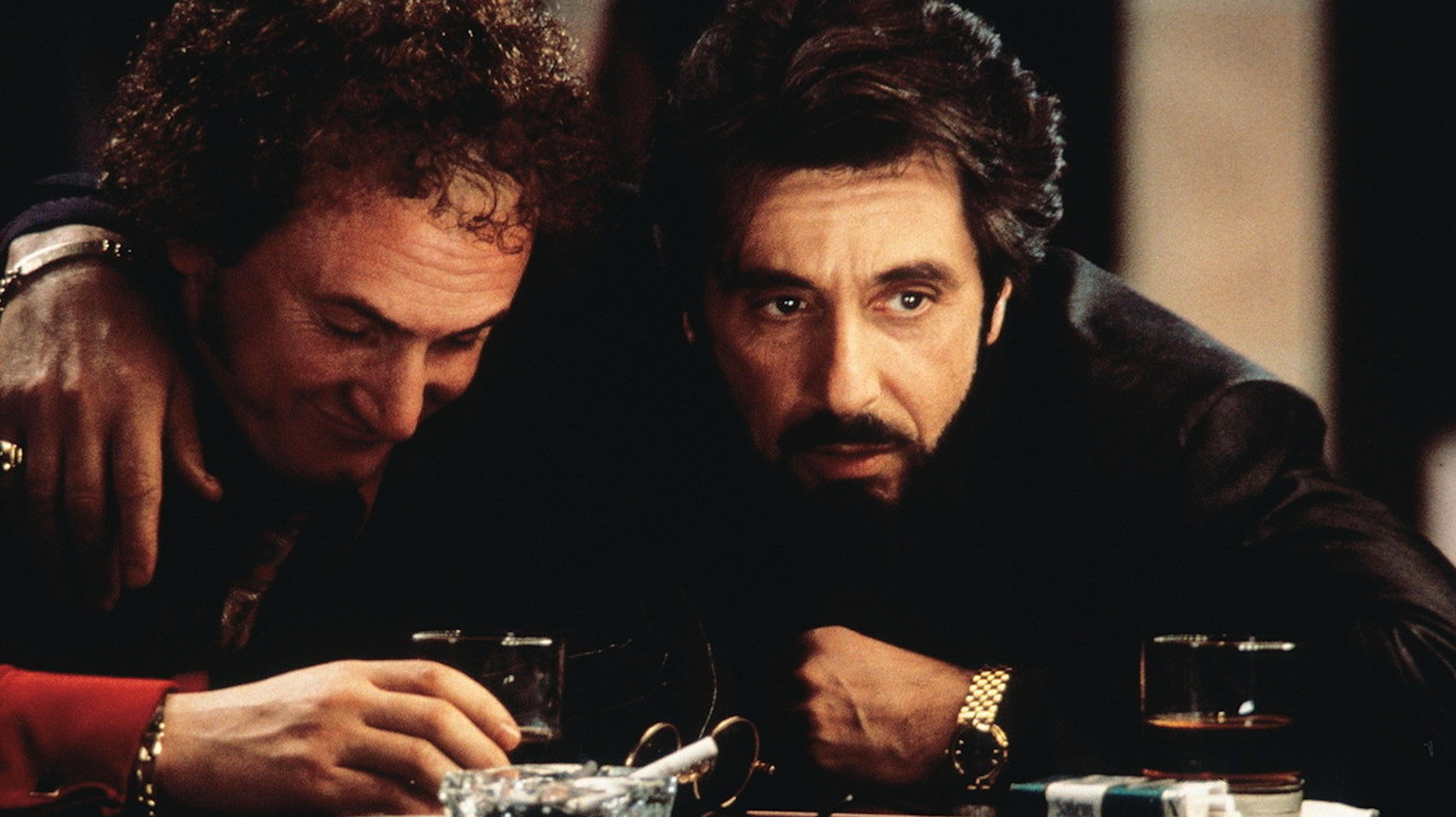
And yet Carlito won’t disentangle himself from his precarious intimacy with this unscrupulous operator, because his principles govern that he’s bound to Dave by obligation. Dave is, after all, the man who exploited the legal technicality that saw Carlito liberated after just five years of his 30-year sentence — something that Carlito sees as so much more than just a professional doing his job well. “You saved my life,” Carlito murmurs into Dave’s ear, the two men gently collapsing into each other, in an early moment that proves to be just as ominous as it is achingly tender. Later, when Dave is forced to orchestrate a prison break for a mob boss from whom he’s been stealing millions, he turns to Carlito for help — and Pacino’s character just can’t bring himself to turn away from his imperilled friend. So stringent and literal is Carlito in his specific worldview that it seems as if the only way for him to properly repay Dave is to save his life. Too late, he realises that his devotion has been misplaced. “Fuck you and your self-righteous code of the goddamn street,” says Dave, spitting on everything that Carlito stands for once their relationship has irrevocably curdled, before elucidating his own philosophy: “There’s only one rule: you save your own ass.”
For Carlito, ethics are immutable — but so is love, and the critical tension of the film stems from his desperate efforts to somehow reconcile these seemingly irreconcilable presences in his life, or at least pay tribute to both at the same time. Just as Dave’s turpitude makes him a perfect rival against Carlito’s rigour, Gail’s enervated realism makes her a perfect companion for Carlito’s reinvigorated optimism. She’s a woman who doesn’t dream anymore, for whom the dream is dead. Their initial exchanges are nervous and tentative, as they try to pick up the pieces of what they once had, try to make sense of their feelings. Carlito tries to explain why he had to cut off their relationship before he went to prison five years ago, and then doesn’t quite know how to react when he finds out that Gail has traded her artistic ambitions for dancing in a strip club to survive. They fidget and fumble, neither of them wanting to tread too heavily or commit too hastily. It’s all very restrained, sapped of confidence and wary of heartbreak. Until, in the grandest sequence of Carlito’s Way, De Palma dissolves all sense of inhibition in a frenetic shot that wobbles and spins around the lovers as they fervently embrace to the soulful sound of Joe Cocker’s “You Are So Beautiful.”
Is that corny? Sure, but then, so what? Corny is only a bad thing if you subscribe to an inflexibly macho school of cool, which Carlito certainly doesn’t. Indeed, few men have ever looked as gloriously uncool as Carlito does when he’s surreptitiously watching Gail in her dance class. Standing goofily on a nearby rooftop, with only a trash can lid to shelter him from the downpour, he cuts a ridiculous figure. At first, Carlito blinks repeatedly, as if trying and failing to process everything about her. Then, he doesn’t blink at all, gawking as if hypnotised. It’s the look of a man who’s finally stripped away the layers of protection that clung to his skin and encumbered him for so long, relieved and happy to feel utterly vulnerable. And De Palma, wholeheartedly invested in Carlito’s ecstatic transition, commits to seemingly unfashionable stylistic choices that become sublime expressions of his hero’s essence.
More by Cian Tsang: Sympathy for the Devil: How ‘Batman Returns’ Complicates the Penguin
So Carlito’s Way ends with death, yes, but also with revival. Revival is what it’s all about. It’s about a man finally bursting from his chrysalis, maturing into the best version of himself. It’s about Carlito confronting and conquering his own mythology. It’s about him defying not just expectation, but also predestination. It’s about Carlito reclaiming agency and restoring the dream. And it’s about him leaving something meaningful behind. Carlito never reaches the Bahamas, but the final shot of the film confirms that he succeeds in securing a brighter future for those he loves. Escape to paradise indeed.
Cian Tsang (@CianHHTsang) studied English Literature at UCL, and is now a writer based in London. He spends most of his time listening to the Twin Peaks soundtrack.
Categories: 1990s, 2020 Film Essays, Crime, Drama, Featured, Film Essays, Thriller
1 reply »