

Vague Visages’ Napoleon review contains minor spoilers. Ridley Scott’s 2023 Apple TV+ movie features Joaquin Phoenix, Vanessa Kirby and Tahar Rahim. Check out the VV home page for more film reviews, along with cast/character summaries, streaming guides and complete soundtrack song listings.
*
In the turn-based strategy video game series Civilization, the goal is to lead people to victory from the dawn of time to the modern age, whether through war, scientific advancement, cultural hegemony or religious domination. Each available “civ” comes with unique skills, buildings and units, alongside a leader specific to that nation — Teddy Roosevelt for the Americans, or Mahatma Gandhi for India, for example — who comes with their own set of bonuses. Some civs have the option of two or more leaders, and players can fiddle the gameplay rules to divorce leaders from their nation, having, say, Saladin lead the Christian armies of the Holy Roman Empire. In the most recent iteration of the game, Civilization VI, leader bonuses are useful but provide far less of a net positive than the civilizational bonuses. In other words, the people one leads as a player are of more importance than the actual leader.
As a function of game design, it’s a subtle but effective repudiation of the “Great Man” school of historiography, which supposes that highly powerful individuals are the defining factors in the development of world-shifting historical events; a category often bestowed upon Napoleon Bonaparte, the subject of Ridley Scott’s latest historical epic. This is a figure who, after all, inspired much of the “Great Man’” historical school, and whose previous biopics themselves often replicate the common idea of Napoleon as a unique, culturally-potent and earth-shifting figure.
Napoleon Review: Related — Know the Cast: ‘Killers of the Flower Moon’
The opposite to the “Great Man” theory suggests that it is the history of the masses, colored with less perceptible cultural and social shifts, that defines history, priming the ground also for these iconic individuals to take their place; they are merely products of their environment, for better or worse. “Great Man” history is, in a sense, easier to digest, understand and make palatable. Heroic (or villainous) figures, existing outside of time, define an era, and produce a great deal more cultural ephemera — news items, artistic works, political responses — for future historians to parse through. Two-and-a-bit centuries down the line, we know intimate details of Napoleon’s biography, but we barely know the names of many of those who stormed the Bastille on that fateful day on July 14, 1789, kickstarting the French Revolution from which Napoleon would emerge. But “Great Man” history also makes figures more abstracted and totemic: positive figures such as Nikola Tesla become icons for nationalist state building in both Serbia and Croatia, while “Great Man” writing on figures like Adolf Hitler or Joseph Stalin flattens their crimes into historically exceptional acts, obscuring the levels of complicity and agreement within the populace over which they rule.
Napoleon Review: Related — Soundtracks of Television: ‘The Buccaneers’
The Hollywood historical epic has always had plenty to say about these “Great Men” (and the odd woman too), and Scott has long been one of historical epic’s most accomplished practitioners. His willingness to play with the conventions of the genre, even with a mega-budget production, is precisely why this biopic, starring Joaquin Phoenix as the man himself, is so refreshing, as Napoleon is very much a repudiation and a revolt against history’s “Great Men.”
Napoleon Review: Related — Know the Cast: ‘Fingernails’

Scott’s vision of Napoleon Bonaparte is that of a passenger in his own story. He rises through the ranks of the post-Revolutionary French army largely on the coattails of more politically savvy allies; he spends significant sections of the film just wandering through scenes looking at things or people, unwilling or incapable of engaging with them; he is cuckolded by his wife Josephine (Vanessa Kirby) and enraged when she is unable to bear a child. Hell, Napoleon’s crowning of himself as the Emperor of France — arguably the defining moment of his life — is depicted almost glibly, in a brief scene where one of the subject’s leading diplomats, Talleyrand (Paul Rhys), casually suggests he should be Emperor. Cut to the next scene at the coronation of Napoleon and Josephine. No political machinations, no negotiations, no monologues — just one cut to the next. Perhaps this is partly a remnant of the fact that Napoleon has supposedly been cut down to two hours and 38 minutes for theatrical release from a four-hour director’s cut (which Scott plans to release on Apple TV+), but it’s a running theme in the theatrical cut that history happens to Napoleon, rather than Napoleon making and shaping history.
Napoleon Review: Related — Soundtracks of Television: ‘Lessons in Chemistry’
The effect makes for a fascinatingly strange historical biopic in which key events land with no impact. This is not necessarily a bad thing — in fact, it separates Napoleon from other epics of its kind, creating an ahistoricism that says more about the historiography and perception of the subject than his actual life and actions (if you want to find out more about that, Napoleon remains one of the most written-about figures in world history).
Napoleon Review: Related — Know the Cast: ‘Monarch: Legacy of Monsters’

There is a glimmer of truth in Scott’s presentation of Napoleon as a historical passenger. France is one of the world’s longest running states and political units, and the development of the French state is vitally important to the development of modern-day ideas about nations, peoples and ethnicities (often for the worse, if you ask me). In spite of violent revolutions, ruptures and wars, the French state has existed in some form or other since the Capetian era in the 10th century. The French Revolution in 1789 may have abolished the monarchy, but it did not abolish the state itself. Even events such as Vichy France, the rump state of France which functioned as a Nazi puppet state during WWII, exists as part of a continuity of the French state, with the institutions continually proving far more resilient than its people or leaders. Scott’s Napoleon suggests this throughout; political bickering, the general’s military command and his relationship to Josephine are all superseded by the concerns and power of the state. The film’s central protagonist is rarely the center of the scene, even when Phoenix’s leathered face fills the screen in a widescreen close-up.
Napoleon Review: Related — Soundtracks of Cinema: ‘Fingernails’
Phoenix’s performance is also a superb repudiation of historical epic expectations. He plays Napoleon small (and not just physically). The subject is a weirdo, with a wobbly voice and an unsure presence in rooms of power. This is a continuation of Phoenix’s recent work in Joker (2019) and Beau is Afraid (2023), where he also plays outcasts who end up as part of journeys far larger than themselves.
Napoleon Review: Related — Know the Cast: ‘The Buccaneers’
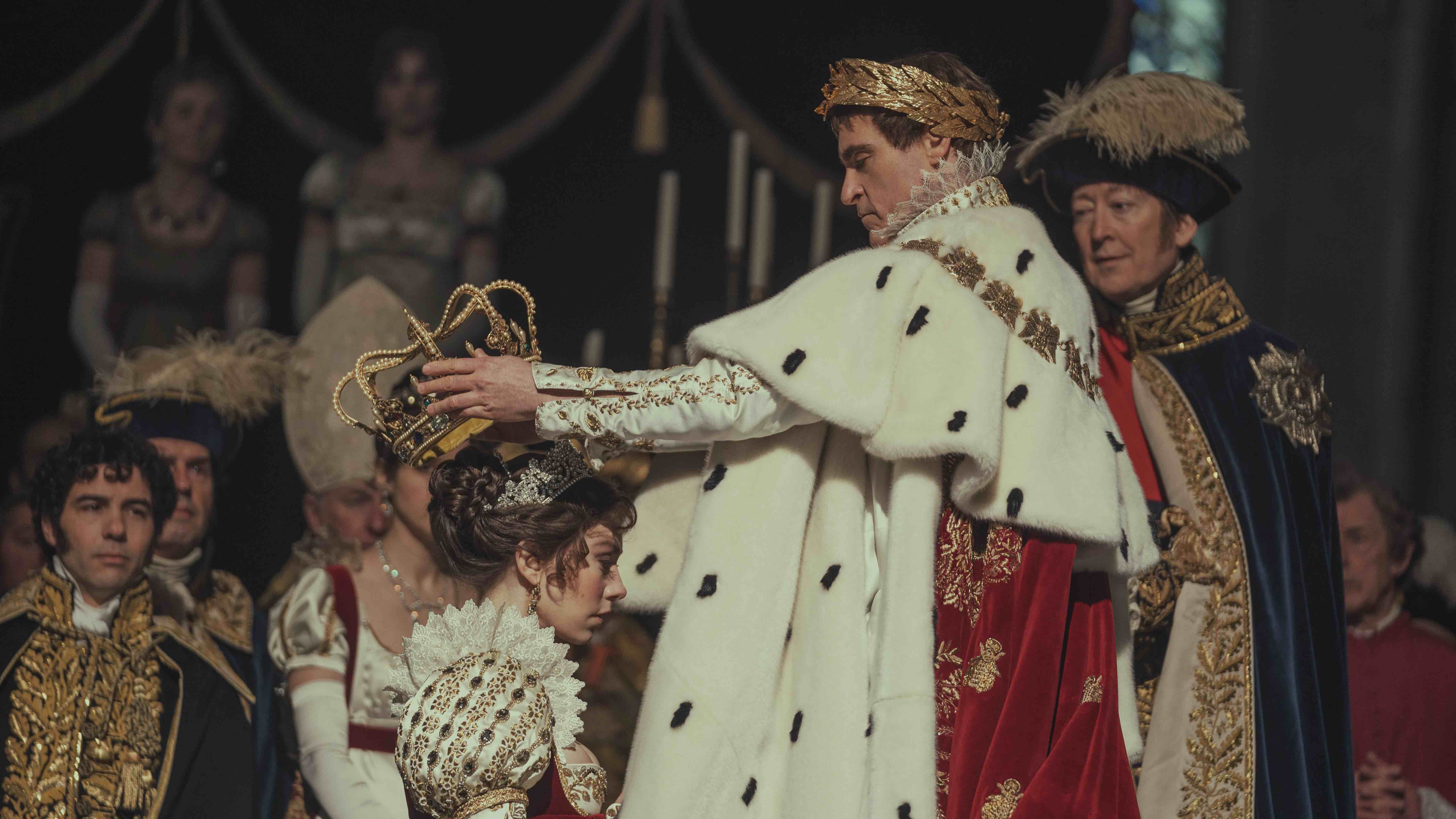
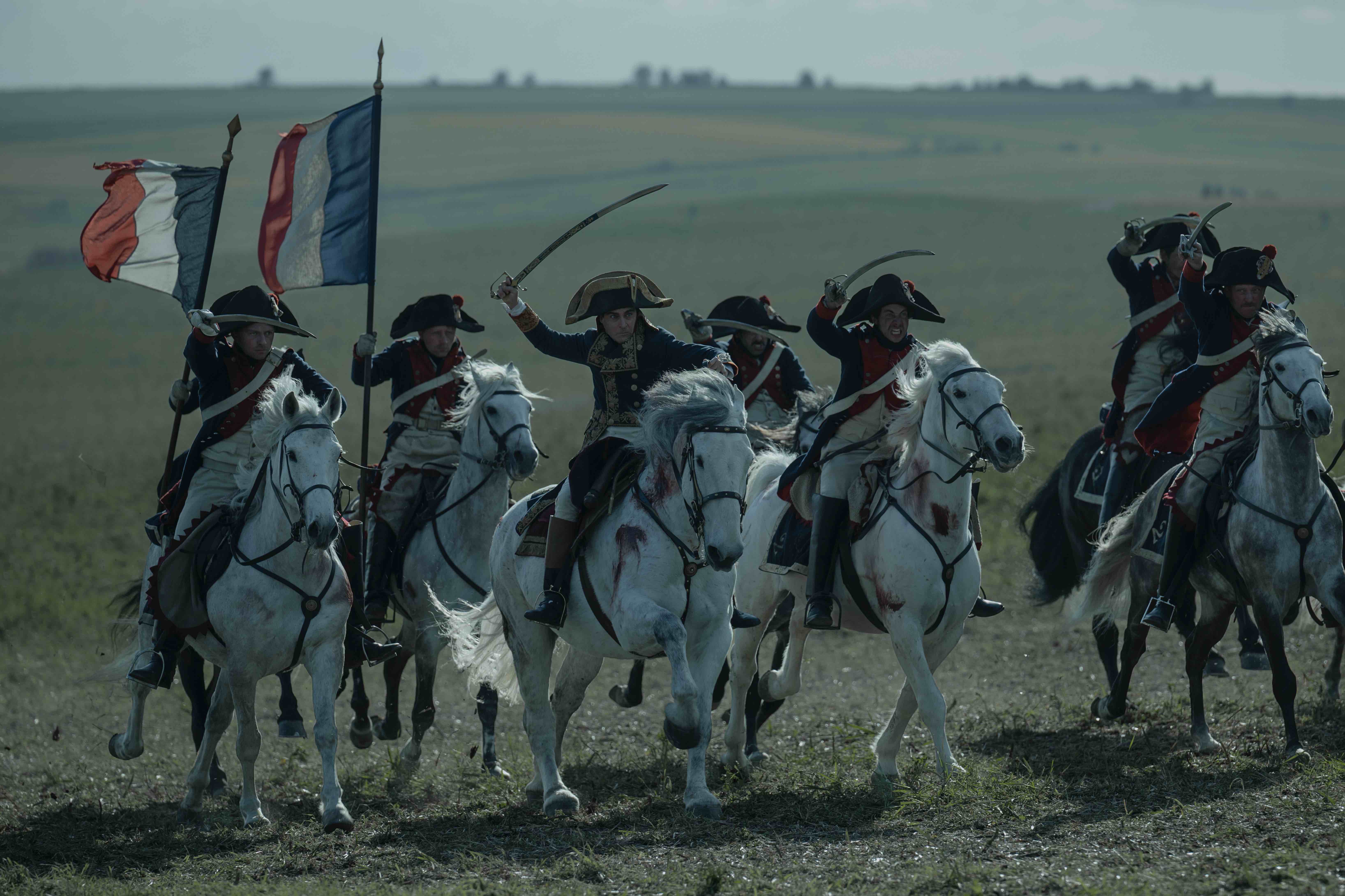
Amidst all this, Scott ensures a glorious sheen of opulence throughout Napoleon. His greatest skill as a director has always been his marshalling of production design and cinematography to create unmistakably filmic settings (whether sci-fi or historical), even at the expense of tighter plotting or narrative tension. Light streams in through musty windows, dripping in through exquisite sets, lighting up charismatic actors (Kirby’s Empress Josephine is a particular highlight) in beautiful costumes. Meanwhile the battle scenes may be some of the best action scenes in Scott’s filmography, with huge set-pieces built largely on physical effects and a concrete sense of geography. Where are rival armies approaching from? Where are Napoleon’s men? Where is the momentum of battle? The staging is crystal-clear and gloriously bloody, which makes it all the more fascinating how differently and muddily Scott opted to present the rest of Napoleon’s life.
Napoleon Review: Related — Soundtracks of Cinema: ‘Flora and Son’
Traditional historians have already been raging at the historical inaccuracies present in Napoleon. But in its rejection of the subject’s “Great Man” status, Scott offers a refreshing analysis of the uselessness of this sort of historiography. In Civilization VI, one gains access to different sorts of buildings and boosts. Basic granaries give way to bustling mega-cities; amphitheatres pave the way for art museums and then broadcast centers; libraries provide the foundation for universities and research labs. The game’s developers have presented this as a continuum on which a people exist and build a political identity for themselves. Scott suggests that Napoleon doesn’t exist as a unique individual, but as one of a continuum of state-building and historical cause-and-effect. Just another actor, and not the star.
Fedor Tot (@redrightman) is a Yugoslav-born, Wales-raised freelance film critic and editor, specializing in the cinema of the ex-Yugoslav region. Beyond that, he also has an interest in film history, particularly in the way film as a business affects and decides the function of film as an art.
Napoleon Review: Related — Know the Cast & Characters: ‘Foundation’
Categories: 2020s, 2023 Film Reviews, Action, Adventure, Apple TV+ Originals, Biography, Film, Movies, Streaming Originals
You must be logged in to post a comment.