
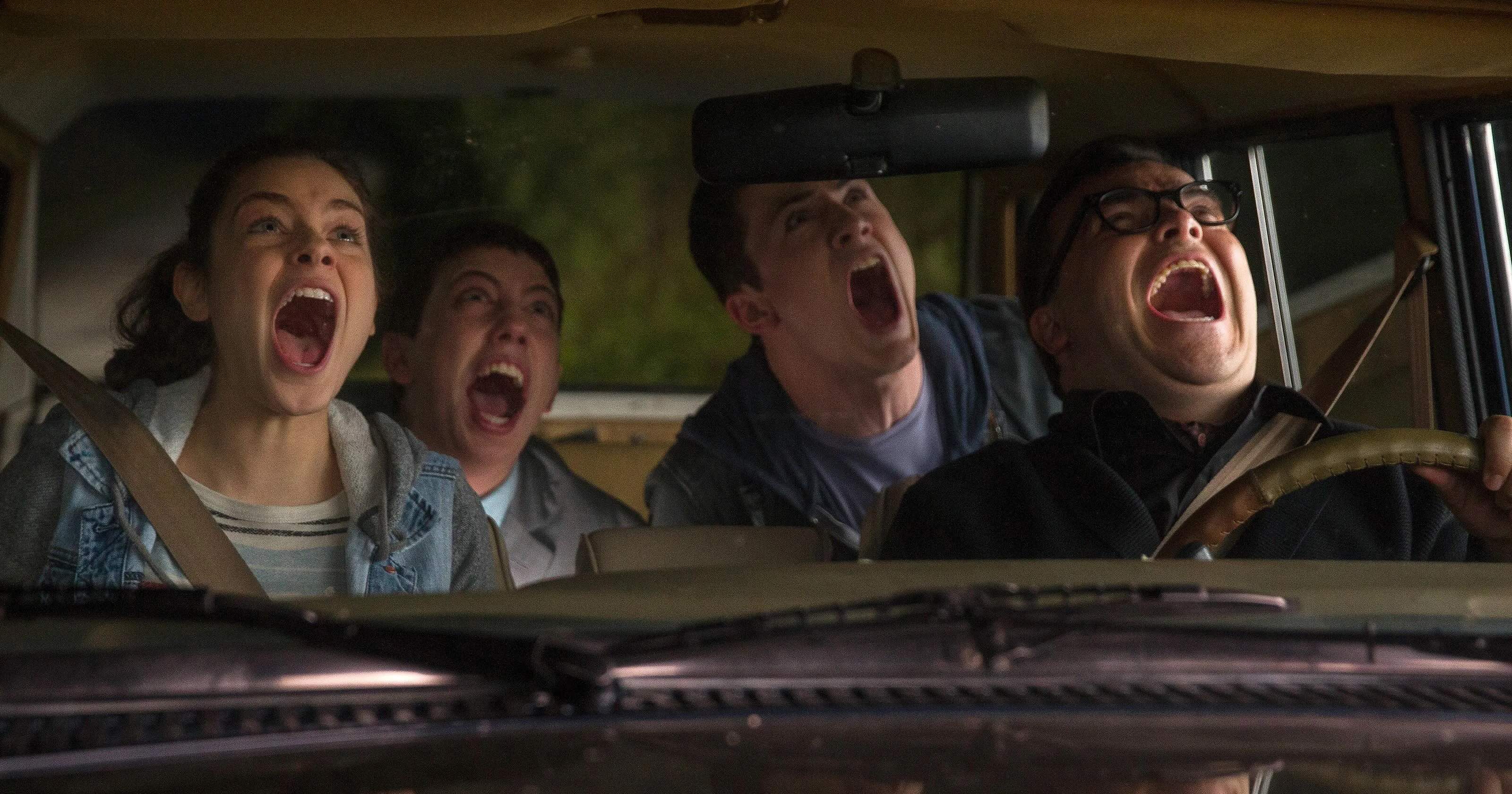
Vague Visages’ Goosebumps essay contains spoilers. Rob Letterman’s 2015 movie on Peacock features Jack Black, Dylan Minnette and Odeya Rush. Check out more VV film essays at the home page.
Kids’ horror was once big business, with nightmare-inducing all-timers like Gremlins (1984), The Witches (1990) and Hocus Pocus (1993) scaring parents and children alike across multiplexes and homes all over the world. Lately, though, everything has become so neutered. Filmmakers are either too scared to even attempt to scare children, or their hands are tied by the money men who don’t believe it’s worth betting on something without obvious mass market appeal. But children can handle spookier stuff and, crucially, they want to be scared. Although Rob Letterman’s 2015 film Goosebumps remains an outlier, the R.L. Stine adaptation is a great example of how to balance laughs and frights without sacrificing the essentials of a classic kids’ horror movie. As a lively and surprisingly spooky sub-genre production starring Jack Black as R.L. Stine, the movie is a laugh-out-loud funny and hugely engaging family film in its own right. Goosebumps stands as further proof that there’s real demand for scary movies for kids, especially given its box office success, earning over $158 million globally on a $58 million budget.
The biggest selling point of Goosebumps, naturally, is Black’s scene-stealing performance as the prolific author. Adopting yet another of his hilariously delightful and decidedly off-kilter voices, the American actor places emphasis in increasingly strange spots, such as when he pronounces “police” like “po-lice.” Black devours everything and everybody in sight. Even better, he does triple duty as the villainous dummy Slappy and the Invisible Boy. The former character, in particular, is a horrifying creation, brought to life using the most impressive special effects in the entire movie (the CGI, while aged, is still convincing enough where it matters though). It’s an exceptionally creepy performance that only Black could pull off, with a genuinely impressive split-shot of the dummy and Stine showcasing how enamored the filmmakers are with the lead actor’s utterly committed portrayal of both characters. Black is the dark heart of Goosebumps, which is only right considering the beloved nature of Stine’s work.
Goosebumps Essay: Related — Fear God: Kevin Smith’s ‘Red State’ Hits Even Harder at 10

Of course, Goosebumps features an incredibly high caliber cast overall, with the likes of Amy Ryan, Jillian Bell and Ken Marino firing on all cylinders, while newcomers Dylan Minnette, Odeya Rush and Ryan Lee more than hold their own. Plus, none of the grown-up actors behave as though they’re solely in it for the easy paycheck, which likely has something to do with the shrewdly-observed script (credited to Darren Lemke, Scott Alexander and Larry Karaszewski). Too often, children are condescended in kids’ horror movies, while cringeworthy “adult” references are shoehorned in for guardians hoping to awake through the screening.
Goosebumps Essay: Related — Sweet, Satisfying and Sex-Positive: ‘Zack and Miri Make a Porno’ at 10
Goosebumps contains actual jokes; it has a point of view that’s fresh and funny, and features characters who feel like real people reacting to crazy situations the way normal human beings would. Bell’s Lorraine describes Stine as “very mysterious, very sexy,” and a cop freaks out when the author deadpans that it’s not a crime to be “an audiophile,” exclaiming “a what-o-phile!?” as she reaches for her gun.
Goosebumps Essay: Related — Everything But the Beak and Feet: ’10 Things I Hate About You’ at 20
But it’s Black who gets all the funniest lines in Goosebumps, including an instantly iconic teardown of Stine’s greatest rival, with the author spitting, “Let me tell you something about STEVE KING.” Likewise, when Black’s protagonists gets pulled into a room for a pow-wow, he states with barely disguised disgust, “You’re touching me.” In anyone else’s hands, much of this would read as mean. But Goosebumps distinguishes itself from the vast majority of children’s entertainment by being joyful rather than cynical. Despite Stine’s obvious irritation at the three teenagers’ insubordination, he still takes care of them, frequently stepping in front of the kids to confront an otherworldly threat. Nobody truly perishes in Goosebumps, but the characters are all believably in danger, with one kid being carried away to certain death by a gigantic praying mantis (he’s later shown in a full body cast, still in good spirits), while Minnette’s Zach is almost strangled by some murderous gnomes. There’s a hefty amount of “mild peril,” as the MPAA would categorize it. The various creatures can’t be killed either, which adds an interesting wrinkle and further prevents parents from rolling their eyes about how inconsequential everything seems to be.
Goosebumps Essay: Related — A Star Is Torn: ‘Martha Marcy May Marlene’ at 10

There are some bum notes of course, with the lack of non-white characters jumping out immediately (the principal is the only person of color involved in the main plot), considering that Goosebumps is only 10 years old. Luckily, the filmmakers corrected this misstep by putting several POC front and center in the 2018 follow-up Goosebumps 2: Haunted Halloween. Still, even beyond the CGI, this lack of diversity ages Goosebumps more than anything else. Regardless, the movie captures the childhood excitement of being scared in a similar manner to the aforementioned and similarly white Hocus Pocus. Legendary composer Danny Elfman even references its’ score with big, brassy moments in his own fun, plinky-plonky take on the original Goosebumps theme tune that’s eerily evocative rather than derivative. The deceptively simple story focuses on an intriguing small-town-wide conspiracy. It’s very grounded, and the geography of Madison is clear, with local landmarks like the creepy house next door, the spooky woods and the abandoned fun fair all evoking the feeling of reading a classic Goosebumps tome under the covers at night. In keeping with that idea, the overarching theme is childhood and adult loneliness. Zack is still reeling from the loss of his father, while Stine has been an outcast his whole life, to the extent that he wrote his own family into existence. Although the tone is frequently goofy, Goosebumps is surprisingly poignant, particularly in the delicate way it handles themes of bullying and self-imposed isolation.
Goosebumps Essay: Related — Embracing Imperfection: ‘Bridget Jones’s Diary’ Turns 20

At one point, Stine describes how a typical Goosebumps book must contain “twists, turns, frights and some personal growth for our hero.” Cleverly, the movie hits all those notes while integrating the books themselves in a manner that’s inventive, not clunky. The animation of them coming to life (complete with oozing, melty letters) is super cool, while the director, Letterman, demonstrates his visual panache with how the big action sequences are staged and shot. Unlike sludgy Marvel slop, there’s a tactility to everything onscreen, even despite the many endearingly gruesome CGI creations (the filmmakers clearly employed practical FX wherever possible, which is sadly also noteworthy). Goosebumps is pacy, moving along at a nice clip with little downtime to ruminate on the plot mechanics. Mercifully, there’s no cloying sentimentality either. Although a happy ending is predictable, Goosebumps still ends with laughs and frights aplenty, reiterating that if you build the haunted house, the kids will come to play around in it.
Joey Keogh (@JoeyLDG) is a writer from Dublin, Ireland with an unhealthy appetite for horror movies and Judge Judy. In stark contrast with every other Irish person ever, she’s straight edge. Hello to Jason Isaacs. Thank you for reading film criticism, movie reviews and film reviews at Vague Visages.
Goosebumps Essay: Related — Embracing the New Normal: ‘The Addams Family’ Is Timeless at 30
Categories: 2020s, 2025 Film Essays, 2025 Horror Reviews, Adventure, Comedy, Fantasy, Featured, Film, Horror, Movies
You must be logged in to post a comment.