
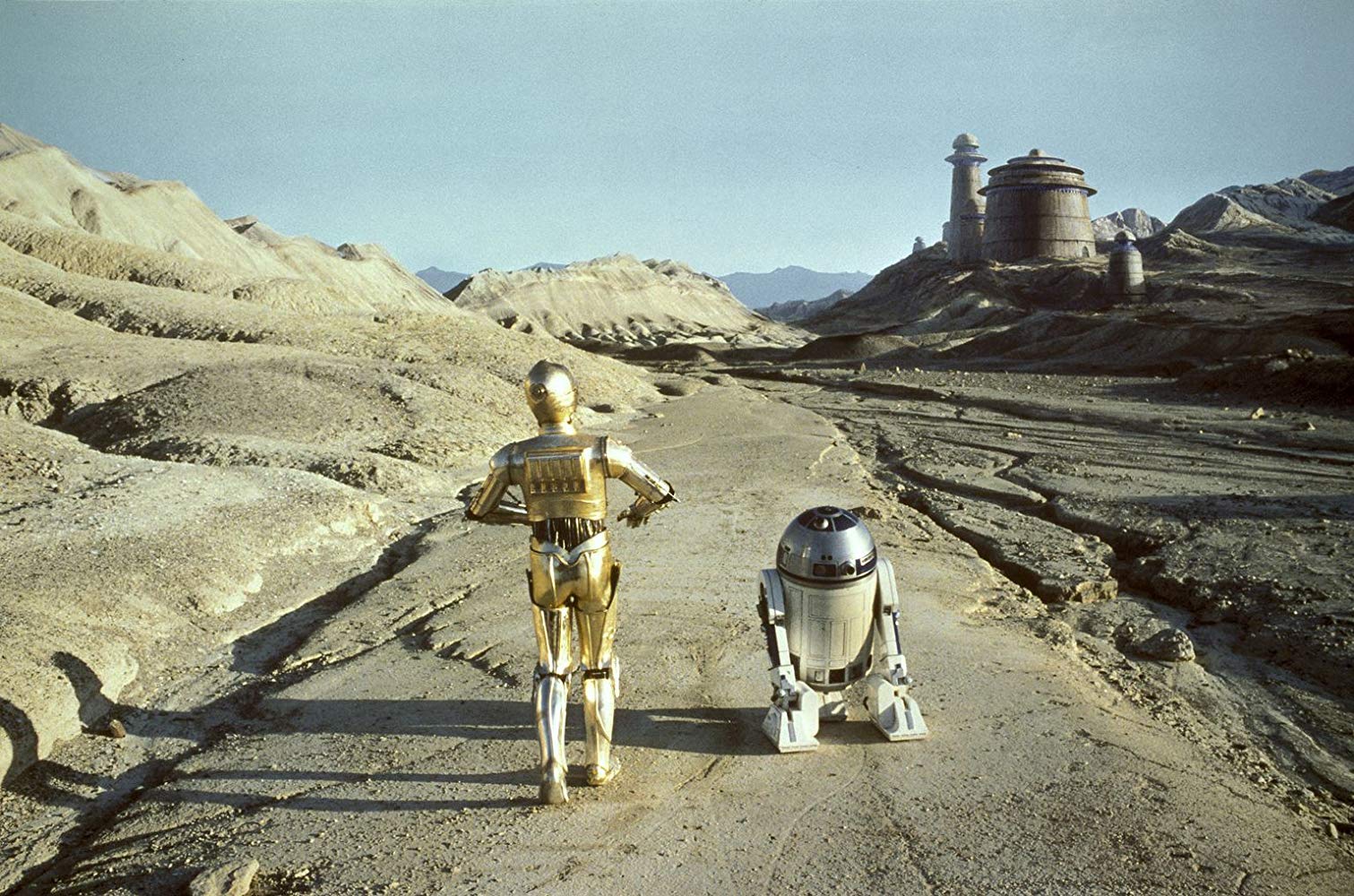
Sometime in the early 1980s, two men walked into a room in Northern California. One was a thirty-something white guy with a middle-class upbringing and a film school education, who was extremely rich. The other was a thirty-something white guy with a middle-class upbringing and a film school education, who was not so rich. The first man showed the second man something from his imagination — tall, hairy creatures called “Wookiees.” Then the first man made a shocking offer to the second: he asked that second man to direct his imagination. The second man declined Return of the Jedi. When he told his lawyer, the second man was scolded for throwing away untold amounts of money.
The first man, as you can probably tell, was George Lucas, the writer-director-producer-creator of the Star Wars franchise. The second man was David Lynch. This story has boggled people’s minds for years. Lucas asking David Lynch to direct Return of the Jedi? Two more dissimilar directors could hardly be spoken of in the same sentence, right? But if we think on it, we can see that’s not the case. Lucas could see something in Lynch that was like himself, even if Lynch did not recognize it, and does not to this day. That Return of the Jedi offer back in the early 80s was like two trains passing in the night — two great forces starting from different origins, headed for different destinations, briefly passing by each other and sharing the same space before trailing far away into the distance.
Lucas was born in Modesto, northern California in 1944; Lynch was born two years later in Missoula, Montana. Early years for these two boys were defined by dreamy 50s pop and rock ‘n’ roll, TV and radio, movie matinees, fun and games. “My childhood was elegant homes, tree-lined streets, the milkman, building backyard forts, droning airplanes, blue skies, picket fences, green grass, cherry trees. Middle America as it’s supposed to be,” Lynch would recall years later, adding “but on the cherry tree there’s this pitch oozing out – some black, some yellow, and millions of red ants crawling all over it. I discovered that if one looks a little closer at this beautiful world, there are always red ants underneath.”
Lucas’ boyhood dream of being a racecar driver ended on black pitch at age 18 — a driver blindsided him, sending him crashing out of his Italian minicar and nearly killing him on the road. Turning away from California custom car culture, Lucas discovered 1960s art cinema — European geniuses like Federico Fellini and François Truffaut and homegrown pioneers like Stan Brakhage. At the University of Southern California’s School of Cinematic Arts, he came under the tutelage of Francis Ford Coppola, and was soon directing award-winning short films like Electronic Labyrinth: THX 1138 4EB. In that film, the title character, a dehumanized prisoner of a future dystopia, attempts to escape from an even-more dehumanized and computerized society free of passion. It is a chilling look at a future that feels distant and yet shockingly close; Lucas described it as an attempt at making “a futuristic film using existing stuff,” and the result is an analogue nightmare. The sound design, so important to having a student film not feel like a student film, plays a big part: the short opens with almost a minute of black screen, ambient noise and minimalist music before transitioning into voices distorted as if by computer — the viewer/listener catches a few recognizable human sounds that escape through the white noise and the din of the humming computers: stray letters and numbers, and at least one clear phrase, a woman’s voice saying “Of course I don’t love him [. . .] we were never in love.”

Lynch took a slightly different path before Return of the Jedi, coming to filmmaking in a roundabout way after art school, an aborted journey across Europe and a job painting engravings to make ends meet. At the Pennsylvania Academy of Fine Arts, Lynch began directing deliberately disturbing short films with deceptively cozy titles like The Alphabet and The Grandmother. In the latter, a little boy grows a grandmother, like a plant, in order to create an alternative to his abusive, animalistic parents. The tree-lined paradise of his Boy Scout childhood was coming apart at the seams as the red ants were hungrily chomping their way through.
Throughout Lynch’s work, from his student films up through his acknowledged classics like Blue Velvet and the Twin Peaks franchise, there hovers the threat of the predatory parent. In Blue Velvet, Dennis Hopper’s manic gangster Frank and sad songbird Dorothy (Isabella Rossellini) form a twisted parental unit, a dark mirror of Father and Mother to young Lynch-avatar protagonist Jeffrey (Kyle MacLachlan). Like a scared child watching the grown-ups passively but with fascination, Jeffrey spies on Dorothy and watches as Frank barges into her apartment, demanding sex and alternating between his personas of “Daddy” and “Baby.” Jeffrey’s schoolboy-esque sexual curiosity has already been aroused by the older Dorothy, but seeing her violated by Frank sends him on a personal journey of self-doubt and confusion. An Oedipal hero wants to marry his mother and kill his father; Jeffrey wants to fuck “Mommy” and kill “Daddy,” who is also “Baby,” but realizes that he is also both Daddy and Baby. In his lowest point, Jeffrey is held prisoner by Frank, who takes time of out his regular schedule of gas-huffing to stare chillingly at Jeffrey and say, bluntly, “You’re like me!” Jeffrey’s initial reaction is not anger, or incredulity, to guilt and shame — MacLachlan’s face drops and his eyes lose their color in a moment of sad resignation. When Frank gets back to sexually abusing Dorothy afterwards (as Baby), Jeffrey bursts out with “Leave her alone!” and a punch. In an unforgettable scene, Frank has his henchmen hold Jeffrey back as he repeatedly smothers him with sloppy wet-lipstick kisses, sings along to Roy Orbison’s “In Dreams” and beats the crap out of Jeffrey as Dorothy cries out in vain. An abstract shot of a candle’s flame being extinguished in a gust of air transitions the scene to blackness, then to Jeffrey at home, mercifully alive, but alone and afraid. Jeffrey has touched the dark, been swallowed by it. In the film’s last act, he must find his way out of it.
In this regard, Lynch, the arthouse favorite, is about as subtle as the Return of the Jedi filmmaker Lucas, often mocked for his obviousness and gawky storytelling. Having Hopper’s dark father figure Frank look directly at the protagonist and croak “You’re like me!” is not really any more covert than having Luke Skywalker dream of decapitating his dark father figure only to find that his own face is underneath the disembodied mask. Star Wars, the franchise that has dominated most of Lucas’ life and nearly all his career, is fundamentally a story about not wanting to become your father. Like MacLachlan’s Jeffrey Beaumont (who even dresses like Lynch), Star Wars hero Luke Skywalker is a pretty transparent stand-in for the creator: even his name is an abbreviation of the director. Skywalker is a typical American — er, outer space teen, an intergalactic Baby Boomer who goes cruising in his hot rod (landspeeder), hangs out at the local malt shop (Toschi Station) and dreams of moving beyond his dull provincial life, with his square guardians, to see the world and achieve greatness. At first, he’s enticed by stories of his long-dead war hero father, a brave pilot who got to know the whole galaxy before being cut down. The absence of this father spurs Luke on to adventure, but his curiosity leads him to dark revelation: Darth Vader, a menacingly inhuman killer, the blunt instrument of the hated Galactic Emperor, the being who murdered his father, is his father. Luke screams out that that’s impossible, but loses both his hand and his innocence all at once. The darkness comes on; the one he idolized, the one he wanted to be, is everything he didn’t want to be. Then who shall he be?
Daddy issues are hardly foreign to male directors, especially of the Baby Boomer generation, but the parent-child struggles of Lynch and Lucas’ films are distinct from their contemporaries’. There sits in both an uneasy mixture of naïve childlike love and bitter venom. Lynch’s Twin Peaks series shows how the murder of a child — high school homecoming queen Laura Palmer — reveals the fault lines in a quaint, quirky small town in the Pacific Northwest. At least, that’s the pitch, before Lynch uses the narrative and setting to explore the nature of evil in the universe and certain metaphysical ideas about existence. It’s trippy stuff, man, 60s hippie mysticism updated for the yuppie 90s, and later the hipster aughts. But at the heart of it all is a simple and poisonous relationship that is simultaneously unthinkable and common: the sexual abuse of Laura by her father Leland Palmer. “Who killed Laura Palmer?” was the show’s tagline, and it cycled through a cast of colorful and unsavory characters before revealing in a one-two-three episode punch in season 2 that Leland was the cause of both Laura’s death and her pain in life. Yet the supernatural elements that the show had slowly teased out ended up being (in the case of Laura’s abuse and murder) simply a vessel through which the very human sins of Leland Palmer emerged. The dark and unknowable being called BOB, which hovered around the show as a malevolent presence, was possessing Leland’s body, but the line between Leland and BOB is so thin as to be functionally irrelevant. “Maybe that’s all BOB is,” one character says, when the truth is let out and the blood spilled, “The evil that men do. Maybe it doesn’t matter what we call it.” At the moment of his death, Leland realizes the enormity of his crimes and breaks out in tears. The show’s lead character, Agent Dale Cooper (played by Lynch’s regular stand-in, Kyle MacLachlain), holds his body and quotes from the Tibetan Book of the Dead as Leland sees a vision of Laura — a vision Cooper will later interpret as being the spirit of Laura forgiving her father.

There is, of course, more to Twin Peaks’ story, but this is the end of one particular story within Twin Peaks — just as the end of Return of the Jedi represents the end of one storyline within the larger Star Wars narrative. Like Agent Cooper finding forgiveness in Leland Palmer’s death and the spirit of Laura seemingly coming from beyond to symbolize redemption, Return of the Jedi concludes with Luke Skywalker, having finally conquered his identity crisis and redeemed Darth Vader, looking upon the Force-ghosts of his father and his two Jedi mentors. They look back at look, smiling and contented, at one with the universe. Both Lucas and Lynch’s world views allow for the possibility of personal atonement, and for external peace emerging from inner peace. The tableau-like widescreen image that ends Return of the Jedi, of Luke and his friends celebrating the end of Empire and evil, calls to mind the ending of Blue Velvet. In the closing minutes of that film, Jeffrey Beaumont, having spiritually and physically defeated the Evil Daddy of Frank, and fixed (mostly) the broken family of Dorothy, joins his own family and his new girlfriend Sandy to look at a curious sight: a robin with a bug in its mouth, representing the triumph of good over evil, light over darkness. With warmth and charm, Sandy remarks, simply but profoundly: “It’s a strange world.”
Both filmmakers created strange worlds of their own, governed by strange rules, animated by a strange magic. Things like the Black Lodge, the Dark Side of the Force, the Dweller on the Threshold, and so on, could easily overwhelm viewers in their dense mythology, but instead they draw the audience in — all the details and proper nouns aside, stories like Twin Peaks and Return of the Jedi both derive from basic, elemental beliefs in good and evil, even if the depiction of evil in Lynch’s world seems much more bizarre, complicated and perverse. It’s telling that despite its fairly niche appeal, Twin Peaks inspires the same kind of fan devotion as a bigger franchise like Star Wars — the cosplay, the fan theories, the fixation on catchphrases. Both Lynch and Lucas returned to their most popular franchise later in their career, to varied results. Fans went crazy for Twin Peaks: The Return, while Lucas’ Return of the Jedi prequels inspired as much vitriol as it did love. When Lynch visited Lucas’s natural habit in Northern California in the early 80s, Lucas was on top of the world, a wealthy and influential man because of the love millions had for his movies; 30 years later, he cut himself off from his creation, handing those strange Wookiees that puzzled Lynch so much over to Disney. The reasons why Lucas would do this have been interpreted in different ways, and there’s no one answer that can explain everything about such a huge life decision. But in January of 2012, several months before news of the Lucasfilm-Disney sale became public, Lucas publicly mused “Why would I make any more [Star Wars films], when everybody yells at you all the time and says what a terrible person you are?”
In many ways, that’s the catch, that’s the bargain that gets made when you reach massive popular success. Lynch found his niche, his own little corner of cinephiles whom he could count on — his combination of squareness and artiness spoke to a small segment of the population that saw their hearts and souls in it. Lucas didn’t have a niche, he had the world, and the world didn’t always agree with him. Despite their similarities in background, in interests, in spiritual beliefs, that is what separated Lucas and Lynch, more than anything. It’s hard to imagine Lynch, who has created some of the most surreal images in American cinema, genuinely being weirded out by Lucas’ aliens and spacemen in Return of the Jedi; what he was more likely unsettled by was the knowledge that these things had somehow found a mass audience, a spectacle on its own more surreal than anything in Lost Highway or Mulholland Drive. On that afternoon in Northern California, so many years ago, two men walked into a room. Their lives and careers intersected with Return of the Jedi. They met that day but whether or not they truly saw each other is up to you.
Michael Guarnieri (@MichaelusEdward) is a critic and writer currently living in Louisville, Kentucky. He is one of the founders of The Solute, and his work has been featured at PopOptiq and highlighted on RogerEbert.com. Michael’s essay “The World Belongs to Savages” is featured in Matt Zoller Seitz’s book The Oliver Stone Experience. He is a proud graduate of the Media and Cinema Studies program at DePaul University, graduating with an M.A. in 2017.
Categories: 1960s, 1990s, 2019 Film Essays, Crime, Drama, Featured, Film Essays, Mystery, Short Films
5 replies »