

“I have never asked you to stop being a woman. So please don’t ask me to stop being a man.”
Tune into any piece of mainstream media from a few decades back and there’s a pretty decent chance you’ll land on something groan-inducing, especially if you happen to arrive at a moment when they’re discussing things like gender, race or sexuality. It would be easy to write off the cringe-worthy line above as simply an unfortunate product of its time, the kind of archaic blemish found on most Hollywood classics, serving to date it but not to ruin it. But the Rocky II scene which contains it –one of the movie’s most intimate moments, the line itself made somehow both better and worse by Sylvester Stallone’s excellent delivery — comes at a pivotal point. Rocky reveals that he has decided to return to the ring to face Apollo Creed once again in spite of his wife’s pleas not to. He doesn’t cite their money troubles or his love of boxing or his anger at Creed’s continual insults. He tells his terrified, pregnant wife Adrian that he is going to step into the ring once more with the man who left him blood-covered and half-blind last time for one simple reason: because he is a man.
It’s always worth noting that a movie needs certain things to happen so it can be a movie. There must be an inciting incident to put the plot into motion, a conflict and a resolution. In Rocky II, Stallone’s protagonist has to eventually agree to come out of retirement for another bout with Creed because there just isn’t a movie if he doesn’t. But even if the decision itself is a matter of plot necessity, the means by which the movie justifies it, the emotional logic of it, is still highly significant. The feelings which inspire Rocky’s return to the ring need to feel believable and consistent with the character. Perhaps most importantly, they also need to feel relatable. The audience has to be able to connect with his decision if they are going to be invested in the fight itself.
“Don’t ask me to stop being a man.” At this pivotal moment, Rocky II asks its audience to relate to an idea of masculinity that is both highly specific and emotionally charged.
Read More by Ross McIndoe: Fight Like a Man: The ‘Rocky’ Series and Masculinity
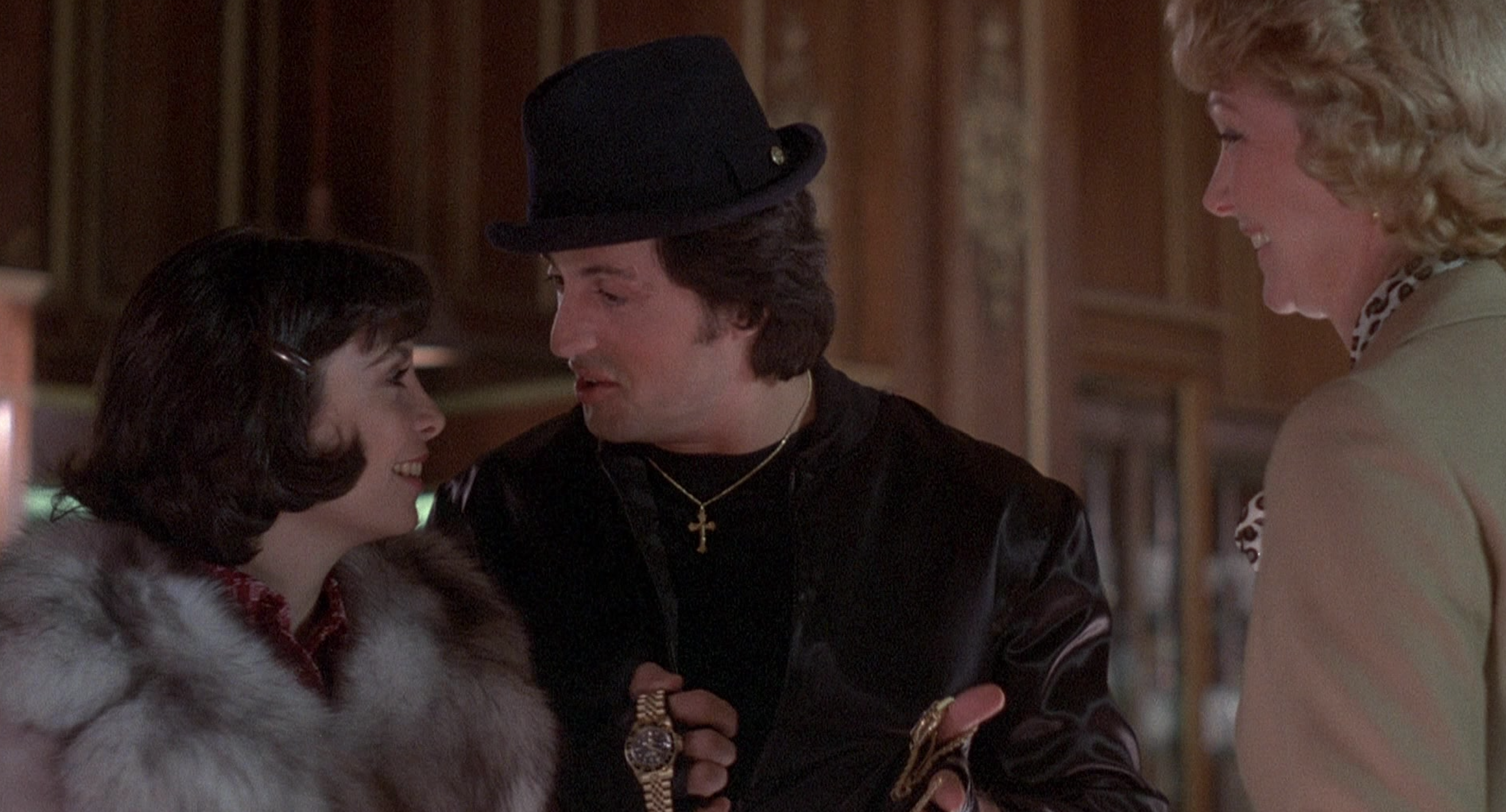 Rocky II begins with the final blows of the first movie’s matchup and follows Rocky into the immediate aftermath. After the bludgeoning he and Creed gave each other, a visit to the hospital naturally follows. After the blood has been cleaned up and the swelling has begun to settle, the results are bad but not terrible. Rocky can’t see out of his right eye, and he’s not far from brain-damaged, but all the other breaks and bruises
Suddenly rich after a lifetime of scraping by, Rocky immediately goes on a spending spree. He buys a big house for him and Adrian to start a family in. He buys a flashy car, though he doesn’t entirely know how to drive it. Rocky buys a gold watch for Adrian, one for him and one for Paulie — because why not? Rocky is a star now, and he has no doubt that his newfound celebrity status will pay for all the details of his happily ever after.
However, Rocky’s first attempt to film a TV spot make it painfully clear that he isn’t built for the high-pace world of television. He finds the people rude and the make-up ridiculous. Rocky’s lack of schooling makes memorising lines difficult, reading off cue-cards even more so. His lack of education even holds him back when he abandons his celebrity ambitions and tries to get a simple office job. Despite Rocky’s honesty, reliability and work ethic, he is a blue collar guy who doesn’t have the certificates or that “professional” finish that the kids born a wage bracket above him all take for granted.

Rocky’s story is one that will resonate with scores of people across the U.S. and beyond, both back in 1979 and now. After the 2016 general election, one of the main explanations offered for Donald Trump’s victory was the plight of people in Rocky’s position: average workers left behind by an increasingly automated, service-based economy that had no place for them. Their situation quickly came to be described as “Economic Anxiety.” Just like Rocky, the story went, they finally got sick of a bad situation and chose to do something drastic.
What’s so important to the emotional core of Rocky II, though, is that this struggle is never just about economic hardship. At various times, Adrian offers to go back to work at the pet shop to help them pay the bills while Rocky figures things out. Over and over again, he tells her not to. Even as Rocky works himself to exhaustion at the meat plant and sells off the things he was so proud of finally being able to buy, he won’t let Adrian take on some of the strain. He has to be the one to do it. He has to be the one to provide.

For her part, Adrian is never much interested in living a life of luxury. She sheepishly goes along with Rocky on his spending spree because she loves him, swept up in his puppy-dog enthusiasm. Adrian supports Rocky as he tries to build the life of his dreams, but she makes it pretty clear that she would have been as happy with a smaller house, a simpler life, and a husband who wasn’t working himself to death — because it’s not really her that Rocky is doing it all for but rather an abstract, romantic idea of a woman and what she wants. And it’s this conceit, this imaginary vision of womanhood, far more than the living, breathing woman Rocky shares his life with, that informs his idea of what a man has to be. Even as Adrian explicitly tells Rocky, time and again, what she wants from life, he remains fixated on his own idea of what she deserves, of what it is his duty to provide.
It’s not about the money, or the things they can buy. It’s about his ability to buy them. It’s about status.
You see it from the look on Rocky’s face during the commercial shoot when the director yells at him to read off the “dummy cards.” You can see it when his white-collar fall-back plan doesn’t pan out because he doesn’t have the credentials. And when his manual labour job, his last resort, is taken from him in the middle of a shift, in a two-minute conversation. The pained, lost look on Rocky’s face is not about the bills he won’t be able to pay or the things he won’t be able to buy. It’s about the fact that Rocky is not respected as a man, out in the world, trying to make a living.
This is what calls Rocky back to the ring. No matter how much it terrifies his wife, he has to go back because it is the only place in which he was able to stand tall and provide for his family

All of these concepts make Rocky II even more fascinating today — because Rocky is a deeply sympathetic character, played with a perfect mixture of wide-eyed excitement and hard-learned weariness by Stallone that makes him look lighter than air one minute and endlessly heavy the next. Even as he rattles off some pretty unenlightened ideas about men and women — his lecture to a local teenager about not being a slut is especially cringey — it’s impossible to get away from the sense that he is doing his best to be a good man in a world that is not making it easy. The fact that Rocky’s own conception of “a good man” only serves to make his journey that much more tragic. From the vantage point of 2019, we’re not just watching an ageing, blue-collar guy struggling to get by in a modernising world, but a Shakespearean hero being slowly undone by his own fatal flaw.
Some movies age well because they are ahead of their time, tuned into ideas that wouldn’t become mainstream for years to come. Films like Rocky II age well because the moments that now seem anachronistic serve to shed light on problems we still have today, delivered by the kind of characters viewers can sympathise with, even if one doesn’t agree with all their opinions.
Ross McIndoe (@OneBigWiggle) is a freelance writer based in Glasgow. Other bylines include The Skinny, Film School Rejects and Bright Wall/Dark Room.
Categories: 2019 Film Essays, Featured, Fight Like a Man by Ross McIndoe, Film Essays
You know, I’m really torn on this series so far. On the one hand, you’re an excellent writer, and your analysis of Rocky as a character and the films in general, what makes them so appealing and stand the test of time, is equally excellent. Some of your thoughts and statements are genuinely wonderful, and deeply true.
On the other, your ideas are utter claptrap, “progressive” nonsense in which you assume the motives of people you do not know and judge them racist, sexist, and homophobic because you are the sole arbiter of what defines those things; in which you declare the basic urges that drive men–that have driven men for millennia, long before the idea of “masculinity” was even born–are toxic nonsense because you, for some arrogant and foolish reason, think you know better. It would be just as easy for someone to read your analyses and decide they come from the heart of a man who is and always has been a failure at what he deems truly important; a man whose bitterness and fear at his lack of stereotypical “masculinity” drives him to tear down men he sees as superior; a man who, like a child, sees what he cannot have and declares he didn’t want it anyway. Certainly a man who has never experienced life outside his own tiny circle and never met grown women who will be honest with him about what they truly want. Definitely a man whose racism runs so deep that he cannot see beyond skin color, and believes black men are not individual men in their own right but mere creatures, interchangeable and disposable, tokens to be crushed.
I could say all of those things about the man writing this…and they are exactly as true as some of your arrogant, unfounded, nasty declarations. I’m not saying them, because I don’t know you and do not judge what is in your heart, and because I have been raised to believe we assume goodwill in others rather than assuming the worst.
But I could say them.