

Much has been written on First Reformed’s adherence to what Schrader himself christened a “transcendental style” in his book, Transcendental Style in Film, originally published in 1972 and reissued in 2018 with a new foreword revisiting the subject. In Schrader’s original text, he examines the films of three key directors, Yasujirō Ozu, Robert Bresson and Carl Theodor Dreyer, in an effort to describe the ways in which their stylistic approaches to cinema align with the religious art that offers a transcendent experience to its audiences. Schrader argues that these films are characterized by their use of withholding techniques that minimize typical cinematic flourishes like camera movement and music, just to name a few. The goal of a film made in transcendental style is to withhold the emotional release that audiences crave until the film’s climactic moments, rather than building a narrative around emotional peaks and valleys. Transcendental films do not guide their audiences through the narrative emotionally in the way that traditional films do; they withhold those stylistic markers, and ask audiences to lean in to the story by delaying traditional emotional gratification. The theory, according to Schrader, is that the delayed payoff will make up for the lack of regular emotional engagement by virtue of its intensity.
In practice, First Reformed makes good on the theoretical framework that Schrader lays out in his book, which he recognized in the films of Ozu, Bresson and Dreyer. Throughout the movie, Schrader minimizes the use of showy visual techniques to such a degree that he eliminates even over-the-shoulder coverage of dialogue. Characters do not enter one another’s close-ups; they are restricted to their own, often shot straight on in flat compositions that are emphasized even further by Schrader’s decision to shoot in the 1.33:1 Academy ratio, making the frame square instead of a sweeping widescreen aspect ratio. The camera itself moves only a handful of times throughout the film. Its first shot dollies towards the eponymous church, a historic white building in upstate New York. One move is a slow push in on Toller in a crucial moment, making a close-up even closer. Another subtly tracks to the right to follow a pair of characters from a house’s front porch to its driveway, where they head for the garage. The startling lack of camera movement draws attention to each individual shot, and the accumulated effect offers a stark contrast to the dominant visual style of cinema in 2018, frames filled with visual noise, edits coming fast and furious.
Despite Schrader’s clearly defined direction and Hawke’s intense performance, the film’s lone nomination comes for its screenplay, which is a slow burn that matches the transcendental style of the visuals. Schrader lets austerity govern his every writing decision, wherein each scene is deliberately chosen, building towards the transcendental moment at the film’s climax. As a screenwriter, Schrader has long been obsessed with a few key ideas that resurface again and again in his work, often built around contradictory impulses. His early work, most notably the screenplay for Martin Scorsese’s Taxi Driver (1976), accesses the anger lurking at the heart of the American man. His most iconic creation, Travis Bickle (Robert De Niro), is, in the words of the screenplay, “God’s lonely man,” an isolated, angry New York City cabbie driven to violence in the hopes that someone, anyone will notice him. Some 40 years later, Toller is the same kind of man, driven into a frustrated, pointless existence by his own self-doubt and guilt over past transgressions. He tells a parishioner that his wife left him, he abandoned his role as a military chaplain and his son was killed fighting in the Iraq War after being encouraged to enlist. Toller’s post at First Reformed church is unfulfilling; he serves mostly as a tour guide to passing motorists and children on school field trips, passing on the building’s historical significance to groups of politely interested visitors, while the nearby mega-church, Abundant Life, thrives on a bottomless well of donations from wealthy businessmen.

Schrader’s Taxi Driver screenplay is his most famous work, and he’s often joked that a reference to it will be in the first line of his obituary. It should be no surprise then that as Schrader reaches the twilight of his career, First Reformed looks back on that film, in some ways closing a book that Travis opened some 40 years ago. In addition to the obvious character lineage between Bickle and Toller, Schrader has written in deliberate echoes to Taxi Driver, the tiny moments of Toller alone in his room recalling Bickle’s in his decrepit New York City apartment. Like Travis, Toller sprinkles whiskey on his breakfast. In an ominous moment, Toller dumps a half-bottle of Pepto Bismol into his tumbler full of booze. Schrader’s camera lingers on the mutating liquid, bubbling and oozing in the same way that Scorsese’s camera drift into a close-up of Travis’ glass of water boiling with an Alka-Seltzer tablet inside. Toller also seems to have finally achieved his predecessor’s imagined illness. In one Taxi Driver aside, Travis expresses the paranoid fear that he has stomach cancer, despite no evidence of illness. Throughout the film, Toller urinates blood, coughs, vomits, and a visit to the doctor late in the film seems to confirm this diagnosis. In 40 years, what Schrader’s angry American men only feared has now come true. They are sick, laid low by a culture that has let itself slide into oblivion. Bickle saw New York City as polluted by crime, prostitution and violence, and he wanted “a real rain” to “come and wash all this scum off the streets.” Though Taxi Driver closely represents Travis’ point of view, the intended effect of the film (like many by Scorsese and Schrader) is to make the audience complicit in its identification with a psychologically troubled character. Travis’ sexism, racism and predilection for violence are all condemned by the film, presented as pathetic (if understandable) reactions by a damaged person to the world’s indifference to him.
First Reformed, however, asks the audience to believe, as Toller says of Michael, even after the discovery of the suicide vest, “his cause was just.” Toller, unlike Travis, is no sexist, no racist. He has suffered true loss and is worthy of pity, because Schrader has given him a backstory that engenders sympathy. The purgative act of violence that Toller pursues is not the desperate act of a psychopath, but the misguided zealotry of a convert to a righteous cause.
Schrader’s script, like Taxi Driver before it, provides close access to its central character through the use of a journal, conveyed to the audience primarily through voice-over offered as the character writes it. Though voice-over is a much-derided screenwriting technique, “the crutch of a lazy writer,” Schrader’s employment of narration emphasizes the film’s commitment to austerity. In interviews, he has spoken of his fondness for narration — he uses it in a number of his films — partially because of its relationship to the cinema of Bresson, for which he has unyielding adoration. One of the films he has cited most frequently is the 75-five minute Pickpocket (1955), Bresson’s portrait of a low-stakes sneak thief who writes in his journal between swipes. In his book, Schrader analyzes Bresson’s use of voice-over narration, which often acts redundantly, as the character describes exactly what the audience can see on screen, a dynamic most obviously represented in Bresson’s prison drama A Man Escaped (1956), as the film’s prisoner narrates every aspect of his plot to crash out, complemented by visuals. Schrader often uses voice-over to reinforce the images, but he sometimes creates contrasts. In one hilarious moment in First Reformed, Toller ruminates theologically in voice-over as he says, “Discernment intersects with Christian life at every moment. Discernment. Listening and waiting for God’s wish what action must be taken.” On screen, Toller discerns between a plunger and a bottle of drain cleaner as the best method for unclogging a pesky toilet. Through contrast, Schrader creates a tension between the idealized life of the religiously-minded, dragged back down to earth by the necessity of moving through the world and dealing with its petty concerns. The simplicity of this contradictory examination of existence contains multitudes.

The scene itself is exhilarating for the viewer, as well. About six minutes in, its sheer length starts to become more obvious. For an audience conditioned not only to cuts between characters every few seconds, but also to modern film scenes that last no longer than a couple of minutes or so, it can be quite destabilizing to watch two characters do nothing more than speak to one another in just a handful of shots for what amounts to almost 10 percent of the film’s entire running time. It is in this sequence, though, where the viewer has to lean forward. Its quiet, precise and deliberate approach becomes ostentatious by virtue of its contrast with most other approaches to modern filmmaking. In an era when the most filmmakers think the route to better almost always seems to run through bigger, Schrader’s bold decision to go small feels daring.
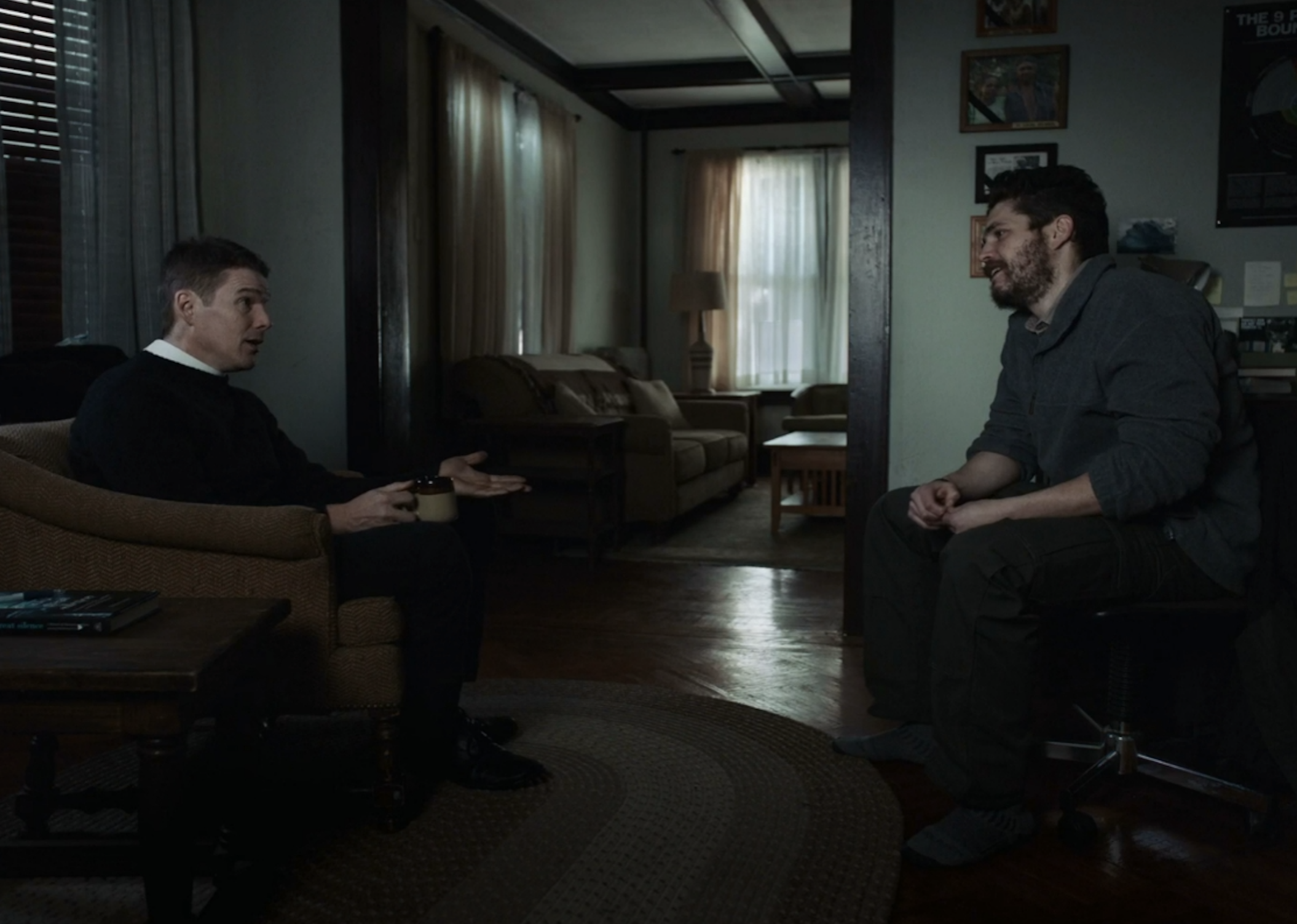 The precise language given to both Toller and Michael must communicate the film’s key themes: the intertwined, inseparable companionship of two contradictory emotions, hope and despair. Michael is understandably afflicted by the despair he feels at the seemingly utter hopelessness of the impending threat of climate catastrophe. News about the worsening climate comes at regular intervals, and it is almost never good. The headlines almost always contain phrases like “worse than imagined” and “faster than scientists initially thought.” Toller acknowledges his despair, but counters: “Courage is the solution to despair, reason provides no answers. I can’t know what the future will bring; we have to choose despite uncertainty. Wisdom is holding two contradictory truths in our mind, simultaneously, hope and despair. A life without despair is a life without hope. Holding these two ideas in our head is life itself.” The sentences Toller speaks are pruned to their essence; there are no verbal crutches, no stammering fumbles or appeals to authenticity of human speech. The lines are short, punctual, the word choice precise. The repetition is strategic, finely crafted. At the level of craft, the power of Schrader’s writing is that these words serve as a microcosm of the film’s larger questions. As Toller, Michael and Mary struggle to reconcile hope and despair, the audience does so as well.
Toller, of course, is an imperfect messenger for these sentiments, as he himself is plagued by despair for much of the film and shows little interest in hope. He drinks to excess despite the obvious impact on his deteriorating health. He reads scripture disinterestedly from the pulpit to a smattering of churchgoers. He is the embodiment of the film’s many themes: the battle in the mind between hope and despair, the earthly responsibility to be stewards of God’s creation, the ethics of suicide, the relationship between creation and destruction, an honest devotion to faith in contrast with the big business of monetized houses of worship, and the morality of raising children in a world that only grows more inhospitable to them with each passing year.
The loftiness of these themes, however, obscures another one that connects them all together, and must have meaning for the film’s author: the efficacy of writing. In Toller’s first voice-over narration, he tells the audience: “I have decided to keep a journal. Not in a word program or digital file, but in longhand, writing every word out so that every inflection of penmanship, every word chosen, scratched out, revised, is recorded. To set down all my thoughts and the simple events of my day factually and without hiding anything. When writing about oneself, one should show no mercy. I will keep this diary for one year; 12 months. And at the end of that time, it will be destroyed. Shredded, then burnt. The experiment will be over.” Likewise, Schrader shows the pages of the journal bearing these words as Toller writes them. He returns to this pairing of image and voice-over throughout the film, Toller narrating as he writes. In the journal, Toller can confess his darkest thoughts. He can use it to fight against the darkness that intrudes on his every waking moment. As he later writes, “It is a form of prayer.”

For Paul Schrader, First Reformed’s visual style realizes ideas of transcendental style that he first theorized at the beginning of his career. But that style only works because it serves the story and character he crafted so carefully. The collapse of the monoculture and the balkanization of media is such that it is difficult to imagine Reverend Toller becoming as culturally ubiquitous a character as Travis Bickle, but Schrader has assuredly created another troubled man as fascinating as his predecessor. If he wins the Academy Award for the film’s screenplay, the honor will undoubtedly carry with it some degree of “lifetime achievement” recognition for his body of work. If so, such an implication will unfairly obscure the degree to which Toller and the film in which he lives speak to fundamental aspects of life in 2019. First Reformed looks back at the past, but also takes a troubling yet moving look at the present.
Brian Brems (@BrianBrems) is an Assistant Professor of English and Film at the College of DuPage, a large two-year institution located in the western Chicago suburbs. He has a Master’s Degree from Northern Illinois University in English with a Film & Literature concentration. He has a wife, Genna, and two dogs, Bowie and Iggy.
Categories: 2019 Film Essays, Featured, Film Essays
You must be logged in to post a comment.