
Vague Visages’ Mark Jenkin essay contains spoilers. This article covers Dear Marianne (2016), The Road to Zennor (2017), Bait (2019) and Rose of Nevada (2025). Check out more VV film essays at the home page.
Britain has long imagined itself through its coastlines. As an island nation, its beaches, cliffs, harbors and tidal landscapes occupy a singular place in the national imagination: these are sites of arrival and departure, labor and leisure, myth and legend. Cinema has repeatedly returned to these spaces since its earliest incarnations, finding in the meeting of land, sea and sky a landscape that is at once rooted in the distinctly local yet deeply symbolic. Ultimately, the coastline was among the earliest subjects of British cinema as Birt Acres’ Rough Sea at Dover (1896) was one of the first films exhibited to a British audience, screened only a few weeks after the Lumière brothers’ celebrated Paris presentations at the end of 1895. Its brief depiction of waves crashing against the harbor walls of the Admiralty Pier in Dover demonstrates how quickly the coast became a significant cinematic image. At under 30 seconds long, Rough Sea at Dover nevertheless possesses a striking dynamism, depicting the intersection of coastal labor with the natural world, as well as the perils and beauty of the sea. This was a landscape that could be observed and recorded, but also invested with meanings extending beyond its geographical reality. From these earliest films onwards, the British coastline has functioned not simply as a setting, but as a space through which questions of identity, belonging, memory and place can be articulated.
More than a century later, Mark Jenkin provides a contemporary example of this enduring cinematic fixation. Throughout his filmography, the English director repeatedly returns to the coast, whether elsewhere in Britain or, most significantly, in and around his native Cornwall. Drawing on his personal affiliations with these landscapes, his films use the specificity of place to explore more universal questions around identity. Jenkin’s films are particularly attentive to the tensions that emerge when relationships to place are disrupted — when outsiders alter the character of a coastline, or when individuals are displaced from the landscapes they understand as home. In his films, then, the coast acts as more than a backdrop but becomes an active presence through which questions of belonging, memory and attachment to place are negotiated.
Mark Jenkin Essay: Related — Moments of Paradise: Intimacy and Place in Derek Jarman’s Home Movies
These concerns are further reflected in Jenkin’s distinctive use of analogue, hand-processed 16mm film. The medium evokes the materiality and aesthetics of an older form of cinema, producing images charged with a sense of memory and nostalgia, recalling the kinds of short films produced during cinema’s earliest years, such as Rough Sea at Dover. Yet the scratches, chemical marks, fluctuations in exposure and irregularities of the emulsion are more than nostalgic effects, as they become part of the image itself, carrying visible evidence of the film’s own making. In Jenkin’s work, this materiality creates an unusual correspondence between medium and landscape. The weathered surface of the film seems to belong to the same world as the weathered stone, peeling paint, rusted machinery and eroded cliffs that populate his images. The physical degradation of the film stock consequently becomes inseparable from the physical character of the landscapes it records, allowing the medium itself to participate in Jenkin’s exploration of place, memory and belonging.
Mark Jenkin Essay: Related — I Am of Mud and Flame: Landscapes as Conjurors in British Folk Horror
These interests are already present in Jenkin’s early short films, where coastal landscapes emerge as a recurring cinematic image. Many of these films take the form of a travelogue, with roads, fields, villages and coastlines passing before the camera as an unseen narrator — often Jenkin himself, though not always — reflects on the places through which he travels. The landscape is therefore closely connected to the voiceover, as images of particular places become occasions for observation and reflection, giving geographical space a subjective presence. The Road to Zennor (2017), for instance, follows a journey westwards across the Cornish landscape and along a road towards the coast. There is a sense of familiarity and comfort in the passing images, as geographical movement is married with a poetic meditation on the Cornwall and the melancholy transition from summer into winter. Shot on a single, unedited roll of Super 8, there is an immediacy to which the filmmaker captures the surrounding landscape, one that is already charged with a feeling of attachment. A low autumnal hue also helps to dissolve the landscape into shades, shapes and “strips,” its hazy softness suffusing the image with an overall sense of reminiscence. Jenkin’s landscape is therefore experienced not as something static or external, but as something lived in and shared.
Mark Jenkin Essay: Related — The Past Dreamed the Future Present: Derek Jarman’s ‘Jubilee’

Jenkin’s short film Dear Marianne (2016) similarly plays with the conventions of the travelogue, combining them with those of the home movie and holiday film. Taking the form of a trip in Ireland, the movie features a narrator reading postcard-like reflections on what he has seen and the associations that those particular places evoke. Yet the further the narrator travels from Cornwall, the more insistently the county seems to return as he is often heard repeating the phrase, “it looks just like home… just like home.” This sense of return unfolds through a series of encounters in which unfamiliar landscapes become occasions for memories of Cornwall. The sea crashing against cliff faces evokes memories of Cornish beaches, a visit to an estuary in County Cork prompts a recollection of his youth in Porthilly, a stone circle reminds him of the Merry Maidens and the film ends with images of engine houses as the narrator wistfully reflects on Cornishmen being sent for to mine copper. Here, the landscape is imbued with a distinctly nostalgic quality, as each new place encountered becomes a point of return to Cornwall. The voice-over, with its postcard-like address, further complicates the film’s sense of time and chronology. Rather than simply providing commentary on the images, the narration creates a parallel imaginative journey, raising the possibility that the images themselves function as visual memories of the places described. This is reinforced by the home-movie quality of the footage, in which handheld camerawork and the haziness of the film stock lend the images a softened quality through which the landscape takes on the appearance of remembered experience. Jenkin’s coast is therefore never merely somewhere to be looked at, either. It is somewhere to remember, somewhere to belong and, increasingly, somewhere from which belonging itself can become uncertain.
Mark Jenkin Essay: Related — Shifting Landscapes: Jerzy Skolimowski’s ‘Deep End’ and ‘The Shout’
Jenkin’s celebrated feature film, Bait (2019), develops and consolidates these concerns further, presenting the coastline as a contested territory in which memory and belonging are unsettled by a landscape undergoing profound social and material change. Set in a Cornish harbor town, the film follows Martin Ward (played by Jenkin staple Edward Rowe), whose family home has been sold to an affluent, outsider couple as a holiday property, while his brother Steven (Giles King) uses their father’s former fishing boat to take tourists on coastal trips. Dispossessed of both his home and his traditional livelihood, Martin now fishes from the beach, laying large nets across the sand and later attempting to catch lobster with traps along the cliffs, his efforts yielding little financial reward. Nets, traps and fishing equipment become recurring visual motifs, evoking entrapment and mirroring Martin’s own struggles as he is forced to negotiate modern financial pressures at the expense of the livelihood that has shaped and nurtured his sense of identity. Establishing shots of the ocean’s calm expanse beyond the harbor further reinforce this sense of entrapment, contrasting the apparent freedom of the open sea with Martin’s increasingly restricted existence on the coast. This is compounded as tourists on stag parties use his father’s fishing boat for leisure, enjoying a relationship with the sea that Martin can no longer sustain as a livelihood. As he struggles to make ends meet, the beach becomes not a site of escape, but rather a contested frontier where questions of ownership, community and identity are played out. “I’m talking about fishin’, not fuckin’ hospitality,” Martin exclaims, encapsulating his resistance to an economy that has transformed the meaning and use of the coastline he has grown up in.
Mark Jenkin Essay: Related — The Ten Commandments: Observation and Humilty in Kazuhiro Sôda’s ‘Inland Sea’

Martin’s relationship with the surrounding landscape is a difficult one, then, and his character embodies many of the tensions that surround his coastal community. While he is angry at the state of his hometown and the displacement taking place there, he remains deeply connected to the coastal landscape that once helped form the basis of his identity. This connection is further embodied through his father’s fishing boat, which remains on the water even as its function has been transformed. The landscape itself therefore remains materially recognizable, while the relationships that once gave it meaning have been altered. The boat, harbor, fishing equipment and coastline survive as traces of an inherited way of life, but they have become increasingly detached from the practices and communities that produced that history. This tension extends into the town’s local pub, where Martin often sells his catch, and which functions as another space in which the changing relationship between the local community and the tourist economy becomes visible. The pub allows these two worlds to intermingle but also exposes the tensions between them. While some residents are drawn towards the allure and mystery of the outsider tourists, like Martin’s nephew, Neil (Isaac Woodvine), others are confronted with an unsettling reality that manifests itself through small outbursts of violence. In this way, Bait develops Jenkin’s interest in landscape as a repository of memory and a sense of attachment but ultimately introduces a more fearful possibility: that a place may remain physically recognizable while the cultural relationships through which belonging is experienced can begin to shift and, ultimately, disappear.
Mark Jenkin Essay: Related — In a State of Exile: ‘The Last of England’ in 1987
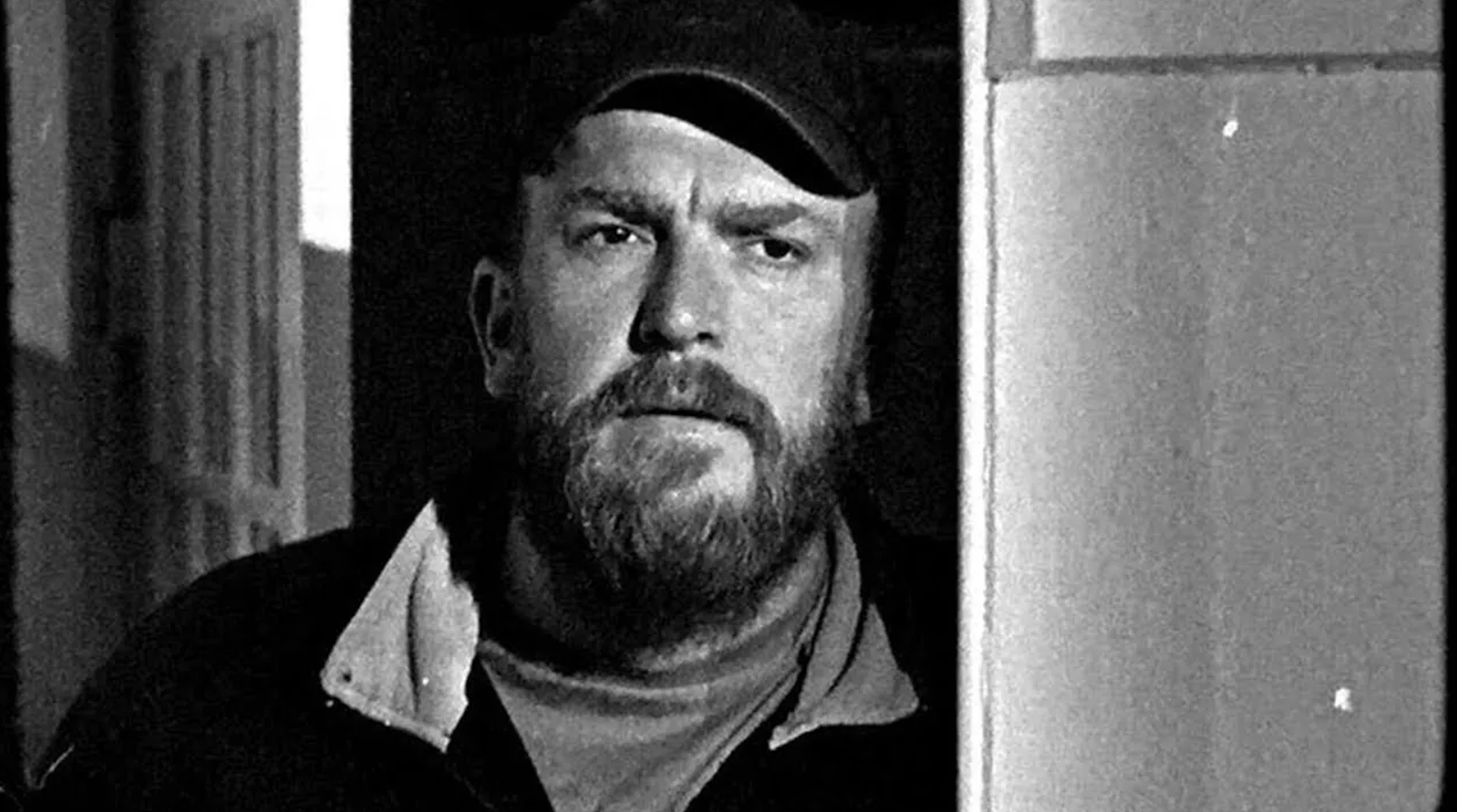
Again, Jenkin’s scratchy, ephemeral 16mm film stock is at its most expressive in Bait. Its weathered monochrome images seem almost excavated from the coastline itself, linking the material texture of the film to the rugged surfaces of the landscape and sea. Jenkin marries this materiality with a visual language built around close-ups of faces, hands, gestures and fishing ephemera scattered around the harbor. Abrupt shots of lobster traps and other objects associated with the fishing industry interrupt the narrative without obvious spatial or temporal continuity, creating a fractured collage of images connected to the region’s industrial history. This discontinuous editing produces an off-kilter rhythm that at times tips Bait towards the conventions of horror, while the repetition of images in subliminal and often unsettling ways creates a persistent sense of foreshadowing. A feeling of dread consequently lingers over those who inhabit the town, ultimately coming to a head when Martin’s nephew dies after falling into the harbor following a scuffle with Hugo (Jowan Jacobs), a member of the family who bought Martin’s former home. Here, the formal dislocation of the film mirrors the social tensions within its narrative, particularly the growing divide between holidaymakers who experience the coast as a place for leisure and residents, such as Martin and his nephew, who struggle to derive a livelihood from it. The flickering instability of these images thus comes to mirror Martin’s simmering resentment, as Jenkin’s aesthetic registers the dislocation produced by a tourist economy that has altered his sense of identity and his relationship with his hometown.
Mark Jenkin Essay: Related — Questioning and Subverting Artistic Authority in ‘Through the Writer’s Mirror’
In Jenkin’s most recent feature film, Rose of Nevada (2025), the remnants of a lost fishing culture return in the form of the titular fishing vessel, which reappears in the village after 30 years lost at sea. Despite an initial uneasiness from the boat’s former owner, Mike (again played by Edward Rowe), its reappearance gives hope of restoring the village to the thriving fishing community that had disappeared alongside it. Unlike Bait, in which the remnants of a fishing culture remain stranded within a coastline increasingly shaped by tourism, Rose of Nevada gives that past a physical body through which it can re-enter the present. The boat is simultaneously an object, a historical relic, a workplace and a vessel of memory, and its very presence seems to awaken a sense of haunting within the village. It quickly becomes clear how deeply the community had been scarred by its disappearance three decades earlier, initially marked by an abandoned harbor of rusted metal and flaking paint, epitomizing the town’s economic decline. This decline is also evident in the town’s reliance on a local food bank, which Nick (George MacKay), a young father struggling to provide for his family, regularly frequents. Elsewhere, the effects of the boat’s disappearance persist in more personal forms as Mrs. Richards (Mary Woodvine), whose son Luke died in the aftermath of the Rose’s disappearance, remains psychologically stranded in her grief. When she later mistakes Nick for Luke following the boat’s return, the boundary between past and present start to blur in eerie ways. Here, the past is not simply preserved as a trace within the village but becomes an active presence capable of returning to the present and altering it.
Mark Jenkin Essay: Related — They Know Not What They Do: The Passion of the Christ in Franco Zeffirelli’s ‘Jesus of Nazareth’

The film’s sense of haunting is further shaped by the movement of the tide. The Rose initially floats back into the village seemingly without explanation, its arrival echoing Liam’s (Callum Turner) appearance in town, a mysterious stranger who seems to emerge almost from nowhere and who sleeps rough about the harbor. Both the boat and Liam arrive at the coast as figures whose histories are initially elusive, making the coastline a space through which the unknown and the forgotten can return. In need of work, both Nick and Liam are hired to crew the boat alongside the enigmatic skipper, Murgey (Francis Magee). As they begin to work aboard the Rose, the tide becomes an important temporal and narrative force, carrying the crew through a storm at sea before the fate of the Rose is finally revealed when they arrive back in the village to discover that they have traveled 30 years into the past. The boat’s movement is therefore also a movement through time — the same sea that carried the Rose away from the village has carried it, and those aboard it, back towards a past that was thought to have been lost. The sea consequently becomes more than a backdrop or a geographical space in which the film’s events unfold, or even a context through which the characters are able to find work. Instead, it becomes the medium through which time itself is displaced, a space where arrival and departure collapse onto one another. Here, the coast becomes haunted not simply because it contains memories of a tragic past event, but also because those memories retain a material presence, carried back into the village on the boat, by the movement of the sea.
Mark Jenkin Essay: Related — Weird Worlds: The Short Films of Ari Aster
The return of the Rose, and its shift into the past, also helps bring fishing back into full focus. Both Nick and Liam find work aboard the vessel, with Liam even joining the community to help repair one of its broken nets, while the town begins to thrive alongside a renewed fishing culture. This emphasis on work points towards the significance of labor more broadly within Jenkin’s cinema. Closely bound to the coast, the fishing industry provides one of the primary means through which his films explore the relationship between people, place and the changing conditions of coastal life. In Rose of Nevada, industry is rendered not as something separate from the natural world but as deeply entangled with it. Jenkin does this visually with shots of the Rose’s machinery helping frame the water that surrounds it, transforming functional objects into apertures onto the wider landscape. Portholes, hatches, windows, netting and gaps within the boat’s structure frame fragments of sea and sky from within the confines of the vessel. The structures and tools of labor become the very means through which the landscape is encountered and understood. In this sense, Jenkin’s depiction of fishing resists a simple opposition between industry and nature, instead presenting the two as mutually integral aspects of coastal life. The boat does not merely carry the characters across the sea but rather mediates their relationship with the landscape, binding labor, memory and place together through the physical act of working upon the water.
Mark Jenkin Essay: Related — By the Rivers of Babylon: Structure and Setting in Margaret Tait’s ‘Orquil Burn’

As with Rough Sea at Dover, the sea in Jenkin’s films retains a dual capacity for beauty and jeopardy. In Rose of Nevada, Liam and Nick’s movement into the past produces radically different consequences, revealing the sea as both a site of loss and a potential route towards another form of belonging. For Liam, his newfound connection to the fishing industry becomes transformative as he assumes the life of a worker who disappeared with the boat 30 years previous. Within this past, he finds a family, cares for a daughter and discovers a sense of meaning and purpose that had previously eluded him in the present. Nick, by contrast, ultimately loses his family and those he loves despite his attempts to return to the present. In Bait, Martin similarly finds himself unable to restore the town’s fishing industry to a form it may have once possessed. Instead, his desire to return to work on the water persists as a means of reconnecting with a landscape increasingly threatened by change. In the film’s final moments, Martin, alongside his brother, finally returns his father’s boat to its former glory reclaiming, however briefly, the work and landscape through which his sense of identity has been formed. Across Jenkin’s films, then, the sea exerts a persistent pull upon those who live beside it, offering the possibility of return while simultaneously carrying the risks of loss. His coastlines are consequently never static spaces but material landscapes in which histories of labor, memory and belonging remain embedded, allowing the past to continually press upon the present. To inhabit a coastal landscape in Jenkin’s cinema is therefore to inhabit a setting where belonging is never entirely secure, but is continually shaped and reshaped by the movement of the sea.
Edwin Miles (@eaj_miles) is a filmmaker, screenwriter and documentarian from the West Midlands, United Kingdom. Now based in London, Edwin’s experimental work reflects on ideas of family and memory, home and displacement. His favourite filmmakers include Derek Jarman, David Lynch and Kazuhiro Sôda. Thank you for reading film criticism, movie reviews and film reviews at Vague Visages.
Mark Jenkin Essay: Related — On Dark and Lonely Waters: PIFs and Rural Landscapes as Sites of Danger
Categories: 2010s, 2020s, 2026 Film Essays, Documentary, Drama, Fantasy, Featured, Film, Horror, Movies, Mystery, Science Fiction, Short Films, Time Travel
You must be logged in to post a comment.