

Vague Visages’ Betânia review and Dormir De Olhos Abertos review contain minor spoilers. Marcelo Botta’s 2024 movie features Diana Mattos, Ulysses Azevedo and Nádia de Cássia, while Nele Wohlatz’s 2024 drama spotlights Nahuel Pérez Biscayart, Liao Kai Ro and Shin-Hong Wang. Check out the VV home page for more film reviews, along with cast/character summaries, streaming guides and complete soundtrack song listings.
*
Traditionally, the heart of the Brazilian film industry has been in Rio de Janeiro or São Paulo, the two major metropolises in the southeastern end of the country. But in recent years, the center of gravity has shifted up to the northeast. Traditionally, this is the poorest region of Brazil, but the left-wing presidencies of both Luiz Inácio Lula da Silva (2003-2010, 2022-) and Dilma Vana Rousseff (2011-2016) have done much to lift the region in comparison to the southern giants. Cinematically, the two most garlanded Brazilian filmmakers of the 21st century thus far are northeasterners: Kleber Mendonça Filho (Aquarius, Bacurau) from Recife, Pernambuco and Karim Aïnouz (Madame Satã, The Invisible Life of Eurídice Gusmão) from Fortaleza, Ceará, with the former in particular making Recife and Pernambuco very much the stars of his films.
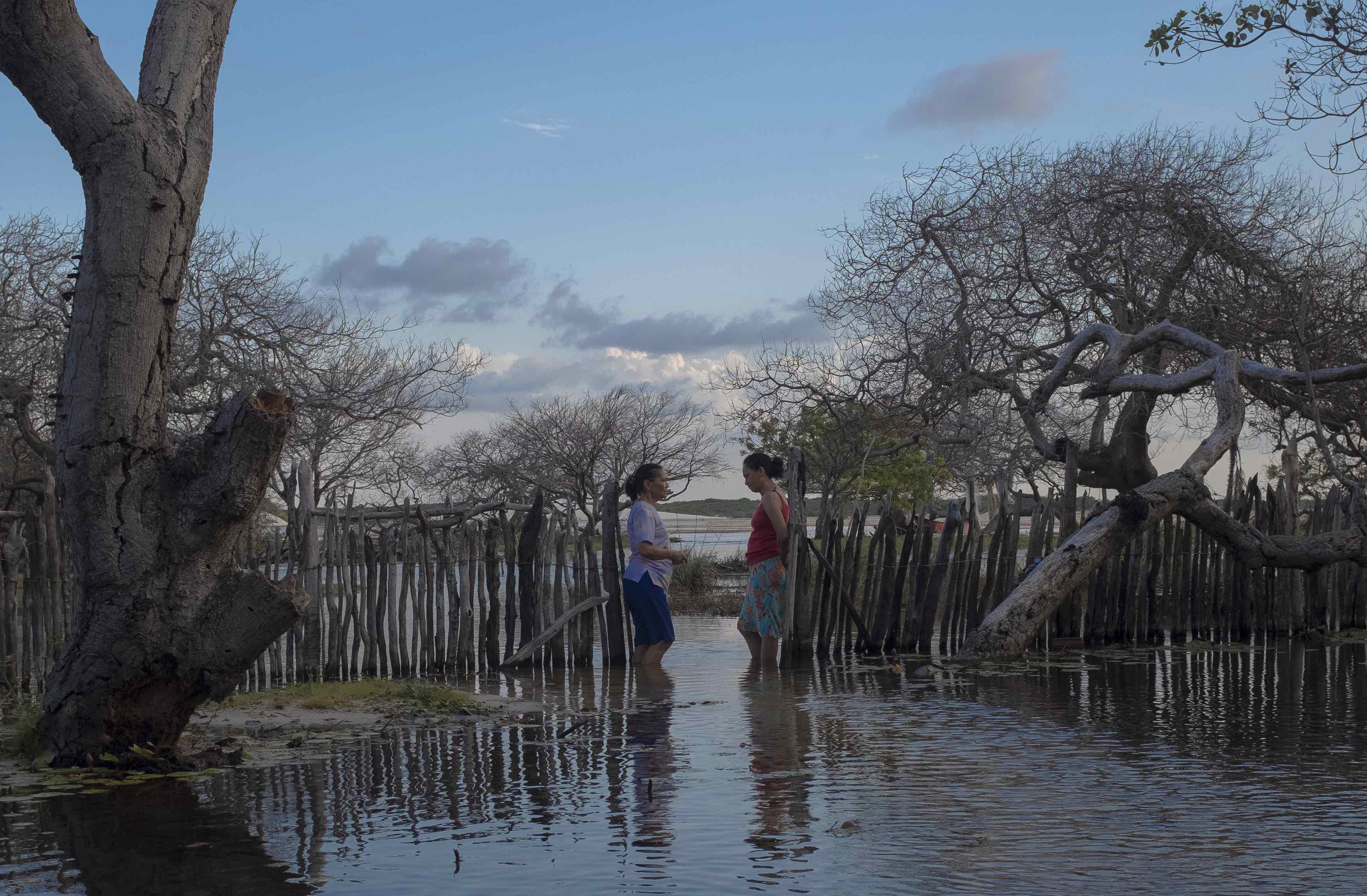
Marcelo Botta’s Betânia is yet another northeastern film that makes the location its star. The movie takes place in Lençóis Maranheses within Maranhão state, an extended national park consisting of an ever-shifting mass of sand dunes containing a network of temporary lakes and lagoons during the rainy season.
Betânia Review: Related — Know the Cast: ‘Fallen Leaves’

Betânia stars Diana Mattos as the titular character, a midwife in the local community. Living out in the sticks without electricity, her existence is difficult but not without its pleasures, most particularly in her tight-knit family. Under pressure to move to a slightly bigger village with electricity and the internet, Betânia resists. Her son, Tonhão (Caçula Rodrigues), sells his quad bike and becomes a tour guide for gringos on the dunes. Her unemployed daughter, Jucélia (Rosa Ewerton Jara), falls under the spell of an evangelical church, which promises financial and earthly gains if she gives “not 10 percent of her current salary, but 10 percent of the salary she wishes to have,” according to the pastor. The grandchildren, adolescent Antonio Filho (Ulysses Azevedo) and young adult Vitória (Nádia D’Cássia), are just starting to imagine a world beyond theirs, and wondering what’s out there, the latter also having to contend with the homophobia and religious conservatism of her mother.
Dormir De Olhos Abertos Review: Related — Soundtracks of Cinema: ‘Eileen’
Botta also examines the looming spectre of global capitalism and climate breakdown in Betânia. The sand dunes are becoming increasingly popular with tourists, whose footsteps can damage the local ecology, while the towns at its edges become increasingly prone to flooding. Things come to a head when Tonhão agrees to take a bickering French couple on the dunes in the dry season when lakes are almost non-existent. When they insist on trekking to a lake visible in the far distance, Tonhão loses his bearings on the dunes and becomes lost.
Betânia Review: Related — Know the Cast: ‘Anatomy of a Fall’
If that sounds dreary and heavy-going, it’s not. Botta has cut his teeth on commercially-oriented work and documentaries of his own. And for his first fictional feature, he displays a remarkably light and airy touch. There is humor and ease to the proceedings, with Betânia and company facing down existential challenges within their community.
Dormir De Olhos Abertos Review: Related — Soundtracks of Cinema: ‘Past Lives’
Repeated throughout Betânia, like a Greek chorus, are musical gatherings in the community, often ritualistic, with traditional Brazilian instruments and songs, many of which describe the hardships of manual labor and poverty. But the gatherings are those of joy and solidarity, a chance for people to come together and share time with each other. The demands of modern capital — like tourists demanding to see lakes that simply don’t exist — sever the family from each other. In these musical sections, Vitória’s trips to a local reggae club — watching Drag Queen DJs represent the future of her community — represent expansive and culturally-engaged methods of coalescing together.
Betânia Review: Related — Know the Cast: ‘Expats’
The dunes of Lençóis Maranheses may be unforgiving and ever-shifting, but the communities are not. Botta grounds them in the geography of this world — they may be remote, but they are not isolated, with group imagery always at the forefront: folks at the dinner table with rice and beans, the search party of dirt bikes and quads scouring the dunes and dance parties. It is when characters isolate themselves that they find trouble, as the French tourists do with Tonhão — a mindful recognition of the dangers of rampant capital if ever there was one.
Dormir De Olhos Abertos Review: Related — Soundtracks of Cinema: ‘Dumb Money’
Remarkably, Betânia isn’t the only northeast Brazilian film at this year’s Berlinale to concern itself with globalism, tourism and mingling cultures. Nele Wohlatz’s Dormir De Olhos Abertos is a Brazilian-Taiwanese-Argentinian-German co-production that’s every bit as multi-national as its origins suggest. The director herself is a German-based filmmaker living in Argentina since 2009, whose superb debut feature The Future Perfect (El futuro perfecto, 2016) explores the linguistic difficulties of adapting to life in Buenos Aires as a Chinese migrant. The film works as a hybrid essay-drama on linguistic possibilities, and Wohlatz’s follow-up tracks much of the same ground. Dormir De Olhos Abertos centers on a lonely Taiwanese tourist, Kai (Liao Kai Ro), in the Boa Viagem neighborhood of Recife. This upmarket, beachside area of the city is also the star of Mendonça’s Neighbouring Sounds (2012) and Aquarius, perhaps no surprise as he is a producer on the film. Underneath the torrent of gentrification in the area, Kai stumbles across a bunch of postcards, written by one of a group of Chinese laborers working on the black market in the area, all of whom have been hired by the unscrupulous Aunt Lin, which leads into a flashback structure.
Betânia Review: Related — Know the Cast: ‘The New Look’

In Dormir De Olhos Abertos’ story-within-the-story, a collective of multi-national lonely souls try to make ends meet and confront their reasons for traveling so far away from home. The high-rise tower in which Aunt Lin lives, Torres Gêmeas, has earned something of a reputation for being emblematic of the vast gap between rich and poor in Brazil: police raids on corrupt business owners, and the tragic death of a young boy because of negligence (likely because of both his race and his class). Just like Botta, Wohlatz roots her story in the geography of the place. But whereas the former’s characters are of the land, the latter’s are alienated from it, by their illicit, exploited status, and by the very isolationist architecture of luxury high-rise blocks. In the city, as in the country, global capital seeks to separate individuals from each other. There is a strain of dry, absurdist humor to Wohlatz’s vision, in which characters start fights half-heartedly and give up midway, and where selling inflatables on a stretch of beach notorious for shark attacks seems like a good business idea.
Dormir De Olhos Abertos Review: Related — Soundtracks of Cinema: ‘Nyad’
Betânia and Dormir De Olhos Abertos arrive at the same conclusions through different means. Where one is musical, rhythmic and widescreen in scope, the other is deliberately static and awkward. Where Botta’s film is free-wheeling, Wohlatz’s 2024 movie is rigid and dry. On their own, Betânia and Dormir De Olhos Abertos represent excellent achievements — but taken together, the two productions provide an excellent account of gentrification and globalization in the northeast of Brazil.
Fedor Tot (@redrightman) is a Yugoslav-born, Wales-raised freelance film critic and editor, specializing in the cinema of the ex-Yugoslav region. Beyond that, he also has an interest in film history, particularly in the way film as a business affects and decides the function of film as an art.
Betânia Review: Related — Know the Cast: ‘Upgraded’
You must be logged in to post a comment.