
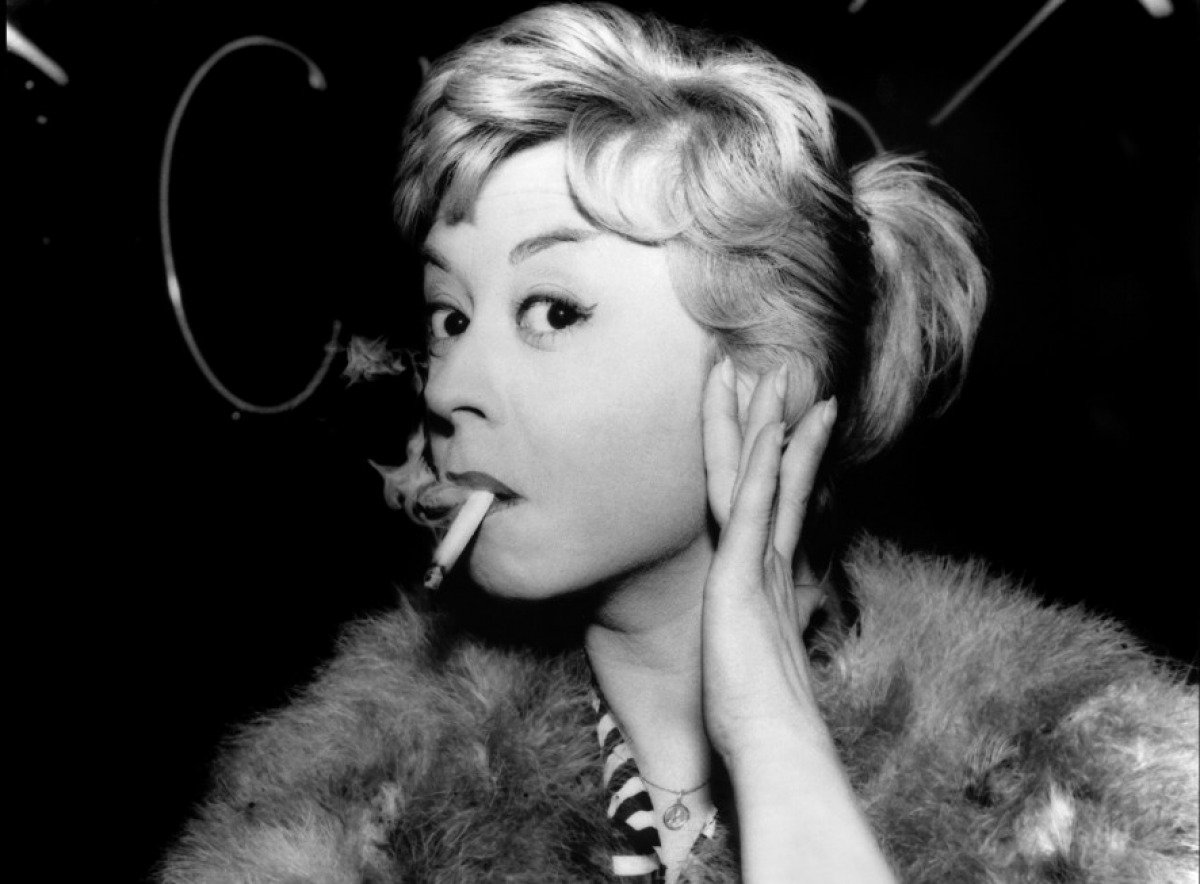
You could easily spend the bulk of Federico Fellini’s Nights of Cabiria trying to figure out exactly who it is that Giulietta Masina reminds you of. The round face, the smirk, the pantomimes and the short blond hair with the little ponytail. But you’ll never figure it out, because she is, in a word, incomparable. Maybe some of her is reminiscent of Charlie Chaplin, Buster Keaton and Lucille Ball, but Masina is of another kind altogether. If anything, she’s less the amalgamation of many different comedians and actors, and more of a motherly figure to modern offshoots like Kristen Wiig, Tavi Gevinson and Melissa McCarthy — each carrying something from Masina like long lost actorly children.
As the down-on-her-luck prostitute Cabiria, Masina is a firebrand. There’s still an element of the naiveté she displayed in La Strada, but it’s been amplified in addition to her expressions and movements. She fumbles in a curtain at a nightclub, trying to get through an impenetrable door, and she gets into fights with the other hookers. Cabiria is quick, agile, volatile and dumb. When she dances at the night club, her movements are big and stiff, yet she is still free: Cabiria dances like a white girl who just don’t care. And through these elements is a truly singular expressiveness. She doesn’t technically fit in with the more “elegant” prostitutes due to her clumsiness and short stature, so she makes up for that gap with her polarizing personality.
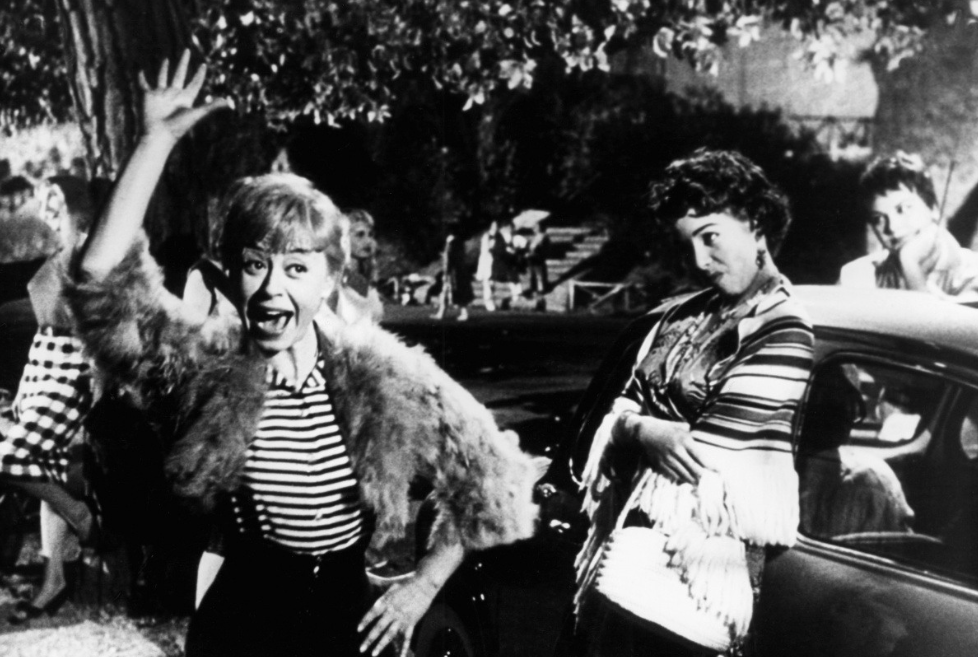
Yet, etched in her face is an ambivalence. At once, there is an elusive loneliness she feels, constantly jilted by men who claim to love and care for her (only to leave with her purse), as well as a crackling independence and desire for autonomy. She doesn’t need a man to be happy, but she wants one. Cabiria smirks, rolls her eyes, furrows her eyebrows, arches her lips and frowns. And she does so in the most affecting of ways; the expressions recognizable but completely unique to her screen presence.
In a way, it’s not totally unlike Far From the Madding Crowd, in that Bathsheba doesn’t need a man, but the idea of comfort and security — both emotionally and otherwise — is appealing. There’s a wealth porn element to Nights of Cabiria, which is particularly evident in the way that she tends to go after wealthier men (through at least no conscious fault of her own). Cabiria’s satisfied with the hunky dory house she has, modest as it is, but only to not worry about financial issues, and to finally be rid of the vicious rumors that already swirl around in her presence. Even at the magic show, she expresses those two desires (love/security and independence), which seem to everyone else as incompatible. How can you want a husband and want to fall in love but also enjoy being alone? Is she settling? It’s evident of a rather ignorant assumption that these two ideals are mutually exclusive. At the same time, there’s a willful resistance to that world, as if buying into it would somehow tarnish her identity. It’s all an elaborate, ironically honest act to retain as much dignity as possible.
Dignity and self-respect are interesting themes in the world of Cabiria, as respect amongst the other women is predicated on a certain amount of ego. But, as little has changed since then, it’s very much a “damned if you do, damned if you don’t” situation, where having the right amount of each is nigh impossible, especially for Cabiria. She fluctuates between a latent self-loathing and an explicit, overt ego, and yet both get her called a nut. She’s a little bit of a fabulist. And she is loud, but no louder than the others. What she has that the others don’t, and of which is evident on her face, is a sense of wonder. It’s partially a facet of her naiveté, but it nonetheless gives a warm, child-like beauty to her character. As Cabiria prays to the Madonna, she tells her friend, “I feel my heart beating. I feel so strange, Wanda!”
In the pilgrimage to the aforementioned church, Cabiria prays for her life to be changed, and tears cascade from her face. She whispers, “Madonna help me to change my life. Bestow your grace on me too. Make me change my life.” There’s a distinct difference between her prayer and those of the others who treat the Madonna as truly mystical and capable of healing (that’s what comes with omnipotence, right?). But Cabiria seems to understand that many of the troubles in her life are self-imposed, at least to her understanding. What’s interesting about this is that while it seems like it, Fellini isn’t victim blaming. He establishes Cabiria’s circumstances in a brief scene where a man, whom she had seen feeding the poor, drops her off in Rome. Her parents died when she was younger, and this is her means of survival. The world around her, however, is a proto-rape culture. She briefly blames herself, as do the rest of her peers, for being pushed into the river at the beginning of the film by Giorgio. The movie star she encounters, and whose apartment she stays in (albeit, in the bathroom), is abusive. The men are egotistical fops, filled with greed. She hopes she can escape it all.

But Cabiria knows better. After the church, she realizes that “We haven’t changed. Nobody’s changed! We’re all the same as before, just like the cripple.” Nights of Cabiria, almost like Mad Men, has an interesting relationship with the transitory, fluctuating nature of human change, and often the lack thereof. The ambivalence appears again with Cabiria’s trust issues, as she’s both too quick to trust and too hesitant. She’s desperate for validation, and yet so often someone takes something away from her. But that is how we operate; a mix of hope for the future, but reticence based on the past. And, like Don Draper, she hopes to change herself through a journey for truth within her identity.
Fellini was always more of a magical realist than a neo-realist, despite starting off as the latter. Part of the great beauty of Nights of Cabiria is how gently that magic is weaved into the film. In practice, magician shows are insufferable, and Fellini gives us a paradoxical safe haven for Cabiria. On the one hand, she’s tormented on stage, yet on the other, she’s allowed her desires to be momentarily fulfilled under the spell of the magician. It’s bittersweet. But there’s an uncomfortable truth in there. She wants validation as much as the next person, even if she’s disinclined to admit it.
Oscar, whom she meets after the magic show, offers an attractive too-good-to-be-true marriage pitch, but what all the above aspects of the film boil down to is a kind of home (as was suggested in Mad Men and Looking). It’s a saccharine notion, but one worth exploring time and again as our shifting identities, social mores and understanding of human relationships mutate. As much of Night of Cabiria presents the ruins of post-war Italy, it is especially important that Cabiria find some home for herself. And though her peers, and a priest, stress the idea of matrimony, safety isn’t contingent on that and the film recognizes it.
Bosley Crowther complained, “It has a sordid atmosphere and there is something elusive and insufficient about the character of the heroine. Her get-up is weird and illogical for the milieu in which she lives and her farcical mannerisms clash with the ugly realism of the theme.” But I’d argue that Crowther is missing the point. That juxtaposition is intentional; her superficiality is a defense. Her pantomimes are an anarchic reaction to the harsh realities around her. That jarring contrast between light and dark, however, is intentional, creating a fascinating disconnect between expectation and results. It’s technically no different than the Depression-era setting of Chaplin’s Modern Times, or any of Chaplin really. A delicate balance is utilized by Fellini, but unlike Chaplin — where one sequence of comedy is used to complement tragedy and vice versa — he takes his comedic character and places her in dire situations, partially as experiment (probably as troubling as the female led experiments of Lars von Trier), and partially as an examination of the truths of different people. Thus, Masina herself employs a careful balance: strange and comical enough to create a rhythm, but full of dramatic depth in order to seem at odds with the neorealist-derived world around her.
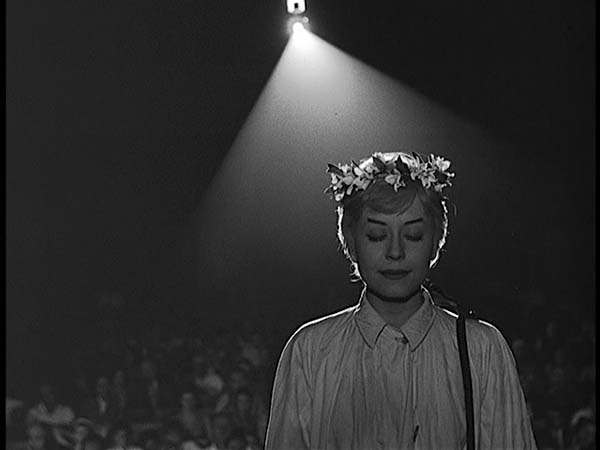
The success of Masina’s performance is harder than it sounds. We root for her and empathize with her. Cabiria is unapologetic in her persona; she’s flakey, cynical and optimistic — a mishmash of contradictions, and almost a proto-Frances Ha. But we love her. It looks like she’s finally found someone to love and respect her. She pauses for a moment while she and Oscar have lunch and ruminates on the previous lovers who’d taken from her. But she’s led up to a cliff, only to be swindled again.
I think von Trier has learned valuable lessons from Fellini, as both directors have to reconcile their romanticism with ugly realities. Cynicism and romanticism are stirring in Nights of Cabiria, and like the ending of Melancholia, they’re married together to create the sublime. But isn’t that what love is?
The magician at the show is a fraud, and perhaps Fellini is as much of one, capable of conjuring emotions in ourselves that are overwhelming. The real magic, though, is at the end of the film. Her heart shattered once again, Cabiria walks down from the hill and joins a parade. Tears still sparkle on her face, one painted on, but as she walks towards the camera, a smile appears on her face. She’s finally at peace. She’s found true love. She’s finally home.
Postscript
The end of Night of Cabiria has always been somewhat ambiguous. I’ve spoken to several people about it, and I always get different answers in terms of how they interpret the ending. Many accept it on a literal level, but I think Cabiria commits suicide by jumping off the cliff. The parade she joins is her version of Heaven, and she becomes surrounded by the safety she had spent so long searching for. It might be a questionable representation of suicide and escape, but nonetheless, the smile that appears on her face, as if a flower is rising rapidly from the ground, is pure cinematic magic.
Kyle Turner (@tylekurner) is a freelance film critic and writer. He’s also the assistant editor of Movie Mezzanine and began writing on the Internet in 2007 with his blog The Movie Scene. Since then, Kyle has contributed to TheBlackMaria.org, Film School Rejects, Under the Radar and IndieWire’s /Bent. He is studying cinema at the University of Hartford in Connecticut and relieved to know that he’s not a golem.
Categories: 2015 Film Essays, Film Essays, Uncategorized
You must be logged in to post a comment.