
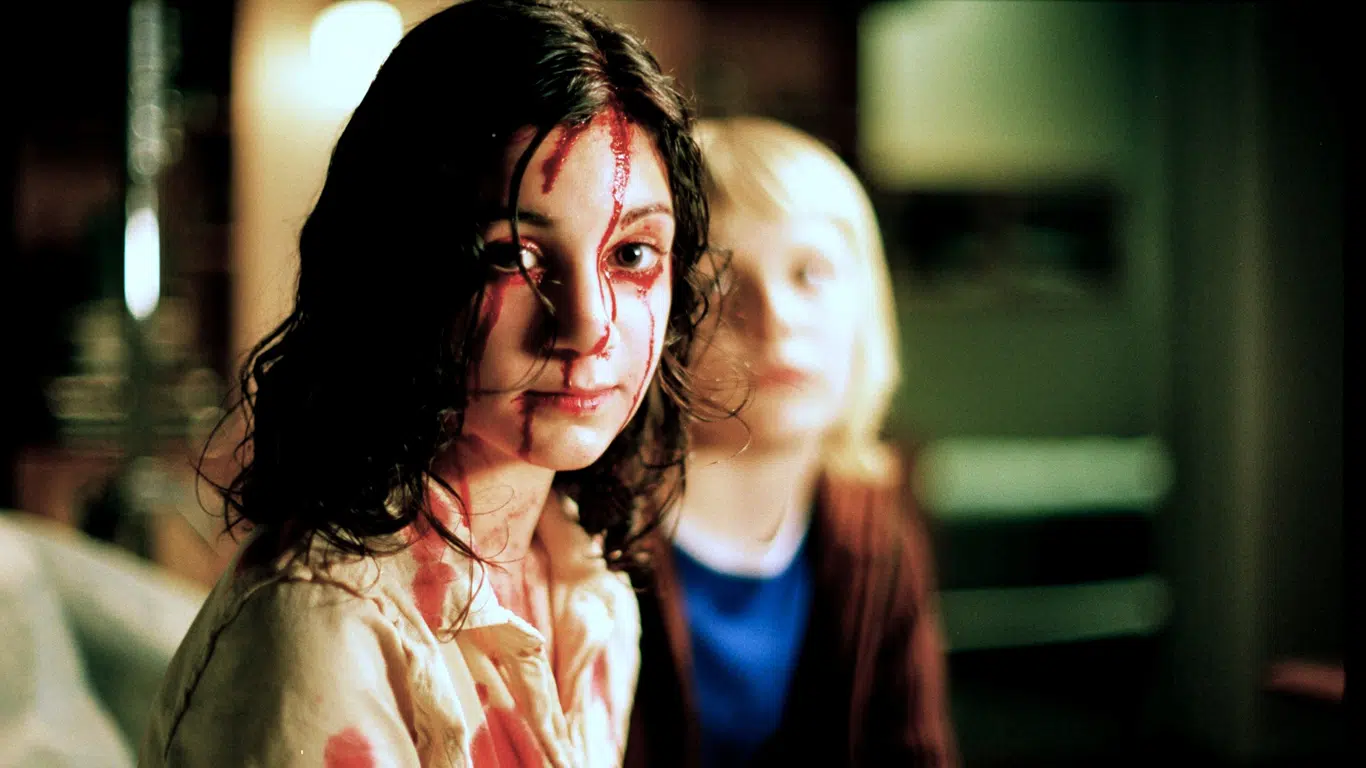
The snow blankets the vast landscape of Stockholm, but there’s a splash of scarlet somewhere. And a young person, barefoot, wanders. The only films in the Criterion Collection that include vampires are Guillermo del Toro’s debut feature Cronos and Carl Theodore Dreyer’s Vampyr — neither of which examine the vampire as a sexual being. Thus, we have Thom Alfredson’s Let the Right One In; a somber, bleak horror film that examines the pain and urgency of queer youth.
The horror of Let the Right One In exists two fold: on the one hand, typical horror film tropes are certainly peppered throughout the film (it’s a vampire movie). Blood is shed, and the looming fear of the unknown permeates the atmosphere. On the other hand, the horror reads as a treatise against a dominant culture that upholds rather old-fashioned ideas of gender and punishes those who transgress them.
Oskar (Kåre Hedebrant) is a paper-white, bleach-blonde stick of a thing, bullied frequently for his weakling abilities and certainly for his androgyny. He’s not manly enough for the older boys at school, so his solution is to work out and essentially perpetuate the violence done to him onto others. It’s a powerful statement of what happens when you push an oppressed person too far: they’re going to fight back.
Read More at VV — Soundtracks of Television: ‘The Bear’

Let the Right One In is particularly interesting because Oskar falls in love with a vampire named Eli (Lina Leandersson). Despite being centuries older, there’s still a winsome quality to the character that effects every movement and motion. That affected quality is of youth lost, particularly queer youth. Prior to becoming a vampire, Oskar’s love was assigned male at birth and castrated later in life. As a result, Eli too seems to seek revenge (out of survival) against a culture that has done them wrong.
Vampirism has a long history of being the monster that’s representative of a sexual other. From Countess Bathory to Dracula’s Daughter to Stoker’s original Dracula (whose homoerotic themes are very present), phrases like “the blood is the life” speak to sexual identity and its implications. Eli and Oskar’s genders are, perhaps, a modern example of that. Eli explicitly states not to be a girl, and it doesn’t matter to Oskar. The connection itself is enough for him, but the fact that he’s able to “get over the hurdle of gender” at such a young age strikes me as important.
Read More at VV — Know the Cast: ‘Beauty’

Let the Right One In ostensibly refers to the mysticism surrounding the vampire’s being, as Eli is unable to enter an abode without being invited in first. However, the title has a double meaning: it also refers to personal vulnerability and allowing someone to become a part of your identity, consciously or not. The brokenness of both characters begins to slowly create a new person; an identity that is fragile and yet imperative to expose for each. In the world winds of Sweden, exposure after various kinds of abuse is difficult, which means that letting the right one in, in this case, means finding your soul mate (platonic or romantic) and casting the world aside.
Read More at VV — Soundtracks of Cinema: ‘Blasted’

At the end of the film, Oskar and Eli board a train to nowhere. They abandon the society that refuses to accept them and go on to presumably live on their own together. It’s a bitter sweet sentiment, at once empowering in its separatist leanings but deeply melancholy in the fact that neither of them were accepted for who they are, scars and all. They don’t fit into their society’s ideas of what should be, and it’s still a topic of debate within the queer community whether acceptance is pandering or true. Does acceptance and assimilation mean that Oskar and Eli, or the queer community, would have to mute their own expressions of living? It also seems especially sad that these children are essentially hoisted out of that society, as they have never done anything wrong. There’s a smile on Oskar’s face, but even he knows the future is uncertain. But at least there’s Eli — the vampire, the person — who is all that Oskar has been looking for. Someone as adrift as he, someone as tender and warm. As Alexander McQueen said, “There’s blood underneath every layer of skin.”
Kyle Turner (@tylekurner) is a freelance film critic and writer. He’s also the assistant editor of Movie Mezzanine and began writing on the Internet in 2007 with his blog The Movie Scene. Since then, Kyle has contributed to TheBlackMaria.org, Film School Rejects, Under the Radar and IndieWire’s /Bent. He is studying cinema at the University of Hartford in Connecticut and relieved to know that he’s not a golem.
Categories: 2000s, 2015 Film Essays, 2015 Horror Essays, Drama, Fantasy, Film Essays, Horror
I dislike most vampire films, but I adore this one. I don’t even consider it a vampire film. It is so much more than that without ever becoming pretentious.