

In Babita Singh Reporting, director Ambiecka Pandit turns the police procedural toward a more intimate subject: how women learn to silently put others’ needs before their own. The film follows the title character (Nimisha Sajayan), affectionately known as Baby — an assistant sub-inspector who travels with her husband, Sharad (Anshumaan Pushkar), to his hometown of Rewa. There, the mysterious death of her childhood friend, Bansi (Barun Sobti), draws her into an unofficial investigation. As Babita investigates, the search for answers gradually opens onto the suspects and motives surrounding Bansi’s death while revealing more about the town and its people. It also brings the constraints of Babita’s own life into focus. Her professional ambitions are tolerated only so long as they do not disrupt the conventions of traditional Indian domestic life.
In this interview, Pandit reflects on her decision to tell Babita’s story through the textures of ordinary life, where professional ambition, the demands of family life and deeply ingrained ideas of femininity constantly collide. Babita Singh Reporting is available to stream on Amazon Prime Video.
Babita Singh Reporting Interview: Related — An Interview with ‘Phera’ Filmmaker Pritha Chakraborty

Dipankar Sarkar: What was it about Amita Vyas’ script that drew you to it and made you want to direct the film?
Ambiecka Pandit: I loved Baby. From the moment I read the script, I could see Baby as a character on screen. She was such an endearing woman — who stands in the ring despite being afraid — that I was instantly drawn to her. I loved the journey Amita had written for Baby: someone who makes herself small to accommodate others learns how to take up space and put herself first. I genuinely feel almost every woman out in the world has some aspect of Baby in her. That’s how universal the character is. I was also very drawn to the world of the film — the small town, the navratri days, the people, the dussehra maidan. All of this was compelling and visually rich.
Babita Singh Reporting Interview: Related — An Interview with ‘Whispers of the Mountains’ Filmmaker Jigar Nagda
DS: You previously directed an episode of Black Warrant (2025), set in Tihar Jail in the 1980s, with a jailor at its center, and now Babita Singh Reporting places a police officer at the heart of a contemporary setting. How did that earlier experience inform your understanding of the institutional world and the people within it?
AP: I am a firm believer in not judging your characters. I do not believe people are either good or bad. I think a complex interplay of circumstances, exposure, love and opportunity makes people do the things they do. Systems too are made of people and behave in much the same way. I loved that Black Warrant [episode] because it humanized the system. I think I carried that approach into Babita Singh Reporting. I did my best to refrain from judging a character and tried to portray them with both the good and bad in them.
Babita Singh Reporting Interview: Related — An Interview with ‘Secret of a Mountain Serpent’ Filmmaker Nidhi Saxena
DS: The film has a strong sense of lived reality, with even its dramatic moments remaining understated rather than hyperbolic. What led you to adopt this subtle tone?
AP: At its heart, Babita Singh Reporting is a bildungsroman — a coming-of-age story. The investigation Baby undertakes is just a vehicle for her to grow from Baby into Babita. I thought that to make her journey land, it would help to let the audience live and breathe with her — to have the experience that they were in the room, watching her life unfold. Every formal decision for me flowed from that intention.
Babita Singh Reporting Interview: Related — An Interview with ‘Noi Kotha’ Filmmaker Pankaj Borah
DS: Babita’s journey towards self-assertion unfolds through small, incremental changes. Why did you feel her struggle to find her voice needed to unfold so gradually?
AP: The film is set over 13 days — from when we see her struggling to get leave to the day after Dussehra when she comes back to take her job. In such a short window, her journey “back to herself” is accelerated because of her childhood friend’s untimely death. The death and her grief are the catalyst that force her outside her comfort zone — she has to stop complying with her environment and do something for herself. It felt to me that she will have the same experiences she has always had, but this time around, she will see them differently. And this usually happens gradually. I feel it also happens that way in life for us when our perspective changes. It is rarely an epiphany. It is usually small accumulations that force our hand and make us see things we don’t always want to see.
Babita Singh Reporting Interview: Related — An Interview with ‘White Snow’ Filmmaker Praveen Morchhale

DS: The film’s most significant inquiry may actually be Babita’s scrutiny of her own life. So, was solving Bansi’s murder a narrative vehicle for a more intimate exploration?
AP: Absolutely. It was just a way to force her hand to do something for herself. She wanted to find out the truth behind Bansi’s death, and she wanted to do that for herself. She could not help herself. That is how much Bansi meant to her and the impact he had had on her life — that she could not look away. This gave her the incentive to start asking questions for herself when all this while she had kept quiet to keep the peace. She had no confidence before this. And it was when she undertook this journey that she uncovered how much resilience, strength and intelligence she has always had within her.
Babita Singh Reporting Interview: Related — An Interview with ‘Early Days’ Filmmaker Priyankar Patra
DS: Sharad’s behavior towards Babita is rooted not simply in control, but also in his own insecurities and a sense of what he believes he has done for her. How important was it for you to give him this sense of self-justification while also showing how his concern becomes a means of controlling her?
AP: Sharad is a guy who wants validation that he is a good guy. It is not enough that he be kind. He wants people to acknowledge his kindness. And that need in itself undercuts his kindness. That was the contradiction in the character I wanted to capture — that every time he does something caring, he feels the need to laud it over her. And it is the same concern he uses to bend her to his will. He will say that he cares for her, “gives” her freedom and then uses exactly that to emotionally blackmail her into doing what suits him — be it deferring her reunion, giving up the quest to find the truth behind Bansi’s death, putting his family before her career or asking for unpaid labor in the name of love.
Babita Singh Reporting Interview: Related — An Interview with ‘Pinch’ Filmmaker and Actress Uttera Singh
DS: What did Nimisha bring to Babita that surprised you once you saw the character come alive on screen?
AP: Nimisha retained this deep intelligence that Baby had suppressed but always had. It comes to the surface in glimpses — when Sethi tries to persuade her to accept the suspension, when she sees Bansi’s wound and says she does not think the drug addict did that, when she lies to the saree shop owner to get the property dealer’s number. She can think on her feet. I liked that for Baby. I liked that she has this intelligence and yet most times she doubts herself.
Babita Singh Reporting Interview: Related — An Interview with ‘Mayilaa’ Filmmaker Semmalar Annam
DS: The film’s production design opts for raw, lived-in spaces that reflect the socioeconomic realities of small-town families. What went into creating these spaces with Mukund Gupta and Vahi Shaikh, and making them feel organic to the film’s milieu?
AP: Mukund and Vahi are really brilliant designers. They arrive at design through the narrative and never in a silo. Every space they design has something to say about the characters that inhabit it. They really focus on the detailing and, honestly, the lived in feel comes from there. For Babita Singh Reporting, we discussed how to create contrast in the spaces that reflect the contrast in the characters — be it Bansi’s artistic but sparse home with broken, incomplete idols, or Mangal’s room above a garage that is very bereft of warmth, or Sharad’s home that is warm and loaded with remnants of decades lived. Every space was designed to say something about the character that was not otherwise being said in dialogue.
Babita Singh Reporting Interview: Related — An Interview with ‘Shape of Momo’ Filmmaker Tribeny Rai
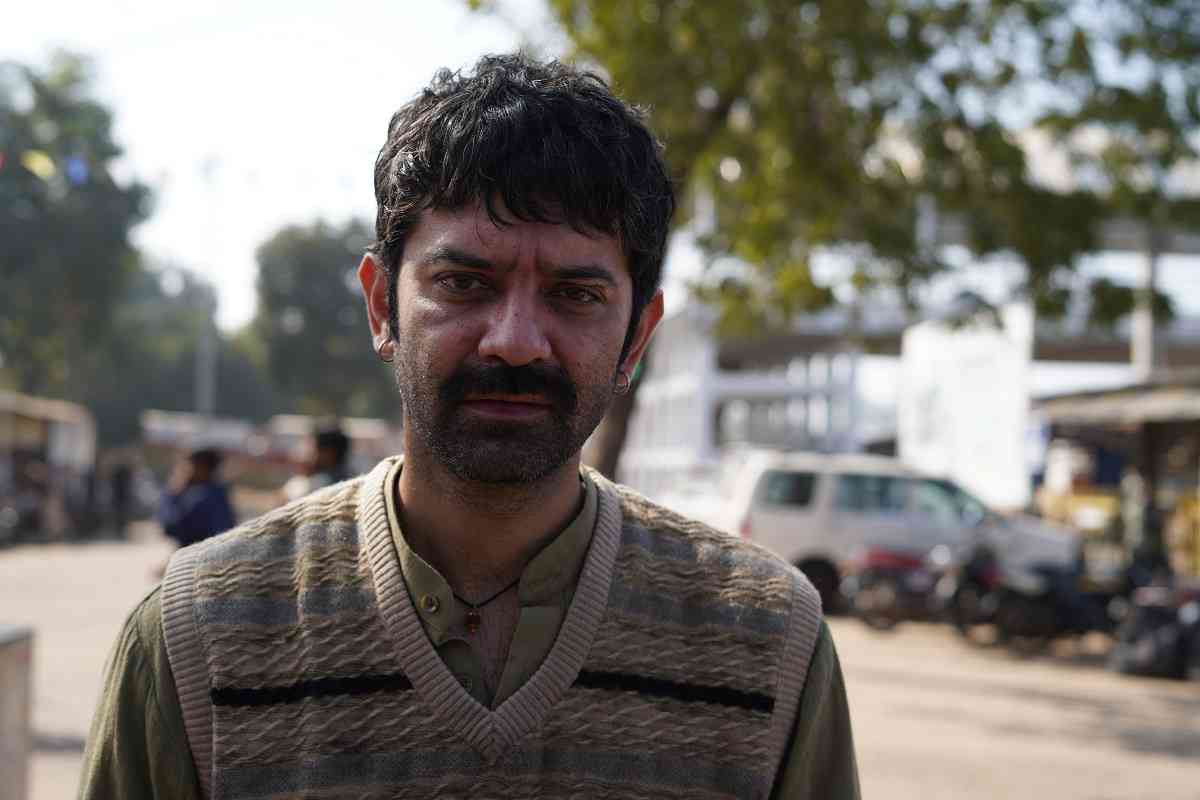
DS: Similarly, Sunil Borkar’s cinematography embraces a naturalistic visual style, where the textures of real locations become an integral part of the aesthetic. What guided your approach to capturing the film’s world and its characters?
AP: Sunil has a very unique eye. It was a very enjoyable collaboration because Sunil and I fortunately saw the film (at its core) in a very similar way. Being authentic was our north star. From our recce of Bhopal, we had flagged the architecture, the colors, the texture we wanted to bring into the film. And inside of that, we wanted to adopt a visual language that allowed us access to Baby’s mind — the way of filming Bhopal versus Rewa came from how Baby feels in those spaces. As the film progresses, we changed the framing and camera movement to better capture her disillusionment with her family, peaking at the car crash. And once something has permanently shifted in her, the visual language changes again to reflect the growing self-assuredness.
Babita Singh Reporting Interview: Related — An Interview with ‘Gondhal’ Filmmaker Santosh Davakhar
DS: You previously collaborated with editor Tanya Chhabria on Black Warrant, and you’ve worked with her again on Babita Singh Reporting. What made you want to continue that collaboration, and how did your creative process evolve this time around?
AP: Tanya and I have worked on so many projects together that we have sort of developed a short hand now. We can communicate without needing to talk too much. I find it very easy to work with her. Tanya does not always see things the same way as I do, and that, to me, is the most valuable asset she brings to a project. She challenges my notion of the film and forces me to see things in another way. And that is very helpful because she adds what I will have overlooked. Tanya is also a very unique editor. She approaches every project differently, and with Babita Singh Reporting, her approach to the edit was different from what we had done on Black Warrant and our other collaborations. It is always a pleasure to discover the rhythm and editing pattern of a project with her.
Babita Singh Reporting Interview: Related — An Interview with ‘Don’t Tell Mother’ Filmmaker Anoop Lokkur
DS: Babita Singh Reporting does not rely heavily on a background score but instead maintains a restrained soundscape that allows the environment to speak for itself. What was your brief to Bigyna Dahal in shaping the film’s aural world?
AP: “Let’s use sound to hear Baby’s mind” — Bigyna and I tried to follow that approach where every scene was designed intentionally to better connect with what Baby was thinking. Bigyna is a very meticulous sound designer who also does location sound himself. He layers his sounds and is very strict about detailing and authenticity. I knew that he would do that so well that it would almost feel invisible. Ajay Jayanthi’s score underscores the scenes so well. Bignya designed in such a way that he let the music breathe and [did] not have to ever compete with the sound design in a scene.
Babita Singh Reporting Interview: Related — An Interview with ‘I, Poppy’ Filmmaker Vivek Chaudhary
DS: Finally, by the end of the film [SPOILER ALERT], Babita seems to have only just begun to discover her professional identity. Do you see this as the beginning of a larger journey for her, and would you be interested in following her into another case?
AP: Absolutely! I personally love the complexity in Babita, and I think we have just scratched the surface. Given how intelligent and intuitive she is, she is bound to be a fast learner and it will be so much fun to see how she turns out as she grows in the police force and solves more challenging cases!
Dipankar Sarkar (@Dipankar_Tezpur) is a Rotten Tomatoes-approved film critic based in India. As a freelancer, he regularly contributes to various Indian publications on cinema-related topics.
Babita Singh Reporting Interview: Related — An Interview with ‘Vimukt’ Filmmaker Jitank Singh Gurjar
Categories: 2020s, 2026 Interviews, Amazon Originals, Coming-Of-Age, Crime, Drama, Featured, Film, Movies, Mystery, Thriller
You must be logged in to post a comment.