
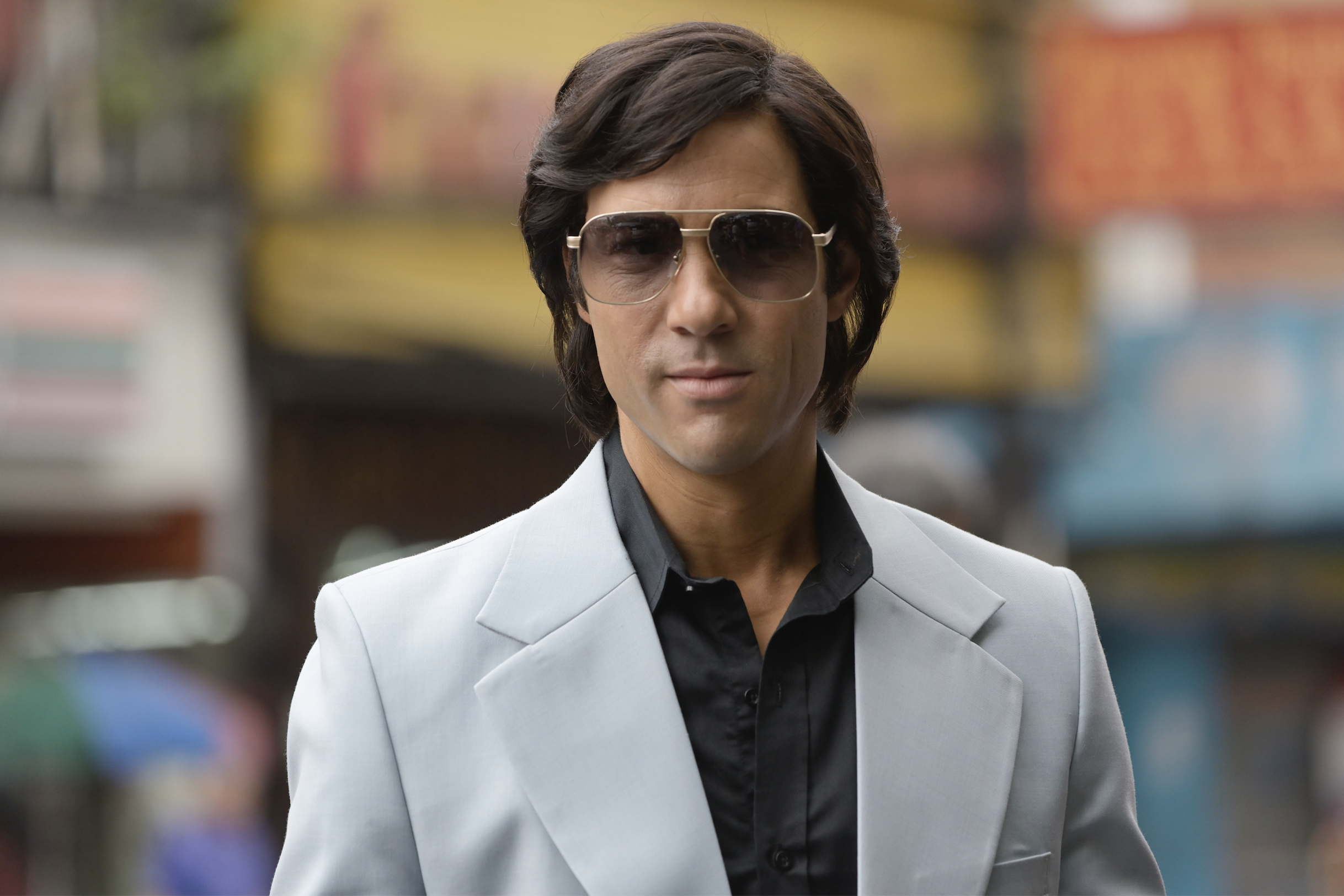
Like so many retro-themed mainstream TV productions, The Serpent suffers from an identity crisis. The Netflix series’ bizarre use of flashback sequences clutters the narrative, and distracts from what actually motivated Charles Sobhraj to kill at least 12 people during the mid-70s. The Serpent fashions itself as a serial killer epic, but feels more like an uninspired Jacques Audiard knockoff that shows little interest in deconstructing the psychology of its subject.
The Serpent begins in 1975 as Sobhraj aka “Alain Gautier” (Tahar Rahim) enjoys a playboy lifestyle with his girlfriend Marie-Andrée Leclerc aka “Monique” (Jenna Coleman) in Bangkok, Thailand. When an American traveler named Teresa Knowlton (Alice Englert) goes missing, a Dutch diplomat (Billy Howle as Herman Knippenberg) investigates the case and links “Gautier” to other crimes. Writers Richard Warlow and Toby Finlay jump back and forth in time as they introduce new characters and try to expand the narrative, but the collective performers unfortunately receive few opportunities to do more than just look supremely confident or entirely confused during the first half of the series.
More by Q.V. Hough: Netflix Review: Barry Avrich’s ‘Made You Look: A True Story About Fake Art’

Impostor syndrome ironically plagues The Serpent, a series about a man who lies to himself and others. The filmmakers seem intent on paying homage to their cinematic inspirations, but don’t offer much depth beyond the all-too-familiar genre archetypes. Rahim struts around without doing much quality acting whatsoever, or at least that’s how it seems when the writers don’t properly flesh out his character arc. As for Coleman, she has a dynamic screen presence, but her character essentially checks off the Glamorous International Girlfriend box. Beyond that, Howles’ Knippenberg aligns with the Obsessed Investigator archetype that is seen time and time again in TV and movies. The Serpent’s flashback and flashforward sequences add little to the story, and seemingly exist to gloss over the obvious fact that the writers struggled with character development when structuring a story based on historical events.
The Serpent finds its groove by the fifth episode. The filmmakers seem to have a better handle on the suspense, and wisely favor a slow burn element over constant flashbacks. When the Netfix series does go back in time, it’s to properly explain Sobhraj’s backstory and the familial factors that affected his worldview during the 60s. Unsurprisingly, the collective performances become much better from this point forward, as there’s more emotional depth to the story. Coleman especially stands out when conveying Marie-Andrée’s confusion and despair, and Howles succeeds in capturing Knippenberg’s evolution from a mild-mannered gentleman into someone consumed by inner rage and frustration. Thematically, these wild-eyed performance moments complement and contrast with the lead’s balanced interpretation of a psychopathic narcissist, but Rahim strangely doesn’t have any big acting scenes of his own, even when the filmmakers attempt to explain Sobhraj’s insecurities and perceived inadequacies as a young man.
More by Q.V. Hough: Netflix Review: ‘Brian Regan: On the Rocks’

Ruby Ashbourne Serkis makes a strong impression early on as Knowlton’s traveling partner, Celia Wilson, and Alma Jodorowsky similarly stands out as the ill-fated Stéphane Parry. However, there’s no consistency with the storytelling, as the writers and directors feel inclined to repeatedly establish Sobhraj as some type of stylish, globe-trotting figure.The Serpent filmmakers seemed to have asked themselves “How we can make this straightforward tale about a narcissistic killer into something more glamorous, something more global?” So, rather than making more room for Serkis (a clear star-in-the-making) as an episode 1 audience hook, they continuously focus on the subject’s persona via constant flashbacks/flashforwards, which really adds nothing when there’s no backstory context to justify the safe (i.e. boring) lead performance. And rather than developing suspense in the subsequent first-half episodes, the filmmakers drown the audience in more archetypal cliches, presumably as a means to connect with global audiences who want and need to see themselves on screen in some form. The writers and directors seem to trust the audience’s intelligence — evidenced by the heavy flashbacks/flashforwards — but they don’t seem to trust their creative approach.
The Serpent would’ve benefitted from a procedural-style narrative and more thoughtful editing. Move away from the flashback/flashforward mess, and explain what motivates these characters. Who is Marie-Andrée beyond her association with Sobhraj? Was the subject really just a privileged and narcissistic #SadBoi who lashed out at hippies because of pure contempt? Like Netflix’s informative yet frustrating Richard Ramirez docuseries, there’s no real attempt to analyze the subject’s frame of mind, but there is indeed a heavy amount of retro-glam aesthetics. The filmmakers stay true to the real story, and then use filmmaking gimmicks to make the logistics seem more interesting. A superb lead performance could theoretically distract from The Serpent’s obvious structural flaws, but even Rahim doesn’t seem that invested in the lead character.
Q.V. Hough (@QVHough) is Vague Visages’ founding editor.
Categories: 2020s, 2021 TV Reviews, Crime, Drama, Featured, Netflix Originals, Streaming Originals, Thriller, TV
3 replies »