
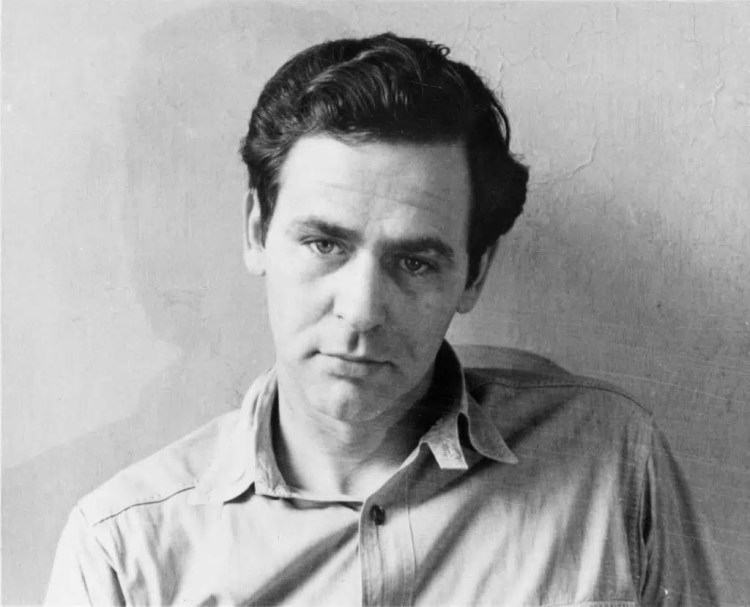
(Photo Credit: Houston Chronicle / Photographer N/A)
James Agee, who wrote most of his criticism during the 1940s, stands among the most important figures in film criticism. Agee’s critical writing serves as an enduring portrait of a time and place but also reflects the adolescent, sensual and impulsive rhetoric of a conflicted man. Criticisms railed against him while he was still alive feel just as potent now; his inconsistencies and tangential prose as stirring and maddening now as they were when they were published.
Within just a few years of his death, Manny Farber took Agee’s reputation to task in the face of the new litter of American critics in a piece called, “Nearer My Agee to Thee”. Farber was Agee’s friend, and the spirit of his takedown was more to tear into Andrew Sarris and Susan Sontag than anything else. Farber’s barbs, infused with wit and backhanded charm, were set up as much as a defence of Agee’s legacy against this new order, as it was a chance to have the playful upper hand against a prematurely lost colleague. Farber, as he exposes Agee’s flaws as a writer, summarily draws a blow against the new critics who have dismissed the old guard of the 1940s. He argues that Agee’s writing for The Nation was “the first important film criticism to show a decided variance between the critic’s words and what actually went on in the film, and without it, there would be no “Sarris-Sontag classifier, who can pack so much authority into a subordinate clause.”
Farber was right about Agee, who was prone to pronouncements, understandings and adorations that were not always present on the screen. Agee’s empathy was at the heart of his appeal but was also at the heart of his flaws. His affection for the disenfranchised and apprehension over figures of authority built towards some of his greatest writing, but he could just as often come across as simplistic and impulsive: he never escaped his youthful candour and the high passions that came with it.
His writing, on a whole, was infused with impossible intimacy. There’s a sense that as soon as the projector was rolling, no matter the film, it was as if Agee was granted passage through the screen and was able to walk right through it — and no matter what he wrote about, it was always from within. It was a reflection not only of his personal hangups and prejudices but the weight of his emotions. Even when panning a film, it was as though Agee was fully immersed within that universe and heartbroken that it didn’t quite live up to his expectations. It should be no surprise that he saw artificial constructs (such as fabricated sets or dramatic musical scores) as an offence, antithetical to his vision of a pure and unburdened cinema.
Agee’s proficiency in writing from within was also granted in his conversational tone. He was more preoccupied with the audience than most any critic I’ve read, but not in the obvious kind of way. Agee saw himself apart of the American audience, something he makes very clear in his first ever column for The Nation when he describes himself as a “would-be-critic.” He prefaces his critical career with that promise and warning, he is not speaking as an expert but as a film lover. He seemed to feel an enormous responsibility towards audiences in general, especially faced with what he felt was the condescension of Hollywood productions towards the intelligence and moral quality of their audiences.
This sense of responsibility means that, even in his highest praise, Agee carefully laid on every possible flaw, ideologically and aesthetically. Take, for example, his rave of The Best Years of Our Lives, which he felt was not only one of the best films of 1946 but among the best American films ever made. His passion for the movie was pulled across longer than average columns for The Nation, with the first half as brutal of a critique as some of the film’s most ardent critics. Agee wrote about the film, “In fact, it would be possible, I don’t doubt, to call the whole picture just one long pious piece of deceit and self-deceit, embarrassed by hot flashes of talent, conscious, truthfulness and dignity,” before adding, “Yet I feel a hundred times more liking and admiration for the film than distaste or disappointment.” He even suggests in part two of his review, almost apologetically, that no one will likely love the film nearly as much as he does.
This is the typical Agee style, as he constantly apologises for falling deeply in love with a film. In another one of his most praised movies, Rome Open City, he sets up a positive review by saying, “I am at once extremely respectful and rather suspicious of it.” This becomes the most common rhetoric in this work, and it’s impossible to say if this comes from a place of self-doubt, a deep sense of moral responsibility or something more obscure. It seems that he wants to please and inform his audience, laying out a film as if it were a product to be used in farming and expose its flaws more carefully than its strengths, because should something go terribly wrong for an audience member, as it might with a tractor, he would feel terribly responsible if he did not give them fair warning.
Arguably, this is the reason why Agee’s work endures so strongly. In spite of his constant dismissal of trifling Hollywood experiments, Agee treats the cinema as something important, though he doesn’t spell it so plainly. He sees cinema’s power in the pat condescension of Hollywood messages, as well as the government’s desire to suppress or censor what he deems as important projects. Later in his critical career, faced with the controversies of Ingrid Bergman’s divorce, the vilification of Charlie Chaplin and Monsieur Verdoux and the trials of the Hollywood Ten, he stands up in defence of freedom and art. In the face of writers who focus solely on aesthetics, he suggests a deeper (if not unconscious) string that runs through the American cinema that might be doing more harm than good.
James Agee has contributed a great wealth to the history of cinema. His prose crackles with sensitivity and humour and invites the reader into an intimate conversation. In fact, the more one disagrees with Agee, the more pleasurable the dialogue becomes. Readers are never far from his mind and he has all the power to make them feel smart and able to play along. He lacks all kinds of condescension toward his audience, though, as he almost spitefully can only find flaws in even his most beloved films. Agee’s work on American cinema, in particular, strikes me as integral to understanding the spirit of the American psyche. Flawed, damaged and full of self-deception, his character reflects the fractured nation built upon promises and broken down by crumbling myths.
Justine Smith (@redroomrantings) lives and writes in Montreal, Quebec. She has a bachelor’s degree in Film Studies and a passionate hunger for all kinds of cinema. Along with writing for Vague Visages, she has written for Vice Canada, Cleo: A Feminist Journal and Little White Lies Magazine.
2 replies »