
Last week, American Crime Story: The People v. O.J. Simpson premiered, looking like nothing else on TV. For one, “From the Ashes of Tragedy” begins with striking documentary footage from the Rodney King riot, making it clear that the racial context of the O.J. case will be an inextricable part of this retelling. Of course, dramatizing the trial without discussing the racial tensions underlying it would border on a whitewashing of history, but, given the personalities that were also part of the story and the high profile actors playing them, it’d be tempting to focus solely on the interpersonal aspects.
Not that “From the Ashes of Tragedy” skimps with the characters, either, or uses them any less to establish the show’s unique style and tone. The episode makes sure to give attention to the many facets of the story, introducing Robert Kardashian, Bob Shapiro, Marcia Clark, and Johnnie Cochran with the spotlight due to each figure. Of these, Clark gets the most human angle, with the frustration over her divorce unavoidably influencing her desire to prosecute O.J., but Cochran’s conflation of stylistic bravado and social justice has a fitting introduction as he looks through his colorful wardrobe. Shapiro is the least convincing of these figures, in large part due to John Travolta’s stiff and bizarre performance, but even that takes on its own meaning in the context of his faded (but not wholly erased) celebrity and the pervasive (if inevitably diminished) cultural status of the Simpson case. Ryan Murphy captures it all with hyperbolic style, using handheld zooms and close-ups nearly throughout the episode to emphasize the urgency of the situation. The Simpson trial was must-see TV in its day, and Murphy’s style in “From the Ashes of Tragedy” introduces American Crime Story as equivalent appointment viewing.
In contrast with the panoramic view of “From the Ashes of Tragedy,” “The Run of His Life” focuses entirely around the LAPD’s infamous chase of O.J. and driver Al Cowlings in a white Ford Bronco. In doing so, the episode still provides a broad pan of the figures directly involved with the case as well as the broader culture of the time, but all through the lens of the hunt for O.J., the focus of the episode grounds Murphy’s hyperactivity, centering American Crime Story’s disparate elements in the way that the Bronco chase once brought viewers together.
This unity is clear from the teaser, which begins with a startling use of an off-screen prayer for Simpson’s well-being. Murphy soon reveals the source of the voice to be a desperate Robert Kardashian, wrought with anxiety over his friend’s well-being. He contrasts starkly with Shapiro, who’s more interested in why O.J. signed his suicide note with a happy face. Like the viewers of American Crime Story, people in a convenience store watch with a lurid fascination, following the story at least in part through footage captured by the paparazzi hounding O.J. and A.C. with a vengeance.
The lawyers eager to prosecute O.J. are no less fascinated, even if their fixation is heavily tinged with disgust. Gil holds a press conference to threaten anyone who aids O.J.’s escape, while Shapiro speaks to reporters to absolve himself of guilt and have Kardashian read O.J.’s suicide note. One of the most fascinating aspects of American Crime Story thus far has been the show’s perspective on the different ways in which media affects points of view, and the parallel of the two press conferences in the first act (and the different viewers of each) pushes this angle. Christopher Darden watches Gil, eager to do what he can to bring O.J. to justice, and Cochran watches Shapiro with disdain. The Kardashian children, on the other hand, are just excited to have their father and name on TV. These figures all have their own agendas, vital to them in their own ways, and “The Run of His Life” encourages a comparison between them without getting too bogged down in equivocation.
O.J., meanwhile, is in a situation all his own. The cops have him cornered, but can they really shoot O.J. Simpson? They won’t, but the matter of whether or not he’ll shoot himself isn’t quite as clear. He wants to see his mother one last time before going into custody, and he won’t yield until he’s able to do so. The rest of the Simpson family watches the chase with a despondent Robert, viewing the scene with a different perspective than everyone else: it’s their Juice they’re watching run from the cops.
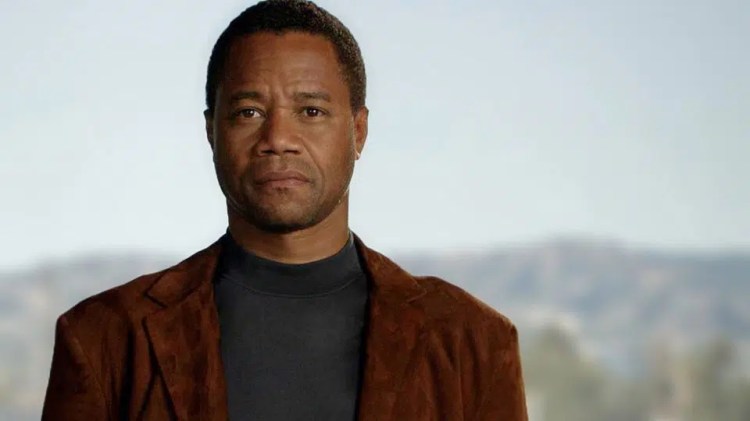
Cuba Gooding, Jr. helps by bringing a remarkable humanity to O.J. throughout these proceedings. As over-the-top and bizarre as the white Bronco chase is, Gooding’s performance emphasizes O.J.’s desperation and encourages sympathy. In the touching phone conversation with Robert, in which they discuss a fond memory of dinner together, the voice of a man pleading with those who love him comes through. In this retelling, there’s no doubt that O.J. has been pushed to his psychological limits, even if he might be the one responsible for his own pain.
Amidst the personal turmoil, the racial context of American Crime Story comes through even stronger in “The Run of His Life,” building on the insinuation of the Rodney King opening of the premiere. Christopher has an ominous conversation with his neighbors, disagreeing with their sympathy for O.J. and foreshadowing the future to come. By contrast, their sympathetic views of O.J. are shared by the onlookers cheering him on, as they explain their anger towards the L.A.P.D.
Still, the socio-political implications of the O.J. case don’t overwhelm the story of the man himself. The emotions of the phone conversation with Robert later get overshadowed by their tearful reunion, during which O.J. collapses out of sheer mental and physical exhaustion. Of course, the biggest challenges facing him are still to come, as he undoubtedly has in mind while the cop car drives him away.
Max Bledstein (@mbled210) is a Montreal-based writer, musician and world-renowned curmudgeon. He writes on all things culture for a variety of fine North American publications. His highly anticipated debut novel will write itself one of these days, he assumes.
Categories: Featured
2 replies »