
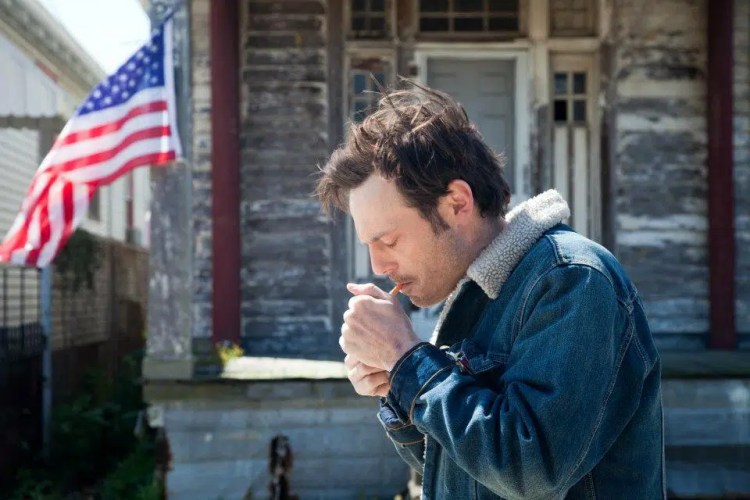
We Failed This Film is a series about underrated films that simply didn’t receive any love upon initial release. For the 13th entry, Dylan Moses Griffin investigates the perils of Andrew Dominik’s Killing Them Softly.
How We Failed It
If you recall, the first film I covered in this column was Andrew Dominik’s 2007 film The Assassination of Jesse James by the Coward Robert Ford. By the time the Australian director announced his followup with 2012’s Killing Them Softly (an adaptation of the George V. Higgins 1974 story Cogan’s Trade), I immediately read the book, and nearly three years ago, I walked into the theater to see Killing Them Softly on opening night. Sadly, the film was received only slightly better than that of Jesse James — Dominik seems to be one of those directors whose films were predestined to find their audiences long after their theatrical debuts.
Set during the 2008 Obama/McCain election, Killing Them Softly kicks off when two criminal low-lifes, Russell (Ben Mendelsohn) and Frankie (Scoot McNair), get hired by a mid-level gangster, Johnny Amato (Vincent Curatola), to knock over a mob-protected card game. That’s an idiotic idea under any circumstance, as the mob will hunt down and kill whoever is responsible. This one is different though, because gangster Markie Trattman (Ray Liotta) runs the game and had previously knocked over one of his own games, only to brag about it later with no punishment. Surely, if another game of his gets held up, the higher-ups will assume he got cocky and punish him. After the robbery, hitman Jackie Cogan (Brad Pitt) enters the scene to find the culprits and determine punishment.

The film was by all means a safer bet than Jesse James, as it only had a $15 million budget and a wide release. Even so, Dominik’s production still bombed during opening weekend, only taking in $6 million. Killing Them Softly would top out domestically at the budget line with $15 million, and foreign markets would only take it up to a $37 million worldwide gross. Once again, another Dominik film had come and gone without much (if any) profit to show for it. One problem the film ran into was that like Jesse James, it was an uncommercial film within a commercial genre. While there are certainly violent and explosive moments, most of Killing Them Softly consists of characters simply talking about their lives and the crumbling nation around them. Dominik used this gangster mold to examine the parallels between criminals and politics, taking a scathing look at what it means to live in modern America.
Killing Them Softly received a fairly split critical reception, with the dividing line seeming to come on how much the critic bought into the sociopolitical undercurrents of the film. On one end, you have writers like Roger Ebert who dismissed the film by inaccurately recounting plot points before capping his review off with “One particular distraction is the comparison drawn between American politics and crime. Only a brief exchange between Jackie and Driver draws the parallel, and it’s so labored that once is more than enough.”

Karina Longworth had much more to say: “I’ve seen Killing Them Softly twice, and while it certainly felt like more of a period piece a few days after Obama’s re-election than it did back in May at Cannes, both times mid-screening I wondered how the movie would play with the sound off. From that opening scene, Dominik has little trouble telling his story visually with depth and potency. But his audio choices are, to use the technical term, absolute shit. As the crooks bop between backroom card games, bus depot drop-offs, and brutal killings, everywhere they go a TV or a radio injects real newscasts and talk radio debates from fall 2008.”
However, Peter Bradshaw admired the comparisons between criminals and politicians: “The movie is adapted by Dominik from novelist George V Higgins’s 1974 thriller Cogan’s Trade, updated to the Bush/Obama handover era of 2008, albeit with some automobiles that seem to belong to that earlier era. It is a time of financial anxiety, which Dominik applies cleverly, if not entirely subtly, to the world of crime. American taxpayers were being asked to bail out banks for the sake of confidence and prestige – and these taxpayers also had to tighten their belts. Here, local wiseguy Markie (Ray Liotta) has to be whacked for robbing some other wiseguys’ poker game: he didn’t do it, but someone has to be seen to get killed for the sake of confidence and prestige. And the hit-men will have to accept a reduced fee in the current economic climate.”

Ty Burr also found intrigue in these comparisons: “By making a film entirely without illusions about the way this country does business — at the top as at the bottom — Killing Them Softly ironically stays true to Cogan’s Trade and Higgins’s cauterizing view of human nature. Let the likes of Steven Spielberg renew our faith in the communal ideals with which we lull ourselves to sleep. This movie’s the anti-Lincoln, and it jeers in your head long after the lights come up.”
Kevin Jagernauth kicked his coverage of the film off with “What is that American promise? It’s a promise that says each of us has the freedom to make of our own lives what we will, but that we also have obligations to treat each other with dignity and respect,” Barack Obama said at the Democratic National Convention in 2008. And that section of the speech opens Andrew Dominik’s seething Killing Them Softly, as he cuts the audio between white noise and the silent black title screen, signifying the blind emptiness of Obama’s statement and the thematic current he’ll be taking for the film. We are not a changed nation. We are not a nation of equals. The government are a bunch of children who need to be led by the hand into any decision making process and Americans at both the top and bottom rungs of the ladder all have their share of the blame to take. Uncompromising and uncommercial, divisive and brave, Killing Them Softly bitterly boils at the state of the nation.”
Why It’s Great

There’s no cinematic entrance quite like Jackie Cogan’s, a character who doesn’t even show up until a third of the way through the film. Johnny Cash’s “The Man Comes Around” plays over shots of Cogan driving into town, the lyrics giving a foreboding hint of his role: “There’s a man going round taking names/And he decides who to free and who to blame/Everybody won’t be treated all the same.” Cogan exits his vehicle, the camera trailing his feet up to the back of his head as he enters the car of “Driver” (Richard Jenkins), a bureaucratic middleman between the bosses and Cogan, and immediately gets to business.
At one point, Cogan tells Driver that he likes to take his victims from a distance, that he likes to “kill them softly.” They beg and they cry if they see him, and that’s just an unnecessary hassle. It’s Cogan’s personal motto, and one that Brad Pitt subtly conveys in each interaction. Jackie Cogan is no doubt one of Pitt’s most understated performances and certainly of his most underrated roles. There’s a lifetime of hard decisions and forced indifference on Pitt’s face, a base level of detachment to those around him. Dominik and Pitt make for a phenomenal director/actor pair, bringing out the best in each other. Pitt’s devotion to Dominik furthers his admirable narrative as an actor who uses his star power to get challenging works off the ground. Neither of Dominik’s films necessarily paid off economically, however both have cemented Pitt in film history, and he thankfully seems to know that’s what counts.
Striking first, the sound design of Killing Them Softly is completely off the chain. Consider the opening moments of the film as Dominik cuts between what sounds like a loud air conditioner with his title cards and an Obama speech, with each shot of Scoot McNairy’s Frankie walking on an abandoned road in a destitute-looking city (the film was shot in New Orleans). The sound displays a dissonance between the inspirational words of Obama’s speech and the harsh realities of Frankie just getting out of jail to discover that it’s not much better on the other side. Later in the film, Markie Trattman gets a beatdown and Dominik heightens the brutality of the moment by letting you hear every bone crack. In the place of a traditional music score, Dominik opts for political speeches playing in the background that hit the same sort of punctuation and emotional clarity as music notes.
Also off the charts, Dominik’s stylistic visuals flourish and run free due to his collaboration with cinematographer Greig Fraser. When Russell shoots heroin, a pullback on a dolly shot repeats itself inconsistently to get in the character’s mind. Just as Russell slips in and out of consciousness, Dominik’s takes the same approach with his framing of Frankie. When one unfortunate mobster gets hit by Cogan later in the film, and it’s done in a hyper, slow-motion sequence to heighten the fact that nobody gets killed softly. There are some engaging one-take sequences on display too, as one features a beatdown for Markie Trattman that denies the viewer a glimpse inside the house. The other appears in the tensely shot card game robbery. Dominik begins with a lengthy tracking shot following the duo into the back room, and he continues to use drawn out takes to let the tensity of the situation sink in. There’s no score, only the ambient sounds of air conditioners and a television.

Similar to his script for Jesse James, Dominik lifts nearly every line of dialogue word for word out of Higgins’ novel. It’s no simple copy and paste job, as he cinematically enriches what was already working. Also similar to Jesse James, Dominik assembles an unbelievable ensemble of character actors who shine. Ray Liotta — already having an iconic place in gangster film history with Goodfellas — sleazes it up as Markie Trattman and produces a sense of authentic tragedy. Of course, nobody can play a scumbag so many different ways like Ben Mendelsohn, and he continues to prove this concept in a hilarious turn as Australian junkie Russell. Incidentally, Scoot McNair crumbles convincingly as Frankie, a walking nervous breakdown. Richard Jenkins wears a quiet frustration as Driver, humanizing the bureaucratic troubles of his job, and James Gandolfini gives one of his most tragic and finest performances as Mickey, a fellow hitman who has lost his nerve and drowns his sorrows in alcohol. His role only amounts to two scenes, but he does heartbreaking work as each drink of alcohol and each story reveals a broken man at the end of his rope. Slaine and Max Casella have some comedic moments, and even Sam Shepard shows up for a quick appearance.

When premiering the film at Cannes, Dominik said “I always feel that crime films are about capitalism, because it’s the one genre where it’s perfectly acceptable for all the characters to be motivated by desire for money only. I always think in some ways the crime film is the most honest American film, because it portrays Americans as I experience them.” Killing Them Softly roots itself in the gangster genre, but underneath, the film functions as a critique on the economic collapse of America and the cruel indifference of trying to get by. A month or so ago, I brought up the idea of the New Americana film movement, one in which films are about the disillusionment of the American Dream and how it doesn’t come by hard work anymore, but constant struggle. Killing Them Softly could fit into that discussion of films. Each character feels the effects of the economic crash to some extent, as even hitmen have to work at discounted recession prices. When Jackie proposes to call in Mickey, Driver insists that they’ll only fly him out if Mickey flies coach. When Jackie leaves a meager dollar tip, another gangster tries to take it, only be to scolded. At one point, Frankie recounts the hassle of going to the probation office to find a job. He can only manage to land one so far away that he would need a car to get there, but he can’t afford a car because he doesn’t have a job. It’s a circular pattern that imprisons him more than the bars of where he did time. Never subtle about its real message, Killing Them Softly conveys an anger and conviction that can’t be dismissed.

The entire point of the film lies in the final lines of dialogue, delivered with a shock that follows you all the way to work. It’s tempting to quote the words, but doing so would spoil the clarity, cold truth and impact of the moment. However, Dominik prefaces the final encounter with an iconic image that captures the spirit of his film. Cogan walks across a street in slow-motion while dozens of fireworks and celebrations go off around him. Obama has just won the election. It’s a new day, hope is a tangible thing for everyone. Cogan remains indifferent to all of this, he’s done his miserable job and going to collect a small payment. This is the America of Killing Them Softly.
Dylan Moses Griffin has been a cinephile for as long as he can remember. His favorite film is Taxi Driver, and he reads the works of Roger Ebert like it’s scripture. If you want, he will talk to you for 30 minutes about the chronologically weird/amazing Fast and Furious franchise.
1 reply »