
Vague Visages’ Omaha review contains minor spoilers. Cole Webley’s 2025 movie features John Magaro, Molly Belle Wright and Wyatt Solis. Check out the VV home page for more film criticism, movie reviews and film essays.
When does a movie stop being a hard-hitting social realist account of life on the margins and start being poverty porn? This was a question that often rattled through my mind while watching Cole Webley’s directorial debut, Omaha — a drama about a father (John Magaro as Dad) and his two children who road trip across the United States. The 2025 Sundance premiere was first conceived by Robert Machoian in 2008 (when the film is set), and to say anything more about the specificities of why that timeframe has been maintained beyond using the financial crash as an easily digestible backdrop would be a spoiler, even if the family’s severe money troubles remain depressingly relevant to a contemporary audience. (For those who don’t mind spoilers, here’s a Nebraska history lesson.)
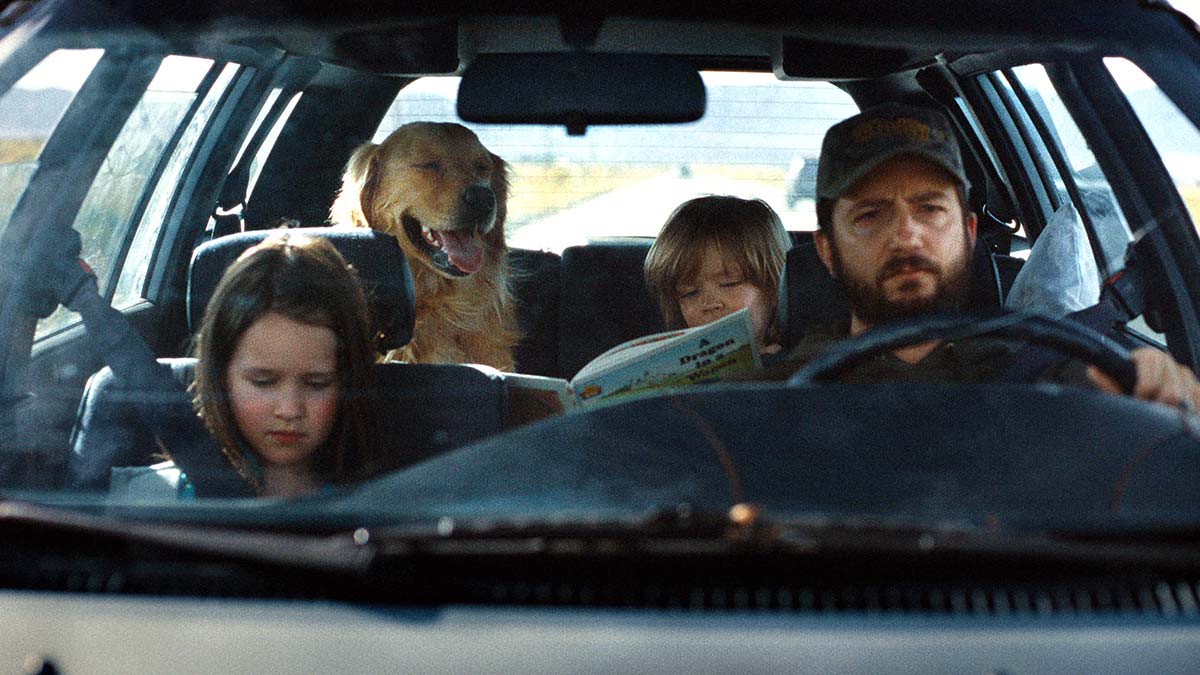
Omaha is at its strongest when focusing on a child’s perspective. The film begins as Magaro’s protagonist tells his children, Ella (Molly Belle Wright) and Charlie (Wyatt Solis), to hastily pack their things, fetch the family dog and get into their car. As Dad attempts to start a faltering engine and get on the road, a policewoman arrives. The conversation she has with the father is held at a distance and purposefully left unclear to the kids, but the foreclosure notice she pins on their door tells the audience everything they need to go. Nebraska is the destination of the family’s road trip, but it’s never clear whether they’ll be able to afford to make it. Dad avoids eating and makes the children share food to ensure they have enough gas money, and he tries to sugar-coat the tough financial decisions by trying to create happy memories along the way. Ella and Charlie don’t know what waits for them in Nebraska, and their dad doesn’t appear to have thought through the seismic impact his plan will have either.
Omaha Review: Related — Review: Chandler Levack’s ‘Mile End Kicks’

Machioan’s screenplay is impressively restrained during Omaha’s first two acts, allowing the audience to fill in the blanks on the family’s situation via contextual clues rather than overly melodramatic monologues. Magaro receives the best dramatic material to work with, but it doesn’t have the same impact as smaller moments when he’s just portraying a struggling dad trying to keep everything together. When the father sings in his car or quietly calculates the cost of a zoo trip, the script feels more realistically drawn out and adds further dimensions to Magaro’s character.
Omaha Review: Related — Review: Rian Johnson’s ‘Wake Up Dead Man: A Knives Out Mystery’
This is largely why Omaha’s final chapter feels dramatically unsatisfying, fully revealing the father’s perspective that had been left open to assumption before. It’s designed to complicate the drama and spark debates about his decisions, even though everything suggests he looks after their interests. However, Omaha succumbs to miserabilism so quickly that it feels unearned. Nothing in the drama could be described as “feel good,” but the filmmakers at least have faith in the audience’s emotional intelligence. Building up towards something that operates like a shocking twist feels like a fatal misunderstanding of what seemingly resonates the most. My biggest concern with Omaha is that the third act turn feels like a calculated rug-pull which transforms a more considered slice-of-life drama into something far more emotionally manipulative.
Omaha Review: Related — Review: Joachim Trier’s ‘Sentimental Value’

Thanks to Magaro (whose excellent collaborations with director Kelly Reichardt have made him the go-to guy to lead a naturalistic slice of Americana) and two exquisite discoveries in the child actors, Omaha is an affecting road trip worth taking. I’m less convinced that the movie remains as assured when it arrives at its final destination, as Webley falls into the poverty porn trap that he managed to avoid up until that point.
Alistair Ryder (@YesitsAlistair) is a film and TV critic based in Manchester, England. By day, he interviews the great and the good of the film world for Zavvi, and by night, he criticizes their work as a regular reviewer at outlets including The Film Stage and Looper. Thank you for reading film criticism, movie reviews and film reviews at Vague Visages.
Omaha Review: Related — Review: Jean-Pierre Dardenne and Luc Dardenne’s ‘The Young Mother’s Home’
You must be logged in to post a comment.