

Chungking Express is split into two distinct yet overlapping stories: the first focuses on Cop 223 played by Takeshi Kaneshiro, and the second focuses on Cop 663 played by Tony Leung. Both officers frequent the same locations (Chungking Mansions) and interact with the same characters whilst never crossing each other’s paths. From the offset, the decision to introduce both central protagonists by their numbers is significant in that it establishes them as but one of many police officers in Hong Kong whose stories the audience could potentially know. Both Cop 223 and Cop 663 take on a subjective significance, as viewers share in their experiences of life in 1990s Hong Kong, with the film bringing one closer and closer into the characters’ interior worlds. For Cop 223, who is recovering from a recent breakup, his perception of time is governed by the date in which his girlfriend left him: April 1st.

Recovering from his recent break up, Cop 223 spends his time between the Midnight Express food stall and his local convenience store where he buys tinned pineapples that expire on May 1st, a month since his breakup. He believes that if he does not get back together with his girlfriend by May 1st then their break up will be finalised. Incidentally, May 1st also happens to be Cop 223’s birthday, a further point of significance for the date that governs his life. As midnight looms and Cop 223 fails to contact his ex-girlfriend, realisation sets in and he consumes all 30 cans of pineapple at once. Heading to a downtown bar to drown his sorrows, he comes across the unnamed woman doing the same. With her blonde wig and sunglasses, she initially ignores Cop 223’s advances before finally entertaining his conversation. Drinking together until closing time, both characters decide to stay in a hotel until morning. While the unnamed woman immediately falls asleep on the hotel bed, Cop 223 orders room service and stays up all night eating and watching late-night television. As the sun rises on May 1st, he takes off her high heels and decides to go for an early morning jog. Running around a sports track in the pouring rain, he unexpectedly receives a message from the unnamed woman on his pager wishing him a happy birthday. Just at this moment, the sequence transitions to a close of the same digital clock now changing from 5:59 am to 6:00 am.
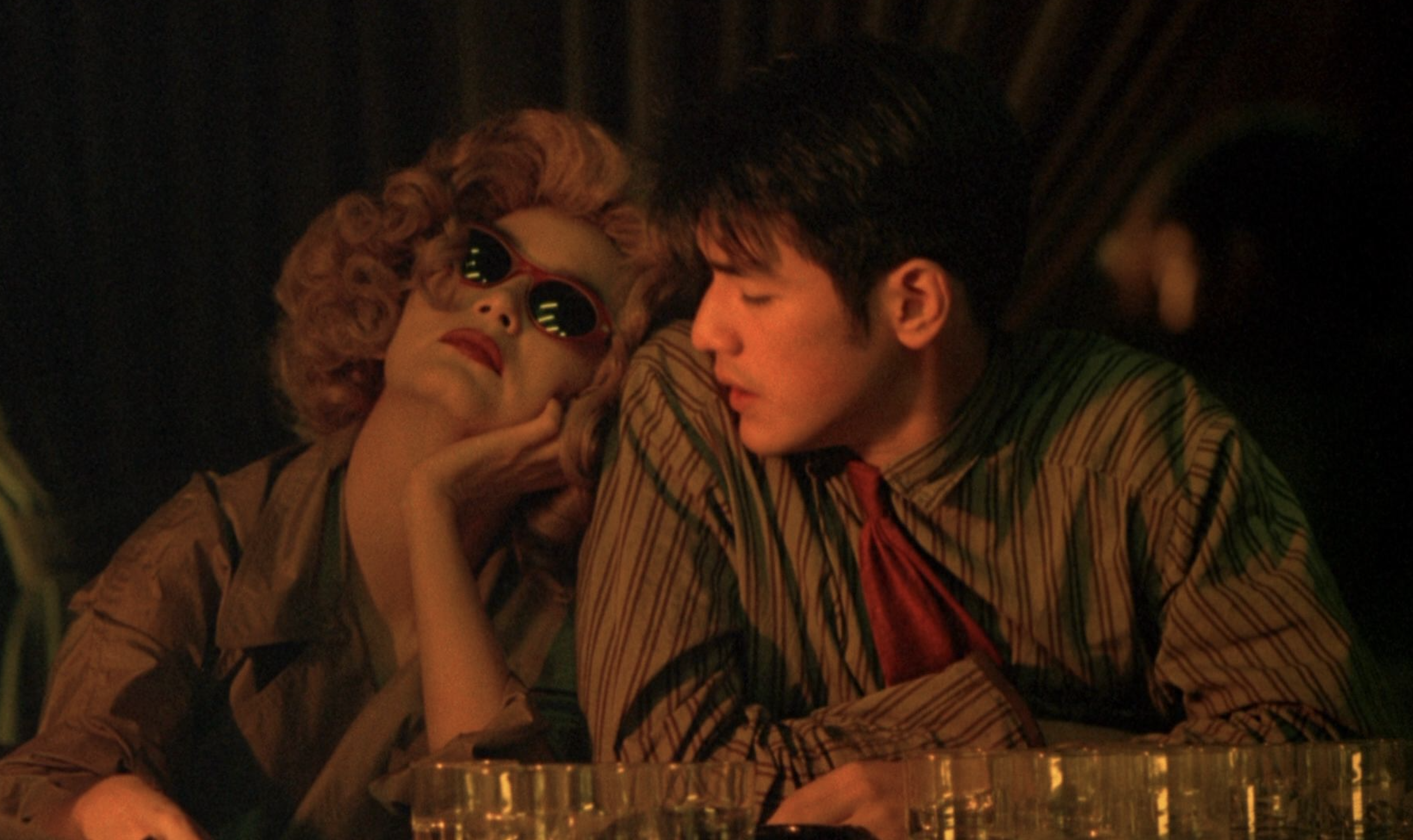 From the initial contact in Chungking Mansions to a fleeting connection, Cop 223 fell in love with the first person to wish him happy birthday on the 1st May. Reminiscing in the rain, his voice over declares:
On May 1, 1994, a woman wishes me happy birthday. Now, I’ll remember her all my life. If memories could be canned, would they also have expiry dates? If so, I hope they last for centuries.
Ending on a freeze frame, Cop 223’s story is eternalised in a manner reminiscent of Antoine Doinel at the end of François Truffaut’s The 400 Blows. Time appears to stand still as the sequence seamlessly transitions to a freeze frame of Cop 223 sat with his hand resting on his chest, a smile upon his face. The memory of his love is captured and canned, frozen in time as a single cinematic image against the backdrop of the city.
Moving onto the second act of the film — the story of Cop 663 — the opening sequence begins with a fade transition from a freeze frame of Cop 223 bumping into Faye at Midnight Express, a girl his voice-over declares will shortly fall in love with another man. This man is Cop 663, and in many ways his story is similar to that of Cop 223. Both men are recovering from tough break ups and spend their time frequenting the food stalls and stores in Chungking Mansions. However, unlike Cop 223 who is rarely seen on the job, Cop 663 is frequently on patrol and visits Midnight Express on his break and after work. One day after ordering a coffee, he informs the stall owner that his flight attendant girlfriend has left him to try new things. Faye, who is cleaning appliances in the background, suddenly perks her head and listens in on their conversation. Weeks later, Cop 663’s ex-girlfriend stops by Midnight Express to hand him a letter containing the keys to his apartment, not realising that is in fact his day off. The owner promises to give him the letter next time he sees him, but not before opening it and passing it around for all the workers to see. When Cop 663 finally returns, Faye informs him that his ex-girlfriend stopped by and left him a letter. Uninterested, he finishes his coffee and tells Faye to keep hold of it for him. It is during this interaction at Midnight Express that the two characters share their first moment of intimacy. With every other worker out on break, Cop 663 slowly drinks his coffee whilst Faye slumps onthe counter with her arms crossed. Captured in long shot, the frame rate is once again lowered in order to foreground the passing of time whilst simultaneously slowing it down. As the jittery motion of passers-by invade the frame, Cop 663 and Faye remain static, their bodies moving briefly with each passing image.

Both stories present time as unique to each of its characters. For Cop 223, time is something that must be captured and cherished as memories, whereas for Cop 663, time is something that must be valued and relished in the moment. In Chungking Express, both stories negotiate time and the modern condition in a distinctly cinematic fashion, and present a valuable lesson in reflection and observation. By dissecting and re-representing time through the cinematic apparatus, Chungking Express demonstrates that modern life is not unequivocally devoid of romanticism. There exists a magic in the everyday that film is capable of capturing like no other medium. Life is captured in every frame and canned for all eternity.
Harrison Hughes (@h_hughes) is a recent film master’s graduate from King’s College London. His interests include film and phenomenology, surrealism and haptic cinema.
Categories: 2019 Film Essays, Featured, Film Essays
You must be logged in to post a comment.