

Walking out of Babak Anvari’s Under the Shadow, I turned to my friends to exclaim how terrified I had been. A fellow patron heard me and laughed. “It was scary, but it wasn’t horror. It was a political film,” he responded, and he was right. The opening shots of Under the Shadow are images of historical exposition: the Iraq-Iran War, one of the longest battles in recent memory fought with modern weaponry, began in 1980 and ended in 1988. Anvari cuts to real footage of the war — shootings, bombings, soldiers storming the battlefield and so on.
Some of the images have a rough, unclear quality to them, as if taken by an amateur cameraman, perhaps a citizen with a cellphone running for their life. There’s a fear and anxiety present in these images that’s further heightened by the way Anvari quickly cuts between each one, feelings which he will then transplant into the rest of the film’s fictional narrative.
Shideh (Narges Rashidi) is an ex-revolutionary, a woman who attempts to go back to university in order to become a doctor. Despite her protests for how everyone participated in the Iranian Revolution, she is refused on the basis of her past political actions. She returns home to her young daughter, Dorsa (Avin Manshadi), and her husband, Iraj (Bobby Naderi), a practicing doctor. Tensions begin to rise when Iraj doesn’t understand Shideh’s anger over being refused. He tells her that her place is home taking care of Dorsa.
Shideh becomes angered by the hypocrisy of Iraj’s words. Even then, however, she is not allowed even that. Iraj receives a draft letter and subsequently enters the middle of the warzone. Before he leaves, the man pleads with Shideh to take Dorsa and leave Tehran because of the encroaching battles. Shideh refuses.
It doesn’t take too long for the war to literally arrive on the doorstep. A missile bursts through the roof but doesn’t explode. Shideh rushes to save her neighbor, but the man dies of cardiac arrest. Later, Shideh is told by the neighbor’s daughter that the impact of the missile wasn’t what shocked him; it was something else, an invisible force. Shideh can only laugh at the woman’s superstitious belief, but she has to acknowledge the increasing presence of such rumors. Dorsa passes on a warning from a fellow playmate: Djinns (ghosts) ride on the winds of anxiety and fear.
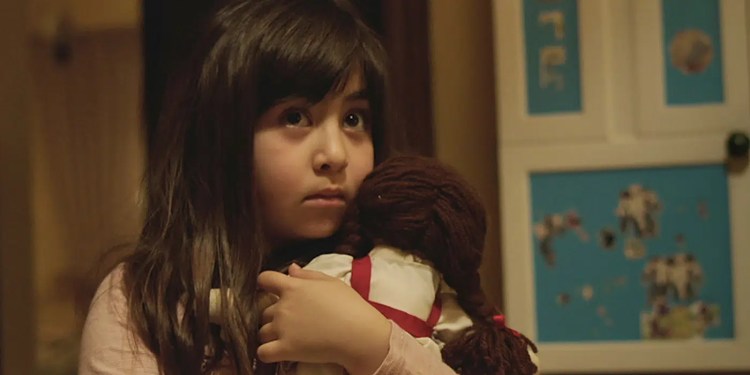
And so, it is through this missile (and the Djinn) that Anvari uses the conventions of the horror genre to get at the underlying political elements of Under the Shadow. The arrival of the Djinn represents the fear and anxiety of the war. And just as the Djinn begins to haunt the apartment complex, so too does the war. Both the Djinn and the war become inextricably linked, with Anvari successfully executing the cinematic metaphor.
As the film continues, the Djinn grows increasingly more powerful and threatening, and the war gets worse, evidenced by the increased frequency in which the air raid sirens go off. Shideh’s neighbors begin to evacuate, one by one, until only she and her daughter are left. At this point, Anvari’s excellent play with horror conventions comes into the fore.

The supernatural aspect of the Djinn allows Anvari certain tricks — specifically, the blending of dreams and reality. At the same time, however, it is important to note that Anvari’s horror stylings don’t simply exist on their own. With Under the Shadows, Anvari combines the political and the horrific.
For example, there’s a scene where Shideh awakens to find that the taping on the window has slightly peeled off. For those unaware, tape is placed over windows in order to prevent glass shards from flying (in the case of explosions). Anvari lingers on the window, and the simple image of a sole piece of tape, breezing in the wind, becomes extremely haunting. Anvari then cuts to a shot of Shideh staring at the window, slightly confused and slightly scared. There’s an implicit understanding, for both Shideh and the audience, that the tape didn’t merely come off on its own. And so, the ensuing moments of Shideh leaving her bed to fix the tape become all the more terrifying.
There’s more psychological terror when the Djinn attacks Shideh, whether she’s awake or sleeping. If horror films were mapped out on a flowchart, there’d be a noticeable amount of moments of reprieve — times where both characters and audience members alike may catch a moment of peace from the antagonist. These moments of reprieve don’t necessarily exist in Under the Shadow (due to the nature of the Djinn), and this is reflected in Shideh’s unrest.

Whether Shideh is awake or asleep, the entire apartment becomes a place of fear and anxiety, but that’s not just because of the Djinn — it’s the reality of the ongoing war. Anvari’s mix of the war experience and horror genre runs deeper than a Djinn removing tape from a window. It’s about the constant atmosphere of inescapable dread and restlessness. Consequently, Anvari creates a sense of cultural understanding for his audience.
Of course, the audience’s experience with Under the Shadow is transitory. The lights come back on, you leave the theater and continue on with your life, free from the fictitious horror. With the conclusion, Anvari touches on this idea, which further highlights the inescapability of the war for Iranian citizens. It’s a powerful, emotionally charged moment, as Anvari proves himself capable of creating a film with style, substance and importance.
Anthony Dominguez (@Dmngzzz) is an English/Film graduate from SUNY at Albany. His interests in cinema lie in independent and foreign films, as these works are less likely to be covered and consequently more likely to be forgotten. Anthony wishes to preserve their importance through his writing so others may discover these films.
Categories: 2016 Film Essays, Featured, Film Essays
1 reply »