
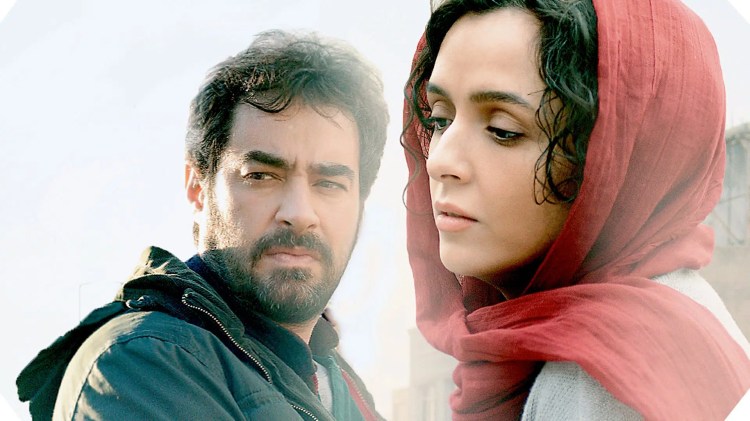
Iranian master Asghar Farhadi’s latest film, The Salesman, begins with the closest thing to an action set piece in the director’s entire filmography. Opening in a rumbling apartment, Emad (Shabab Hosseini) and Rana (Taraneh Alidoosti) scramble to pick up anything they can carry before leaving their home. Giant cracks are appearing in the walls, and it seems like they’re in the middle of national disaster. The camera frantically follows as other tenants are rushing out of their own homes, and Emad is called by a neighbor to help her young son, who’s still groggy in bed. As it turns out, the problem is far more organic — a bulldozer in the adjacent lot has damaged the integrity of the building — but the stage has been set for a Farhadi film that’s more rooted in the physical than the metaphysical.
Akin to much of the director’s work ranging from Fireworks Wednesday to A Separation, The Salesman falls into Farhadi’s concerns of the overlap between the personal and political and the private and intimate. His past films have shown how a single choice could precede a narrative of misconceptions, but while The Salesman is again built on a foundational misunderstanding, its plot machinations are determined by explicit action at every turn. At their most fluid, the narratives of past Farhadi films move like a series of falling dominoes, but The Salesman feels notable in that it’s motivated by direct actions — decisions that are both righteous and self-centered.

After abandoning their home at the beginning of the film, Emad and Rana begin looking for a new place to live, but they have no luck until a mutual friend, Babak (Babak Karimi), tells them that his renter was evicted, and that they are welcome to move in until they find a more permanent place. It’s not an ideal situation. Nearly all of the rooms of the house still have leftover belongings from the previous renter, including a child’s room, which is eerily filled with discarded toys. But Emad and Rana need somewhere to live. By day, Emad is teaching, and at night, Emad and Rana are both starring in a rendition of Arthur Miller’s “Death of a Salesman.”
All of this is just set-up for the main ethical inquiry of The Salesman. The nature of the event is best left vague as it’s deeply wrapped up in Iranian cultural mores, wounded interpersonal relationships and twists of fate, but it’s enough to say that it involves Rana being traumatized while Emad is out. But unlike most Farhadi films, the subsequent narrative is less about sussing out the effects of that event on their relationship than specifically how Emad reacts to the crime and attempts to compensate for his failure to be there.

That’s not to say there aren’t immediate repercussions as well as Rana grows more anxious with each passing day. She doesn’t get enough time on screen, but Alidoosti’s performance is painfully believable in her subtle mounting fear towards her own apartment and the realization of her own fragility. A scene where she refuses to use the bathroom (where the event happened) feels deeply moving exactly because it doesn’t require a theatrical monologue about her grief.
There’s an unspoken tension as well between the film’s intention and its form here as well. Farhadi’s films have sometimes been tricky for me as a Western viewer, as it’s difficult to know what’s considered conventional social perception and what’s considered political commentary. But there’s an uneasiness in The Salesman being about the dangers of co-opting someone’s emotional distress while also placing its central perspective with Emad. That may in fact be the purpose, but there’s still a question about whether Rana’s perspective should be more prominent in the film, even as Emad’s perspective involves far more incident.

Instead, Rana’s rehabilitation period is kept to a short part of the running time while the camera focuses on Emad as he plays detective, and follows the clues around the event like a phone that was left in the apartment and a mysterious truck that’s parked nearby. For a long time, these scenes are just extensions of Farhadi’s patent skills of observation, but they’re worth discussing for their different visual language.
There’s still a uniform rigor to Farhadi and cinematographer Hossein Jafarian’s (About Elly, Fireworks Wednesday) compositions, but there’s also a more unsettled movement to the angles and shot choices. It never reaches the point of handheld camera work, but there’s a number of scenes where the camera moves in streaks, foreshadowing the thriller leanings of the last act. And when Farhadi folds together the internal narrative of the film and the on-stage conflict of Death of A Salesman, there’s a dreaminess and acknowledgement of artificiality that feels distinctly more visually playful.

This all adds up to a film that’s inordinately crowded for a director who prefers streamlined narratives — and that’s not even decoding any of the larger views of purity or patriarchal responsibility that come into play. But while the film suffers from its attempt to manage so many elements, it also feels profoundly different than the rest of the director’s work in the ways it feels so active rather than emergent. Similarly, the aspect of the play brings a different feel to the film.
Sometimes it’s as obvious as Emad and Rana playing out their domestic distress too realistically on stage. But by the end, the play and context of the film intertwine completely to show that even closure is something that’s always in our control.
Michael Snydel (@snydel) is a writer based in Chicago who has been obsessed with film and film reviews since he could read. For the first decade of his life, he could bizarrely tell you the rating of nearly film that came out. He now tries to devote his time to less pointless things. He writes regularly for The Film Stage and has written for Paste Magazine and The Dissolve (RIP).
Categories: 2016 Film Reviews, Featured, Film Reviews
You must be logged in to post a comment.