
We Failed This Film is a series about underrated films that simply didn’t receive the love they deserved upon initial release. For the 23rd entry, Dylan Moses Griffin explores the oil boom of North Dakota and Jesse Moss’ documentary ‘The Overnighters.’
How We Failed It
I’ve often written about the New Americana film movement, or independent American films that are about the struggles of modern America. They represent a deconstruction of the American dream, showing how crushing it actually is. Primarily, I’ve written about fictional narrative films. Yet, an unknown 2014 documentary by Jesse Moss deals with all the aspects of the New America film movement so intimately that it stands as a prime figure. The Overnighters offers a devastating look at what it means to live in modern America by investigating the American Dream in ways both macro and micro.
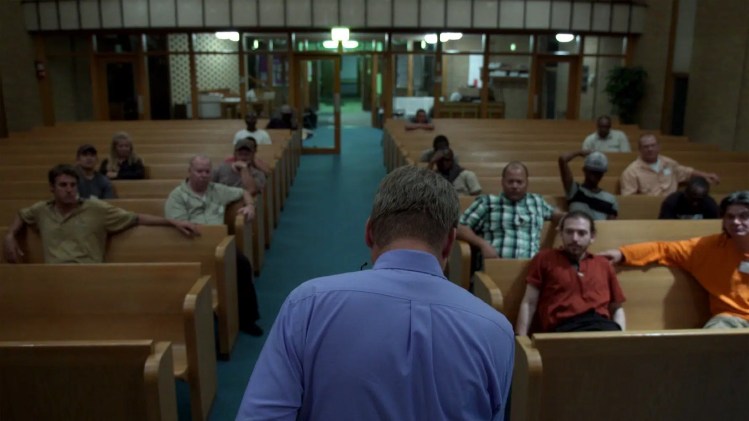
Following a boom in the economy due to oil fracking, tens of thousands of people come to North Dakota in search of jobs. It’s the American Dream. Go west, young man. Many of them arrive in Williston, Nork Dakota with nothing but the clothes on their backs and nowhere to sleep. Lutheran pastor Jay Reinke has set up an “overnighters” program allowing these men to stay inside his church or in their cars on the church lot while they look for work. Reinke faces opposition from his congregation, especially after the reveal of checkered pasts.

Critics did their part in supporting Moss’ film. Scott Tobias wrote “There are an abundance of great angles to Moss’ story, which epitomizes both the working-class desperation of the recession and the insularity of small-town America, which does not want your tired, your poor, and your huddled masses, even if they’re Americans, too. It’s an immigration tale about people who live within the same borders but are not given the same rights and courtesies. And Moss has a riveting subject in Reinke, who keeps on fighting an uphill battle and makes mistakes that speak as much to his extraordinary generosity as to his naiveté, arrogance, and miscalculation. Moss had the instincts to know this situation was a potential powder keg, but he couldn’t have known if it would blow, much less when or how.”
Godfrey Cheshire also praised the film: “While The Overnighters has the feel of an epic, given what an expansive slice of America’s current economic experience it ponders, it’s also a very intimate one. Moss stayed with the Overnighters himself (partly because he couldn’t afford Williston’s inflated hotel prices) and was granted an extraordinary degree of access to the Reinke family. This makes for a film as rich emotionally as it is enlightening regarding the challenges facing people struggling to make a living.”
Drafthouse released the film and did a fine job with their limited resources. Even so, it was just a 23-theater release. The Overnighters only grossed $110 thousand, which is actually a great return given the number of theaters, but the film was never designed to make money — most documentaries aren’t. We failed this film due to the limited visibility during Oscar season. Yes, the Academy Awards are by no means a reliable indicator of greatness and cultural longevity, but somehow they still matter in the overall discussion of film. When awards season came around, The Overnighters did not receive a nomination. And so, the Academy failed to help recognize the most important American documentary film since Hoop Dreams (another seminal work that they ignored).
Why It’s Great

The Overnighters is an unflinching work of New Americana filmmaking and an examination of how the American Dream is nothing but a dream. You work hard and break a sweat, but it’s never enough. The American Dream only comes, if it comes at all, through constant struggle and suffering. It’s so rare that we see the honesty and humanity, even in a documentary, of this magnitude. If The Overnighters was written as a fictional film, audiences just never would believe it. They would never buy into the drama or the twists and turns.
It would be difficult to write a character like Jay Reinke into a script, as his intricacies and flaws would seem unbelievable presented as fiction. He’s at opposition with his congregation, and his whole town, as everybody wants the overnighters to leave. Reinke sees this fear as simple xenophobia that he hopes to alleviate through love and understanding. He’s right to a certain extent, but he’s also equally wrong. There has been an uptick in crime and the number of sex offenders living in the town. Throughout the film, one may feel conflicted about Reinke’s methods, which makes the film so fascinating. One can’t help but admire and hope for Reinke’s crusade of humility and brotherhood to succeed, even when he goes about it in so many wrong ways. He has so much love and support to give, and he gives it honestly. He is trying to do the right thing and help people, yet he ends up blowing his life and reputation due to his combination of naivety and obliviousness. At one point, he accurately sums himself up by remarking, “I don’t say no very well, so it’s easier to say yes and live with the consequences.” A reporter confronts Reinke about the several sex offenders living in the church, including one living in his home. Reinke keeps on walking, evading the questions and ignoring the reporter before sprinting away. He’s so tragically and humanly flawed in his quest to do the right thing… Shakespeare couldn’t have come up with this guy.
Moss’ film is a work of profound, aching empathy. Each of the men in this film represents the struggle of making a living. Alan Mezo was in prison for 16 years, and now he’s helping the pastor as his right hand man in taking care of the overnighters. By the end of the film, he’s denounced Reinke for what he sees as hypocrisy on the pastor’s part. Keith Graves, a documented sex offender due to his relationship with 16-year-old girlfriend when he was 18, finds a job as a truck driver and stays in Reinke’s home — yes, the family knows about his past and they’re okay with it. By the end, Graves too has denounced Reinke as a hypocrite. In both cases, what’s difficult is how the men act, and there’s never a clear dichotomy. Michael Batten lands a good job and is able to send money back to his family, but he eventually has to go back home in order to keep his family from leaving. Keegan Edwards is a tragic figure, perhaps representing the failures of the American Dream. He’s a young teenager (with a baby and a girlfriend back home in Wisconsin) who starts to find success in Williston. He gets promoted quickly in the oil fields and brings his family out a few times. Then, because good things cannot happen to those who work hard, he gets in a car accident and fractures a vertebra in his neck. His hopes of working are done, and he must find a new way to chase his American Dream. He’s a heartbreaking figure, personifying the endless suffering that comes in trying to make enough just to live.

Even in a story so dramatic and heart wrenching, there are still moments of human irony that would also seem like slapstick in a comedy. When Reinke goes to retrieve an RV, he finds that Alan gave him the wrong keys, so as he sits there trying to get a hold of him, a woman comes out with a rifle to scare him off her property. She also comes at Moss with a broom. If the situation wasn’t so immediate and intimate, it would be hilarious.
It’s impossible to talk about The Overnighters in depth without noting its incredible and shocking ending. So, here is your spoiler alert. In the final scene, Reinke admits to his wife that he has had same-sex relations. He doesn’t even say specifically what he’s done, he just says that he’s been blackmailed by a guy. Jay’s wife breaks down, and it’s one of the most heart-wrenching moments put on camera. How lucky was Moss to stumble upon a story and characters so dramatic and universal? How lucky was he to have all this access?
The ending is pure “truth is stranger than fiction” poetry. Jay lost his job, he’s lost his family. All he has is a car and the clothes on his back. Now his entire life is defined by one action, just like so many of the men that he took in. Jay has no prospects but the oil fields, just like the overnighters. A title card informs viewers that he’s looking for work in the oil fields, and in one of the greatest single shots in recent history, Reinke stands in the foreground with the camera looking over his shoulder, as the oil fields in the distance reveal the amplifying sounds of industry. This is modern America.
Dylan Moses Griffin (@DMosesGriffin) has been a cinephile for as long as he can remember. His favorite film is Taxi Driver, and he reads the works of Roger Ebert like it’s scripture. If you want, he will talk to you for 30 minutes about the chronologically weird/amazing Fast and Furious franchise.
The Oscars could have given the film a boost in prestige and general awareness of its compelling subject matter. It is rather deplorable that we are brain washed to yield our attention to what glitzy Hollywood and the Oscars anoint as desirable film subject matter. Similarly we yield our good common sense to the false promises of a Billionaire politician who cons people into believing he feels their pain and will bring back the American Dream of greatness. What is needed is a profound restructuring of societies so that all have equal access to the necessities of LIFE. The elite have captured most of the resources. It is time to redistribute the resources so all can live in dignity.