

We Failed This Film is a series about various films that simply didn’t get the love that they deserved upon initial release. For the seventh entry, we’ll be taking a look at Matt Reeves’ much maligned but masterful 2010 film Let Me In, a remake of the 2008 Swedish film Let the Right One In.
How We Failed It
Last year, Matt Reeves achieved a rare balance of critical and commercial success with his spectacular Dawn of the Planet of the Apes. Just a few years prior, Reeves was experiencing the opposite effect when he released the 2010 horror film Let Me In. His previous work had been Cloverfield, the found-footage monster flick that raked in a monstrous $80 million domestic return and a $170 million worldwide return off a $25 million budget. After the high box office receipts of Cloverfield, Reeves began to take meetings with Hollywood. Strangely, and thankfully, he chose a risky and intimate passion project with his badly received yet brilliant Let Me In, a remake of the 2008 Tomas Alfredson Swedish film Let the Right One In, which itself was adapted from the novel by John Ajvide Lindqvist.
Let Me In follows lonely and bullied boy Owen (Kodi-Smit McPhee), who befriends his mysterious next-door neighbor Abby (Chloë Grace Moretz) after she moves in with her father (Richard Jenkins) — or maybe not her father. As their relationship progresses, Owen finds out Abby is a vampire while a policeman (Elias Koteas) investigates a string of murders the girl and her father are responsible for.
The film, budgeted at $20 million, opened to a sad $5 million in its opening weekend and ended up capping out domestically at just $12 million despite having a fairly wide release of just over 2,000 theaters. Foreign markets matched the $12 million, but that only put it at $24 million total. Nobody was going to call that a box-office win.
Let Me In had a polarizing effect on critics, the deciding factor seeming to be on how much Reeves owed or didn’t owe to the original. Some praised it, such as Roger Ebert writing “The film is remarkably similar in tone and approach to Let the Right One In, and it is clear that the American writer-director, Matt Reeves, has admiration for the Swedish writer-director, John Ajvide Lindqvist, who made the original. Reeves understands what made the first film so eerie and effective, and here the same things work again.” He also wrote that “Those hoping to see a ‘vampire movie’ will be surprised by a good film.” (Note: Lindqvist wrote the novel and screenplay, however the director was Tomas Alfredson.)
A.O. Scott wrote “The story holds a few surprises, but what makes Let Me In so eerily fascinating is the mood it creates. It is at once artful and unpretentious, more interested in intimacy and implication than in easy scares or slick effects.” It also couldn’t have hurt that the film was afforded a Stephen King pull-quote for posters that read “The best American horror film in the last 20 years.”
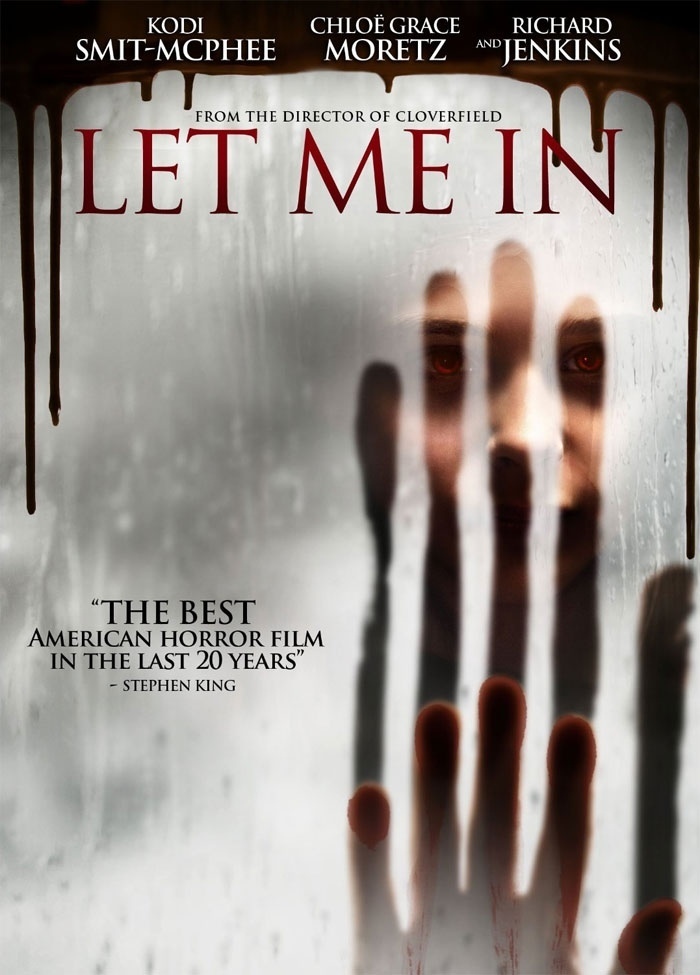
Mark Kermode ripped into Let Me In, however, saying “The thing that’s really annoying about it is whenever it works, it works because it’s almost directly mimicking the original in a way that suggests that the people who made it understood the original well enough to know why it is they shouldn’t have remade it in the first place.” Kermode would go on to elaborate that “Let the Right One In is a film about kids that happens to feature vampires, whereas Let Me In is a film about vampires that happens to feature kids.”
It didn’t help that the trailers marketed a film that seemed only concerned with generic jump scares, and while Let Me In isn’t without its thrills, it’s a far more nuanced and emotional type of horror film that was never advertised. It’s easy to see why the studio went this route, as the Twilight films were raking in money and an arms race was on for the next vampire hit. This was a wrong move as Let Me In is a film interested in intimacy rather than sexuality like the Twilight films were. People were already going to be negative towards an American remake of a foreign film, especially an acclaimed one like Let the Right One, and the only thing they were seeing was something that looked insultingly generic. In the sentiment of Kermode, they were being sold a vampire film that featured kids rather than a film about kids that happened to have vampires.
That brings us to perhaps the biggest reason why Let Me In never took off — our knee-jerk reaction as cinephiles is to reject an American remake of a foreign film rather than giving it a fair chance to stand on its own. It’s understandable, and I’ve been a victim of the rage before too. We’ve received so many terrible ones over the years like The Uninvited (a remake of A Tale of Two Sisters) and Quarantine (a remake of Rec.) that we sometimes forget about masterpieces like The Departed (a remake of the Infernal Affairs trilogy).
Let Me In is not only a rare example of an American remake that is just as good as the original, but I’ll argue that it’s actually the even rarer example of an American remake that is better than its foreign predecessor. Not to be indelicate to Let the Right One In (it’s worth a watch if you haven’t seen it), but Let Me In has far more subtlety, nuance, emotion and — dare I say — originality to it.
Why It’s Great
Let Me In is a type of horror film that doesn’t get made by studios anymore. Ever since Paranormal Activity shot Blumhouse to the moon, the horror genre in the studio system has been one of low budgets — low risk, high reward. That’s not to say there haven’t been great films made in that model, but when something gets amplified, another thing gets amputated. Higher budget horror films have seen a sharp decrease over the past five years, and the only movie to break the mold in wide release and make a killing this decade has been The Conjuring, which racked up a massive $318 million worldwide return with a $20 million budget (the same budget as Let Me In). Hollywood only makes the type of movies that have repeated and consistent success, so even despite The Conjuring, studios are still timid to spend past $10 million on a horror film (this October’s Crimson Peak being a rare exception). When Let Me In failed at the box office, it marked a sharp turn in attitude towards a horror film that had a higher budget and wasn’t made just to scare you.
The film has an eerie, understated tone to it. Each shot by cinematographer Greig Fraser is coated with dread, and both he and Reeves seep their shots in diluted light and darkness, creating the feeling of isolation in conjunction with their outsider protagonist. Their images are seeking warmth and intimacy just as Owen and Abby are. Reeves directs most of the film in a still and calm manner, keeping his camera steady on his characters to let their emotions do the storytelling. When his direction does get flashy, it feels reminiscent of Hitchcock at his best. There are even nods to Rear Window when Owen spies on his neighbors. Consider the scene when Jenkins’ character tries unsuccessfully to kill a teenager in the back of a car and ends up crashing the vehicle. The camera stays in the car as it tumbles down the hill, creating an exhilarating and tense effect that’s technically admirable as well. Consider also the masterful pacing and editing of the scene in which the policeman enters Abby’s apartment with Owen still in it.

The most iconic scene from Let the Right One In comes at the end, when Abby (Eli in the original) returns to rescue Owen (Oskar) from drowning in a pool (courtesy of some bullies). The shot stays level with Oskar’s face in the foreground (underwater), while carnage happens all around him. A kid gets dragged through the water, and blood pours down all in one take. It’s a wonderful shot. Reeves begins his sequence the same way, but then switches up the framing between different and equally tense angles to heighten the disorienting nature of the scene. He still keeps the camera focused on Owen while creating an effect that is just as memorable as the original. Reeves pays tribute to Let the Right One In, then makes the scene his own and just as iconic — if not more.
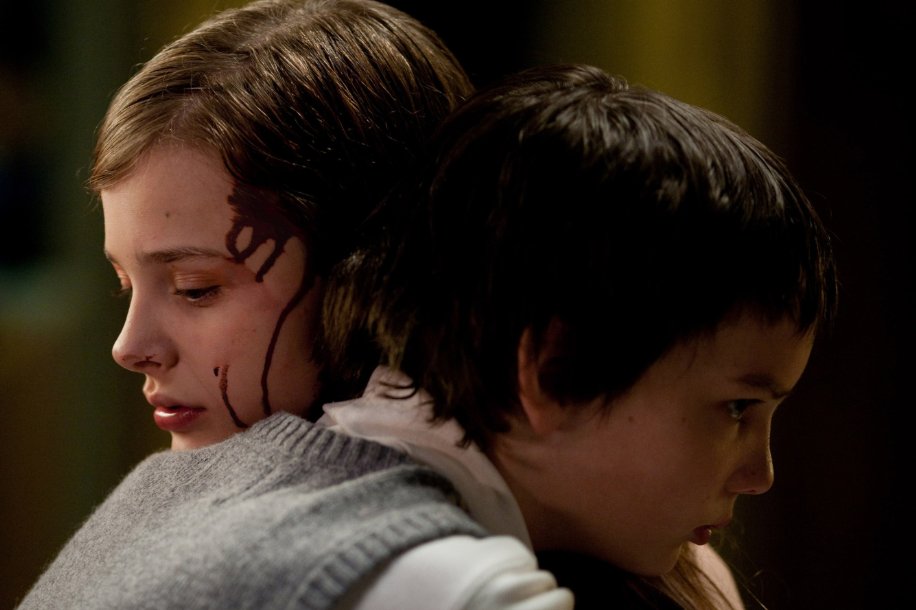
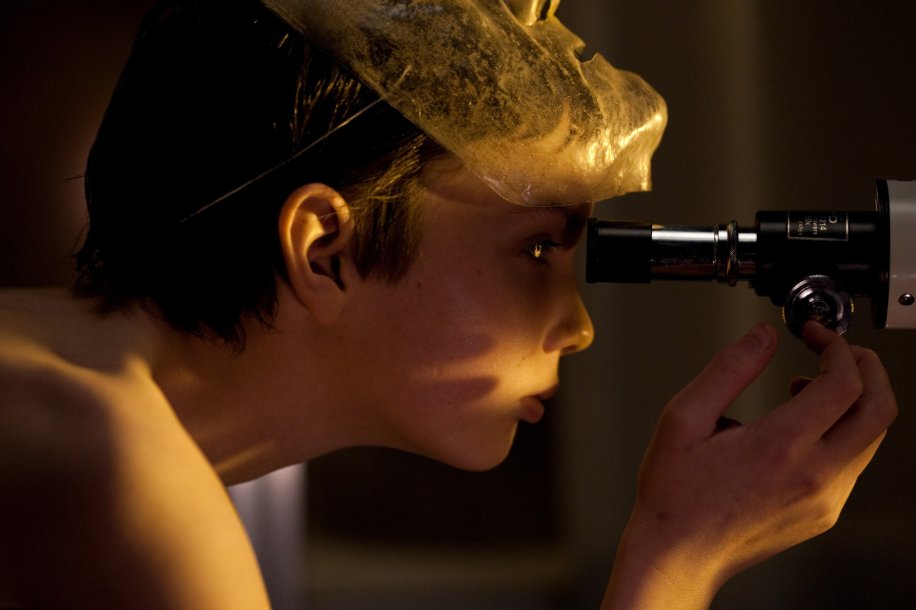
Kodi Smit-McPhee is incredible in the role of Owen. There’s a growing voyeurism inside him that is displayed through his curiousity. He spies on his neighbors through a telescope, sometimes innocently, sometimes not so innocently. There’s a capacity for violence that’s growing inside Owen as he continues to be tormented at school by bullies — he eyes knives with fascination and acts out fantasies of threatening and killing his bullies in his room. Smit-McPhee is able to convey all these things with childlike innocence, just on the cusp of puberty and growing up. Chloë Grace Moretz has an innocent quality as well, but she can grasp the fact that her character has been alive for decades. She’s an old soul but still stuck in an emotional and physical state of a 12-year-old. With how long Abby has been alive, and how she’s stayed alive, she’s grown weary and far past withdrawn at this point. The chemistry between Smit-McPhee and Moretz is tender; Abby and Owen are outsiders looking for understanding and have a shot of finding it in each other.

Richard Jenkins has a weariness to him. Thomas has been killing for years in order to feed his sister, but it’s all finally starting to break him. He tells her that maybe he’s getting sloppy on purpose, that maybe he wants to get caught. There’s a tender scene between the two as the woman comforts Thomas before he goes out to kill for her, a hand to face shot demonstrating their deep connection. Elias Koteas takes the stereotypical character of the police detective and makes his investigation seem personal. He’s a dogged and determined man on the case, but you completely buy into him. There’s a tired nature in how he handles his investigation, as he seems to be up against something that he can’t overcome. He thinks that a satanic cult is responsible, and the feeling feeds into his own religious determinations in the case.
Owen’s parents are going through a divorce, and Reeves captures the isolated feeling of such an experience for a child. You never get a clear look at his mother’s face — she’s always just off camera or obscured in the framing — and the only time his absent father appears is through the phone. They, and other adults in the film, are tertiary presences and referred to in the script by their professions/titles (Mom, Dad). Richard Jenkins’ character is referred to as “The Father” in the script, and then there’s Elias Koteas’ “Policeman.” We’re getting this story through a child’s eyes, and Reeves subtly reinforces that by referring to the adults through signifiers of status.

What’s curious is that Reeves also made the film a period piece, setting the film in 1983 Los Alamos, New Mexico. There are a few nods to the era, but nothing terribly overt. The friendship between Owen and Abby is started when the boy lends his Rubik’s cube, and Owen has a taste for Now and Later candies that plays a recurring theme in their relationship.
The score by Michael Giacchino is among his greatest work, and it will likely remain there when all is said and done. It’s perhaps the greatest horror film score of the 21st century, only Jeff Grace’s score for The House of the Devil deserves to be in the discussion too, and Death Waltz or Mondo would do well to put out a vinyl release. There’s an emotional melody that Giacchino returns to during Abby and Owen’s interactions that evokes connection, warmth and hope. Conversely, his scoring of the moments of tension and horror revolves around an iconic repetition and growth of four notes. It’s greatest use comes in the scene when the policeman comes into Abby’s apartment while Owen is in there, Giacchino and Reeves milking every ounce of unbearable tension that they can with Stan Salfas’ editing timed up perfectly with the score. There’s also perhaps the most important moment for Owen as a character as he watches Abby suck the policeman dry. The policeman reaches out for him like he’s reaching out for Owen’s salvation in the face of what he believes is pure evil, and Owen reaches back, but then stops at the door handle to shut it so he doesn’t have to watch anymore. There’s a subtle “good versus evil” theme that underscores the film, and it reaches its climax when Owen chooses to look away.
The original film, Let the Right One In, seemed to stand back from its characters and only present them in limited dimensions, whereas Reeves is able to create a more intimate and understanding film in regards to his characters. There’s simply more going on with these people in Let Me In, as Reeves has a less-is-more quality to his script and direction that allows the cast to deeply communicate their emotions rather than speaking them. There’s more guilt and weariness in Jenkins’ character, and there’s an almost religious quality in the determination of Koteas’s policeman. Thankfully, Reeves keeps the reveal of Abby’s assigned sex at birth, and he does a better job of translating that to the audience without losing the admirable ambiguity that the original had. Reeves communicates in subtle and nuanced ways through dialogue and character interaction that can get the point across without having to shove a shot of a child’s castrated genitals in your face. One day, I’d like to read an essay on how Reeves presents and deals with the gender representation, fluidity, norms and politics of both Abby and Owen — an essay by someone with a better grasp on gender representation, fluidity, norms and politics in film than I do.
There seems to be a general thought process on remakes that immediately devalues the film because of the simple fact that it would not exist without the blood, sweat and tears that went into making the original. Can’t a recipe be improved upon though? Reeves created a more personal, emotional and nuanced film in his remake. The title alone reflects a more intimate feeling that the film cinematically personifies. Reeves didn’t do it first, but he did it better, and that’s what really matters.
Going Forward
Thankfully, with how well Dawn of the Planet of the Apes did, the hope is that those who loved Let Me In will be compelled to visit the other works of Reeves. The other hope is that by proxy, they will also be compelled to watch Let the Right One In as well and be able to examine for themselves which version they prefer and how the two works speak with each other. Dawn of the Planet of the Apes was the victory that Reeves deserved, the one he should have gotten with Let Me In. As much as I’m looking forward to his sequel War of the Planet of the Apes, the hope is that he’ll follow that up with something as risky and personal as Let Me In. The main lesson to be learned going forward is that we shouldn’t be so quick to judge a remake of a foreign film simply because of its existence. Sometimes, it’s actually going to be better than we could have imagined.
Dylan Moses Griffin has been a cinephile for as long as he can remember. His favorite film is Taxi Driver, and he reads the works of Roger Ebert like it’s scripture. If you want, he will talk to you for 30 minutes about the chronologically weird/amazing Fast and Furious franchise.
2 replies »