

With Japanese animation house Studio Ghibli’s increasingly prominent seeping into Western culture (e.g. a Ghibli-infused sequence in The Simpsons; a Totoro toy in Toy Story 3), it seems odd to declare any of the studio’s back catalogue as, in any way, “hidden.” But then, there does seem to be distinct criteria to those that gain Western pop culture praise.
First of all: be directed by Hayao Miyazaki. Following the crossover success of Princess Mononoke and, in particular, Spirited Away, Miyazaki’s output is basically all Ghibli is to many people. More than any other Ghibli filmmaker, it’s his creations (My Neighbour Totoro, Porco Rosso) or those he has adapted for the film medium (Howl’s Moving Castle) that get the merchandise the casual otaku buy in droves. You’re not so likely to find hats and iPhone 6 cases modeled on the characters of From Up on Poppy Hill.
If not a Hayao Miyazaki film, the second criteria for English territory conquering is to at least be a fantasy feature, and to be an adaptation of established fiction certainly helps (see Arrietty). If not a fantasy feature and not a Miyazaki film, the third option to gain notoriety is to, for lack of a better term, be depressing as hell; the kind of emotionally devastating feature that haunts the minds of the young and old alike. Basically, be Grave of the Fireflies.
Partially thanks to its championing by Roger Ebert, Grave is Ghibli’s most famous film that Miyazaki didn’t make, and it’s probably more widely seen than at least half of his filmography. That film is important for where this piece is going, because Grave’s director, Isao Takahata, is the other great driving force of the Ghibli legacy, being there from the start in the mid-1980s. Bar the folklore-heavy Pom Poko and The Tale of the Princess Kaguya, however, his works tend to focus on more “normal” human protagonists. Though they have flights of fantasy in dream sequences or scenes of nostalgic reminiscence, they are largely grounded affairs. As such, they are deceptively slight. To those less open to more muted pleasures, they can be overlooked in favour of witches and flying pigs. In “simply” offering a portrait of one twenty-something’s childhood memories and how her experiences have shaped her (not exactly a high concept hook), Takahata’s 1991 feature Only Yesterday seems practically set up to be underrated.

To pass it by would be a grave (ho ho!) mistake, however. Few animated films offer as much profundity as this one, and, frankly, not many more live-action looks at childhood do either. Its wonderful, often very amusing vignettes are steeped with nostalgia, but never of the shallow kind, and Takahata perfects a wonderful balancing act of depicting very specific memories that may not be all that familiar to everyone watching (whether gender-specific tales of puberty or things very much rooted in 60s Japanese culture), yet he somehow manages to project and reflect back pure, universal emotions and ideas.
Here is an animated film that, more often than not, favours small gestures and bouts of silence over loud communications. Emotionally intimate animated fare can certainly be done well on a louder scale, as Pixar’s Inside Out has recently proved, but a more nuanced offering such as this offers a greater array of treasures and human truths to be discovered anew in repeat viewings. And like Inside Out, it gets you thinking about the act of remembering.
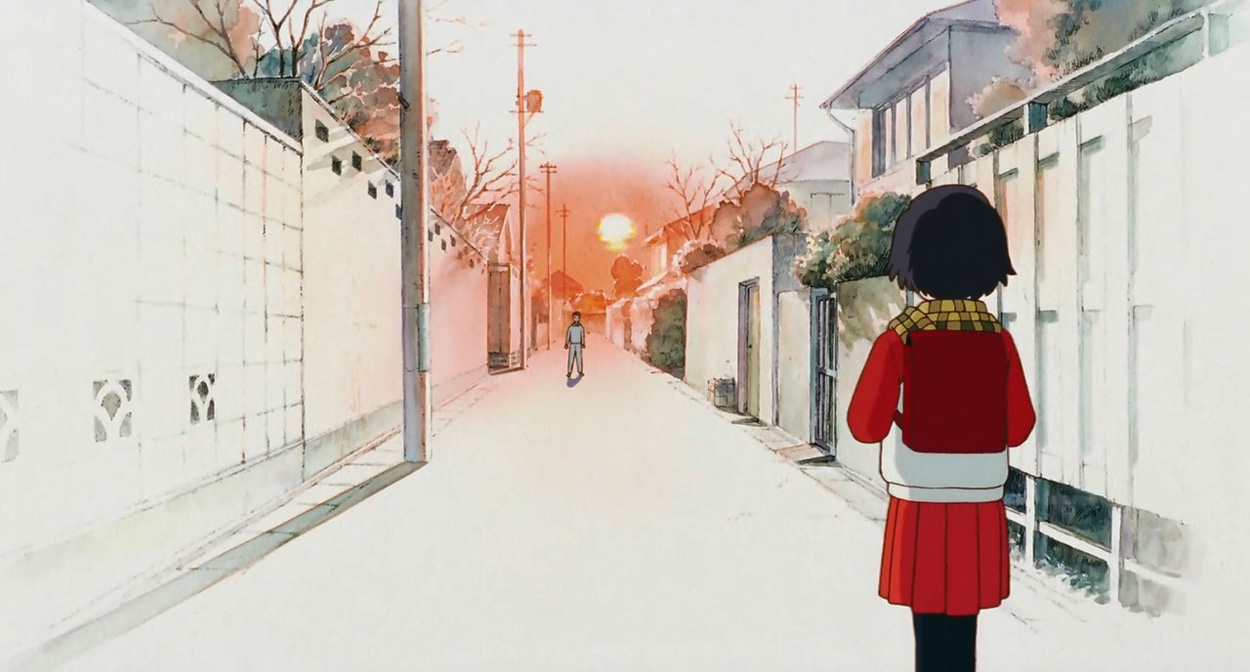
In what’s a precursor to his sketchier animation stylings in Princess Kaguya, Takahata presents the film’s 1966 memories on thinly-guised backgrounds with watercolours, while the 1982 content is much more boldly detailed, less indistinct. One’s childhood becomes an indistinct haze as we age, with mere wisps of events and feelings remaining when we suddenly, often inexplicably, remember moments out of the blue. And those wisps, in enduring and retrospectively gaining significance in how they’ve shaped our adult lives, gain an intangible weight. Only Yesterday is Studio Ghibli’s wisp that lingers in and haunts the mind and soul; a beautiful film that genuinely says something about being human. It is their secret masterpiece.
Josh Slater-Williams (@jslaterwilliams) is a freelance writer based in England. Alongside writing for Vague Visages, he is currently the managing film editor at Sound On Sight, and a regular contributor to independent British magazine The Skinny.
Categories: 2015 Film Essays, Film Essays
2 replies »