

We Failed This Film is a series about various films that simply didn’t get the love that they deserved upon initial release. For the third entry, we’ll be getting behind the wheel of Lana and Andy Wachowski’s criminally underappreciated Speed Racer, a film that flopped upon release but is far better than initial reaction would suggest.
How We Failed It
Speed Racer had an awful reception both critically and commercially. With a bloated budget of $120 million, the directors (and siblings) Lana and Andy Wachowski didn’t even make it back internationally. The film grossed a sour $43 million domestically (only $18 million opening weekend), and the foreign box office didn’t give it the boost it needed to make a profit with only $50 million. Overall, the film made a grand total of $93 million, almost $30 million under its budget. Speed Racer was an official flop.
The Wachowski’s film adapts the popular anime series and follows Speed (Emile Hirsch) as he climbs the rankings in the racing world with the help of his parents Mom (Susan Sarandon) and Pops (John Goodman), his little brother Spritle (Paulie Litt), girlfriend Trixie (Christina Ricci) and mechanic Sparky (Kick Gurry). Speed catches the eye of Royalton (Roger Allam), a powerful CEO of his own racing company who wants to recruit the young prodigy, but when his offer is declined, the business man sets out to wreck Speed’s career and the family business. In retaliation, the racer joins up with fellow competitors Taejo Togokahn (Rain) and the mysterious Racer X (Matthew Fox) in a cross-country race (the Casa Cristo) to help take down Royalton industries. Speed’s family is anxious about him participating, as their oldest son Rex (Scott Porter) died in that race several years ago.
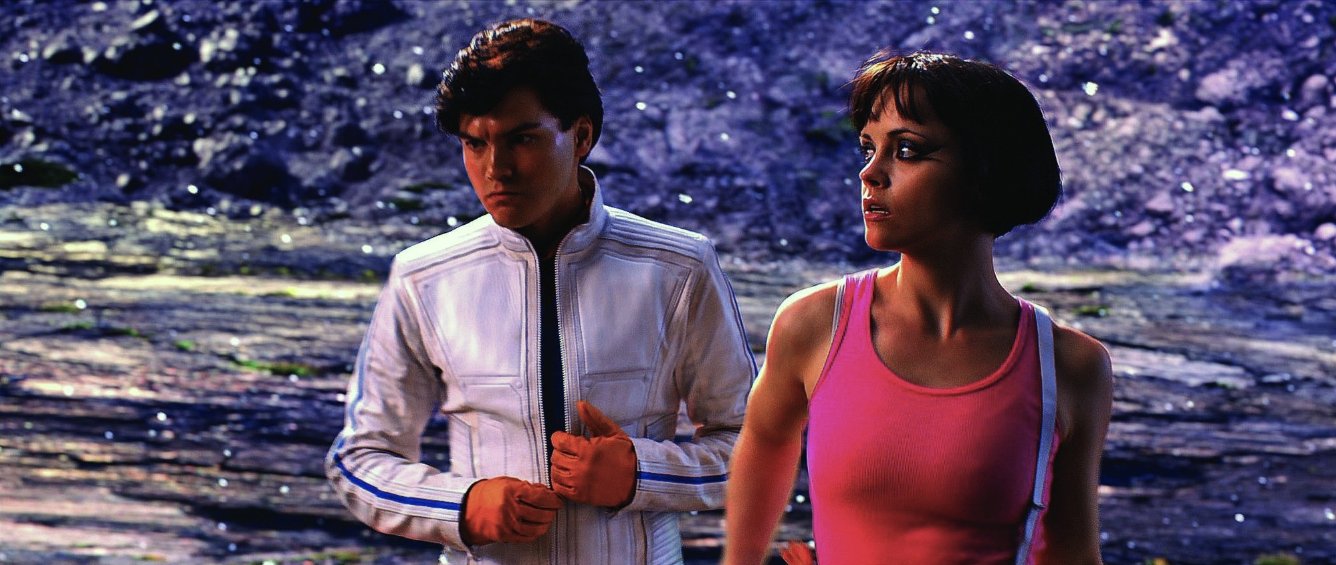
Why the bad reception? It starts with the venomous reaction to the film from critics, but the reasons for the flop go beyond them to the marketing. Jim Emerson wrote, “Speed Racer is a manufactured widget, a packaged commodity that capitalizes on an anthropomorphized cartoon of Capitalist Evil in order to sell itself and its ancillary products.” Nathan Rabin at the A.V. Club wrote, “It’s stuck somewhere between kitsch and heavy drama, outright ridiculousness and moody intensity. It doesn’t seem to know whether to wholly embrace camp, or to keep it at arm’s length, which is not a problem any movie featuring an extended end-credit sequence with a chimpanzee mugging for the camera should have.” J. Hoberman of The Village Voice wrote, “Ideologically anti-corporate, previous Wachowski productions aspired to be something more than mind-less sensation; Speed Racer is thrilled to be less. It’s the delusions minus the grandeur.”
While the film had some defenders in Richard Corliss, who wrote a piece entitled “Speed Racer: The Future of Movies,” the amount of vitriol directed at it drove away a skeptical audience. In addition, flooding $120 million into a Speed Racer movie was never a great idea. While every cent is on screen in glorious fashion, it was a bad gamble from the start. Was Speed Racer a popular enough intellectual property to net a large return to begin with? Probably not. What Warner Bros. was banking on was that the combined forces of original series fans and fans of the Wachowski’s Matrix trilogy would propel the movie to profitability. It’s not a bad plan — most people were eager to see what the Wachowski’s would do after the Matrix films — but they forgot to take into account that a sizeable amount of those fans didn’t like the previous two films. Good will towards the directors wasn’t the same amount it used to be. Add a well-documented instance of animal abuse on set by one of the chimpanzee trainers, and you’ve got bad press that’s hard to overcome. All of these things combined to make Speed Racer flop, and that’s a tragedy, because it is the Wachowski’s most gonzo, uncompromised piece of art.
Full Disclosure: I dressed as Speed Racer for Halloween the year of its release. It was a great costume.

Why It’s Great
There is simply no other film like Speed Racer, as it creates a cinematic language and world all of its own. The first images are like being thrust down a kaleidoscope head first. Its opening sequence grips immediately, taking place during a climactic race that offers an incredible amount of expositional setup for the story, world and characters while bringing the thrills. The Wachowskis repeatedly cut between the present race and the scarred past of Speed’s family, and in the first 20 minutes, there’s enough exposition to fill another film without getting lost in the information, nor does it lose any sense of thrill.
Every scene of Speed Racer is turned up to 11. I’ve had friends describe the movie as “getting hit in the head with a rainbow” or as “an acid trip for kids.” There’s an entire scene devoted to Spritle and Chim-Chim transporting into their favorite anime show via imagination. A mob boss has an office in a moving truck driven by a guy that looks like Boy George, and said driver also has a poster of James Cagney in the driver’s seat for whatever reason. The main policing force in the racing industry is led by a guy called “Inspector Detector,” and Chim-Chim, a chimpanzee, is unquestionably part of the family, while many racers use illegal weapon attachments to their cars in the cross-country Casa Cristo race (one of them is a catapult that flings a beehive).
The entire cast has a good time playing their parts in Speed Racer, especially Goodman, who is afforded an incredible one-liner after quickly beating up a ninja: “More like a non-ja. Terrible what passes for a ninja these days.” Emile Hirsch’s natural boyish innocence is put to good use here, something other films of his haven’t capitalized on. Matthew Fox is strangely playing it straight as Racer X, and in turn he clashes with the campy nature of other performances. Yet somehow his resilience to get in on the joke compliments the heightened nature of the film. However, it’s Roger Allam who steals the show as the pompous villain Royalton, chewing through each of his scenes like he’s feasting on the world’s most expensive filet mignon (or maybe pancakes). Nobody else could sell the line “Pancakes are love” as if it’s the secret to the universe, and his portrayal of Royalton rides a perfect line between hammy and honest — he’s committed to being over-the-top. When Speed declines his offer to race for him, the transition that Royalton makes from smiling and benevolent to corporate reptile is captivating in the actor’s hands. The various threats he spews and the condescending laughs he lobs at Speed makes for one of the most charged moments of performance in the film.
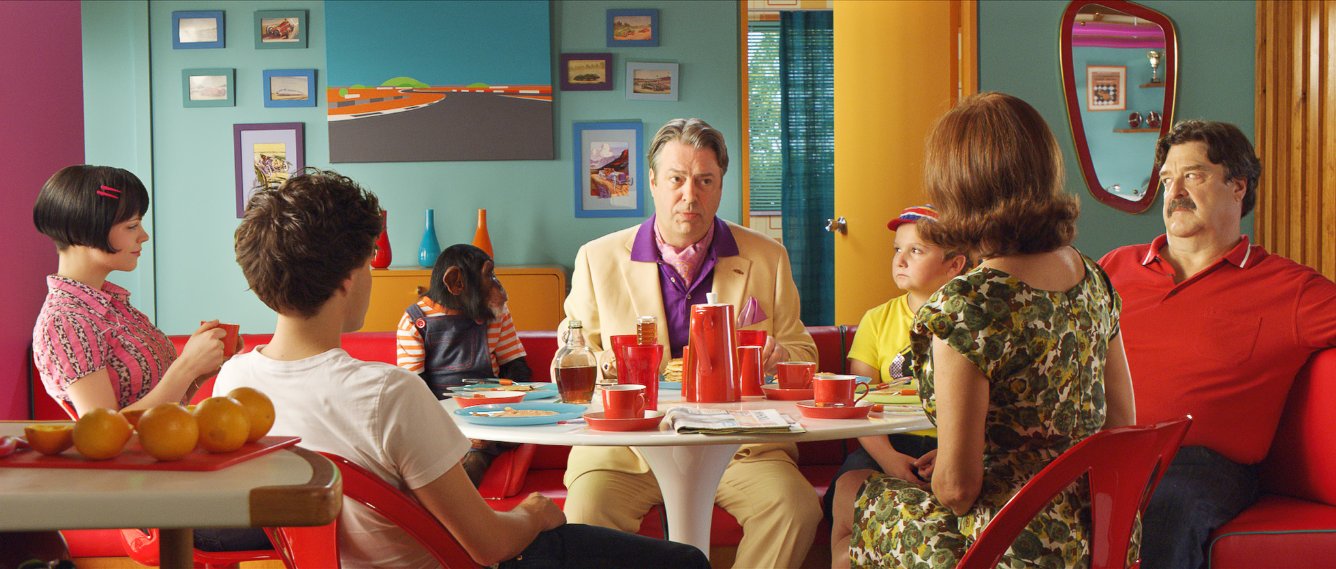
Speed Racer adopts an editing style that feels like Eisenstein on every possible illegal stimulant, as cross-cutting doesn’t describe the insanity and heightened nature here. Shots don’t just cut to the following image, they meld and explode into the next. Scenes, images, characters and passages of dialogue all wash across each other in a barrage of colors and transitions. Similar to the vehicles on display, the film’s pace is always in continuous forward motion. The effect, amazingly, isn’t disorienting — it’s exhilarating.
The exteriors in Speed Racer are completely computer-generated, their artifice seemingly intent in order to heighten the gonzo nature of the film. Rather than cheap, it feels innovative. Most films use CGI in order to make the unreal look real, but this film is unashamed and chooses to use CGI to make the unreal look fantastical. The effect is undeniable euphoria. I saw Speed Racer twice in theaters, and both times I spent the entire two hours of it with the widest smile on my face.
Speed Racer has a genuine sense of heart and emotion in addition to its crazy antics. Consider the climax when Speed is mounting a tremendous comeback on the racetrack at the Grand Prix. Emotional passages of dialogue compliment his racing, and just as the story is reaching its climax, so are the emotions. The crescendo of the dazzling sequence comes when the Wachowskis flashback to Mom telling Speed how amazed she is by his racing: “When I watch you do some of the things you do, you just take my breath away.” And Pops remembers an early bonding moment with him and Speed that helped them move forward after Rex’s death. It’s a truly unforgettable climax that’s as emotional as it is thrilling.
Going back to Rabin’s statement that “It’s stuck somewhere between kitsch and heavy drama, outright ridiculousness and moody intensity,” I’d argue that Speed Racer succeeds in being outright ridiculous and heavily dramatic. It’s both a film that’s completely insane and about a family moving past trauma together. The sequence of them building the car in record time before the Grand Prix is one of healing for these characters, and it drives home the film’s theme of dealing with loss. The opposing ideologies and emotions clash, but they create something wholly unique and moving out of the collision.

Going Forward
Speed Racer is a different case than the first film of this series, The Assassination of Jesse James by the Coward Robert Ford, in that there is no mythical four-hour cut to be seen (though I’d watch it if one exists), nor is it in dire need of a specialty home release (though if Criterion or Arrow wants to put it out, I’d buy it). There’s really been too much time to simply fix the damage that was done, but what can be done, however, is for the public to simply give the film another chance.
One thing is for sure, the Wachowskis need another hit if they want to keep creating films like Speed Racer (and to a further extent, Cloud Atlas), as their last full-blown box office hit came with The Matrix films. They’ve been riding that wave of recognition ever since then, but with Jupiter Ascending serving as the third box office strike in a row, it’s only a matter of time before studios stop indulging them based on just the success of The Matrix. I sincerely hope the Wachowskis continue to receive opportunities to make the films they want to, because when they make a film like Speed Racer, well…as Mom says to Speed about his racing, “It’s beautiful and inspiring, and everything that art should be.”
Dylan Moses Griffin has been a cinephile for as long as he can remember. His favorite film is Taxi Driver, and he reads the works of Roger Ebert like it’s scripture. If you want, he will talk to you for 30 minutes about the chronologically weird/amazing Fast and Furious franchise.
You must be logged in to post a comment.