

A fear of impotence stalks the protagonist of Maniac (1980) — played by Joe Spinell, who portrayed an assortment of hoods and lowlifes in everything from The Godfather: Part II (1974) to Rocky (1976); his is the pockmarked face of pre-cleanup New York. Spinell’s Frank Zito is a kind of urban Norman Bates, tortured by memories of childhood abuse and exacting revenge on an assortment of female victims, whose scalps he extracts in an attempt to construct the perfect inanimate companion. But Zito’s murderous urges are disrupted by an upwardly mobile photographer (Caroline Munro), who seems charmed by Zito’s outward awkwardness and in whom Zito sees the possibility of breaking the cycle of violence.

One can find a vestige of longing in Zito’s pathology, a sense that something can still be salvaged amidst the carnage. There are echoes of the child murderer in Fritz Lang’s M (1931) and the voyeuristic killer in Michael Powell’s Peeping Tom (1960) in the sadness that attends Zito’s crimes. In Maniac Cop (1988), any such ambiguity is extinguished; its protagonist’s backlash strikes to the heart of the patriarchal order. Larry Cohen’s screenplay creates an avatar of untrammelled male power, a figure who ostensibly embodies the authority of the status quo. Yet it also offers a more troubling variant of male rage; this time, the rage is empowered by the symbolism of the state, it wears the vestments of respectability. The protector has become the predator, and in so doing challenges the factors upon which power rests.

One can see in Cordell a spectre of the brute force that would be used to transform the city, and the craving for authoritarianism that accompanies it. A series of talking heads dramatises the discrepancy of contact with power within the city: a black man recounts how he has seen many of his friends “shot in the back” by cops; while a white man states with apparent glee that “cops like you to be scared of them. That’s what makes a man.” There is a suggestion in this that Cordell’s rampage is merely the black experience of law enforcement writ large, and that for the ranks of the protected, such suppression fulfills an unconscious desire to express masculinity through domination. For some, power is a nebulous yet seductive presence, while for others it is a daily incursion in their lives. By crossing the unspoken line between the contained and the protected, Cordell commits his ultimate crime; he is a manifestation of the reactionary id that lurks beneath the implied honour and benevolence of the uniform.
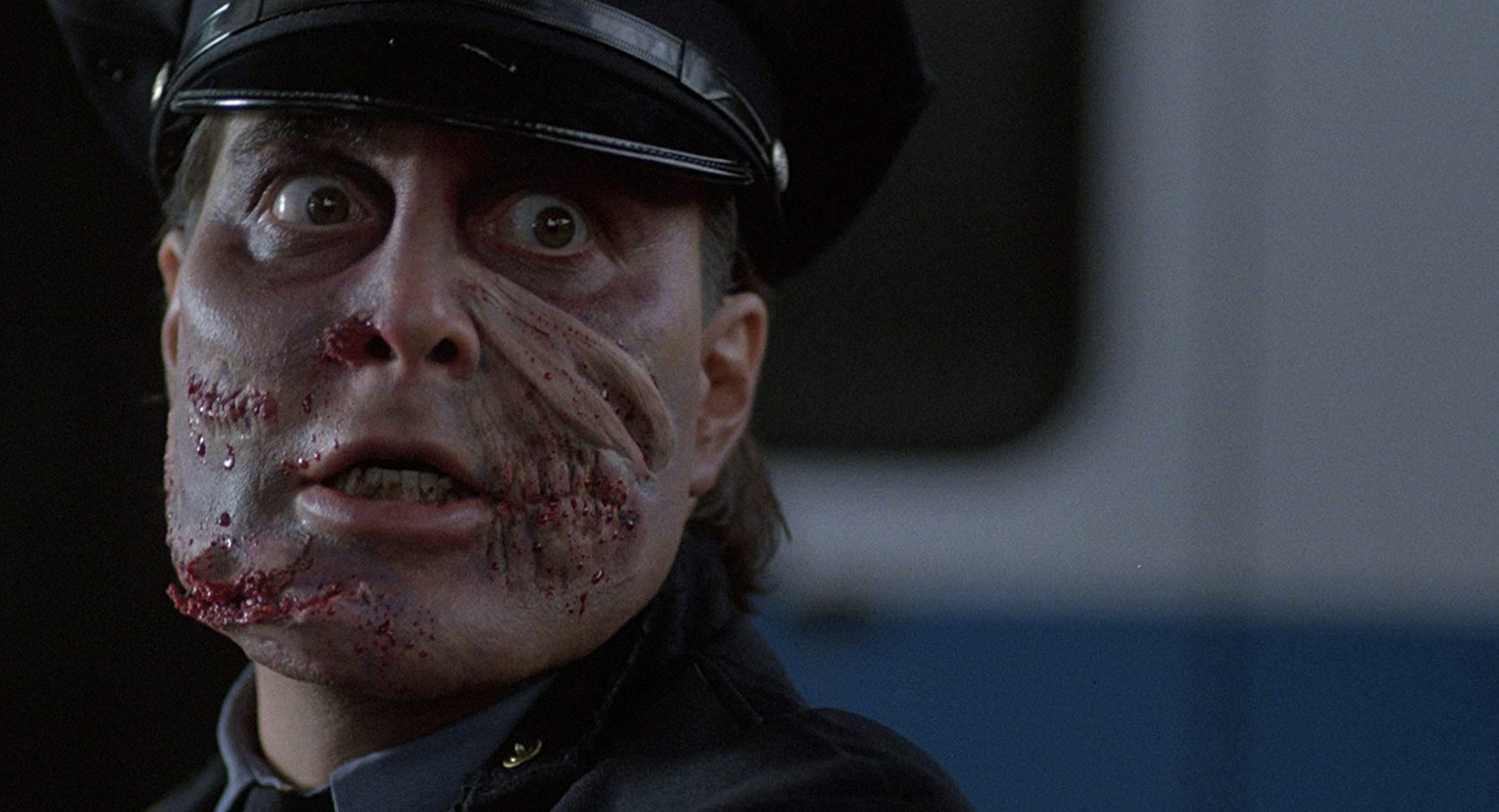 By Maniac Cop 2 (1990), Cordell’s malevolent spirit seems to have infected the whole city; it is a Darwinian playground in which the police no longer feel constrained by legal niceties. Robert Davi’s astringent detective Sean McKinney seems to be slowly morphing into Cordell, echoing his “shoot first” mentality; only Claudia Christian’s police psychologist presents a challenge to McKinney’s macho stoicism. McKinney is keen to point out that “there’s a piece of Cordell is every cop.” There are parallels between Bruce Campbell’s detective Jack Forrest from the first film and McKinney — both uphold an order they are incapable of existing within. But where Forrest laments the collapse of his marriage, McKinney sees it as an occupational hazard. Throughout the “Maniac” cycle, the idea of stable relationships between men and women is challenged, and viewers see the characters’ reactions to their growing alienation.
Like Zito, Cordell rails against his powerlessness; what binds the characters is their response to abuse occurring within societal institutions. In Maniac Cop and Maniac Cop 2, power is represented in a series of ineffectual and self-serving authority figures. In the extended cut of Maniac Cop, Lustig introduces the “fighting mayor” Jerry Killium — played to unctuous perfection by Ken Lerner. Killium comes to stand for the Koch/Dinkins Democratic swamp which Giuliani promised to drain as mayor. In Maniac Cop 2, Lustig presents exotic dancers “in the heart of Times Square,” and a “crusader against the whores of the world” inspired by Cordell to prey on them. Ironically, Cordell’s actions appear to have empowered those with a desire to cleanse the streets of such “human garbage.” Over the course of the films, Cordell makes the transition from monster to “good cop.” In its own histrionic way, the “Maniac” cycle presages a wave of reaction that would draw its power from the patriarchal fear of dispossession.
D.M. Palmer (@MrDMPalmer) is a writer based in Sheffield, UK. He has contributed to sites like HeyUGuys, The Shiznit, Sabotage Times, Roobla, Column F, The State of the Arts and Film Inquiry. He has a propensity to wax lyrical about Film Noir on the slightest provocation, which makes him a hit at parties. The detritus of his creative outpourings can be found at waxbarricades.wordpress.com.
Categories: 2019 Film Essays, Featured, Film Essays
You must be logged in to post a comment.