

Orson Welles would pick up on this two years later in The Lady from Shanghai (1948) — also starring Rita Hayworth — a film that directly implies a major source of noir’s anxiety and paranoia stems from the threat of global nuclear war. In this one, George Grisby (Glenn Anders) wants to fake his own death so he can collect his life insurance and escape to a remote Pacific Island, “as far away as possible from that city, or any city, when they start dropping those bombs!”
But this wasn’t the first mention of nuclear weapons in a noir film. The devices have lurked around the genre’s shadowy edges since the early days. House on 92nd Street (1945) has FBI men chasing Nazis attempting to discover the scientific process used in the development of an atomic weapon. Notorious (1946) sees Ingrid Bergman posing as a fascist sympathizer to infiltrate a group of fascists hiding in Argentina and collecting uranium for a resurgent Third Reich. In both films, the nuclear angle is a MacGuffin, an excuse to get the story rolling. Neither bothers with the Cold War’s overwhelming, end-of-the-world scenarios that would soon preoccupy much of American film.

Atomic power introduced the world to a new type of death, and radiation poisoning was the basis for an early noir picture D.O.A. (1949). The film stars Edmond O’Brien as a fun-loving notary public murdered with a radioactive liquid slipped into his drink at a bar. The “luminous poison” as it’s called, later revealed as iridium, is slow-acting enough that he can spend the film searching for his murderers. In classic noir style, his frantic investigation takes him deep into the labyrinthian underworld where he discovers not only the killers, but his own penchant for violence and criminality. Told through flashbacks, the story has the usual noirish doom-laden aura, but also presages the type of depressed, pessimistic mindset that would infect more and more of film as the true horrors of a global nuclear war became better understood.
In 1951, the Federal Civil Defense Administration was formed to educate American civilians on how to survive a nuclear attack. The FCDA was responsible for those “duck and cover” films shown in schools and on nationwide TV throughout the decade. In a typically unintentional yet bizarre combination of the deadly serious with the inane that would color much of Cold War propaganda, the original “duck and cover” piece was specifically designed to appeal to children and narrated by an animated turtle named Bert! Similar films and pamphlets were distributed to adults instructing them on disaster preparedness the same way people were told to ready themselves and their property for hurricanes and earthquakes.

The bomb even made it to prime time. In what is perhaps the ultimate fusion of the 20th century’s two defining technologies, a hydrogen bomb test was broadcast in 1953 on national television. Conducted in conjunction with what the FCDA named Operation Doorstep, the detonation was performed to assess the effects of a nuclear blast on suburban homes, further reinforcing the idea that in a future conflict the American civilian would be on the front line.
Much product coming out of Hollywood at the time reflected the terror of what had been unleashed. The Atomic City (1952) and World for Ransom (1954) deal in Communist agents on the hunt for American nuclear scientist. Others were atomic-horror films: The Beast from 20,000 Fathoms (1953), Them! (1954), Attack of the Crab Monsters (1957). (To be fair, not all of it was doom and gloom. Living It Up [1954] is a comedic take on the D.O.A. premise.) The Japanese, unsurprisingly, had their own versions, with Gojira being the most notable, and in a strange example of noir meets apocalyptic anxiety, the Americanized Godzilla, King of the Monsters! (1956) stars noir super-villain Raymond Burr via editing-room magic.

None of this squared with the imminent arrival of Doomsday, not to mention the hot war in Korea, or the paranoid, conspiratorial ramblings of Joe McCarthy (and later the House Committee on Un-American Activities) stoking fears that America was beset by enemies from within and engaged in a clandestine war to determine the fate worldwide democracy.
The United States was conflicted to say the least. Is it any wonder that beginning around 1950, noir began a noticeable shift from the chronicle of small lives, desperate chances and street-level crime to stories about aberrant behavior, deviancy and outright psychosis?
Living under the schizophrenic forces of go-go American jingoistic consumerism, Communist paranoia and end-of-the-world fatalism, and always ready to mine the psychic undercurrents, film noir simply gave up any pretense of rationality. The world was simply too mad. Gone were stories of a protagonist’s slide into the dark. The film noir of the 50s began with the craziness at full tilt.
Two notable examples opened the decade.

Gloria Swanson’s Norma Desmond occupies a dilapidated, sprawling estate in the Hollywood of Sunset Blvd. (1950). Aging, clearly dissociative and addled from long isolation, she falls apart after starring film roles no longer come her way. Most people could probably sympathize, if not with a starlet’s failing capital, at least with the feelings of alienation and strain resulting from a world they no longer recognize. The inscrutable forces of the Cold War were invisible, omnipresent and decidedly not concerned with an individual’s happiness or survival. Swanson only endures, as will many noir protagonists in the coming years, by going insane.
But it takes The Prowler (1951) to fully subvert atomic-age anxiety and channel it through the noir triple-threat of neurosis, alienation and nameless fear. Los Angeles beat cop Webb Garwood (Van Heflin) meets bored but wealthy housewife Susan Gilvray (Evelyn Keyes). These two lonely and perverted souls share an immediate affinity, and after Garwood murders Gilvray’s husband — accidentally, in the line of duty — the two are married and use the widow’s inheritance to purchase a hotel. But keeping their handful of the American dream requires deception, and the pair eventually find themselves hiding out in a literal ghost town.

Merely as a practical matter, it’s inevitable that many films shot in Hollywood would use the desert as background. At first glance, the bright, sunny expanse might seem as inhospitable to the film noir aesthetic as it is to human life. But what a city’s shadows and alleyways provide for noir films — a sense of entrapment, loneliness and isolation — the desert more than capably supplies with its desolate expanse and lifeless terrain.
However, as the 1950s progressed and apocalyptic fears sank deeper into the American psyche, these stark landscapes, by then also then associated with regular atomic bomb tests in Nevada, take on even more ominous import. (Another essay might be written on how the Doomsday Clock unveiled in 1947 did the same thing for film noir’s obsession with time and countdowns.)
What The Prowler only suggests is given literal expression in 1953’s Split Second. Three escaped convicts hole up with several hostages in a ghost town that lies on the Nevada Test Site and within the blast radius of an imminent bomb test. The crooks figure the cops will clear out soon and make escape easy. Unknown to them, the timetable for the detonation has been moved ahead an hour. There’s a mad dash to safety once they learn what’s up, but only a few of them survive in the shelter of a mine shaft. “Let’s get a look at the new world,” one intones after the shock wave passes. They emerge to a seared, scoured waste and a mushroom cloud blooming in the distance.
The desert also adds psycho-apocalyptic weight to Ace in the Hole (1951) and The Hitch-hiker (1953). In the former, the landscape is as arid as the conscience of the newsman played with rapacious glee by Kirk Douglas. Ace in the Hole is as cynical about the motives of journalists as it is American society. He’s a shyster and admits it up front. Alternately titled The Big Circus, the film shows an American public willing to use the event of a man trapped and dying underground as an excuse for a day of fun and the massive scene becomes a mid-century danse macabre, citizens partying amid a future vision of a radiation-scorched earth.

Even before the credits roll, Shield for Murder (1954) has cop Barney Nolan (Edmond O’Brien) executing a bookie in an alley for the 25 grand the man carries. It seems this isn’t the only person he’s shot in the line duty, the list of dead perps on his gun runs to at least six. The viewer never sees Nolan’s evolution. He’s not a cop bitter over the fact that the bad guys always skip out on a technicality, nor is he tired of watching dishonest men grow rich. “What makes you so angry?” his girlfriend Patty Winters (Marla English) asks him. True to the emerging trend of inherent, unexamined sociopathy, Nolan can only reply with silence. But his crime spree has a goal: to purchase a house in a new subdivision under construction outside Los Angeles.
Captured in increasingly intimate close-ups as the noose closes around him, O’Brien’s sweaty brow and prominent double chin mark him as the embodiment of middle-class impulses gone haywire, made even more desperate by the imminent end-of-times. (A secondary character jokingly observes, “Nothing matters. In a hundred years, we’ll all be dead.”) Fellow policemen eventually shoot him down in that half-built expanse of new homes. He ends his life bleeding out into the sand while around him squat the empty frames of houses transformed now from vacuous symbols of bourgeois dreams into what seems more like the ruins of the civilization of man.
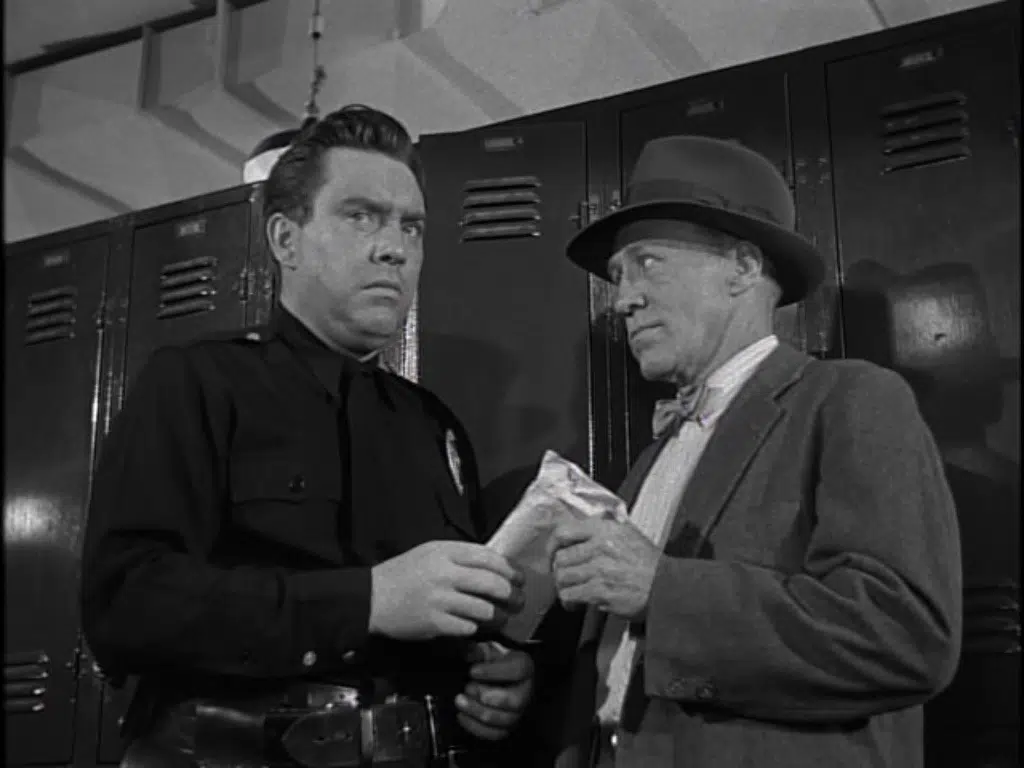
Two late entry noir films are the most explicit in their meshing of mental instability, existential fear and apocalyptic dread.
Kiss Me Deadly (1955) is perhaps the apotheosis of nuclear-anxiety noir. If there ever was a film that represented the American psyche addled after a decade of giddy materialism and atomic paranoia, Kiss Me Deadly is it. Private dick Mike Hammer (Ralph Meeker) picks up a woman named Christina (Cloris Leachman) running barefoot along a stretch of lonely desert road. She confesses she’s just escaped from a local mental institution, to which Hammer shrugs his shoulders as if this kind of thing happened all the time. Christina is just the tip of a mystery that soon sends Hammer careening around Los Angeles in search of “the great whatsit.”

From the opening credits (which scroll in reverse), the movie declares its cuckoo logic, or rather the illogic of the consumerist America’s nuclear nightmare. Filmed in severely skewed camera angles, impossible point-of-view shots and sudden cuts, the movie is not so much a mystery as a cascading series of events that speed across the screen like the wheeled torpedo of Hammer’s sports car. Each clue only ever leads to another clue but never to any cohesive picture of why people are trying to kill Hammer, why someone murdered Christina. or why the government agents seem as interested in “the great whatsit” as do L.A. underworld types. Continual references to Romantic poetry, opera, classical music and ballet seem to skim the edge of meaning, but ultimately amount to only details stretched across the void of a superficial and insane world.
That Kiss Me Deadly ends with an actual nuclear conflagration shouldn’t come as a surprise. In apocalyptic-noir America, all mysteries, all feelings of angst, paranoia and disorientation, as well as the sheen imposed by middle-class exuberance (patriotism, confidence, hope) eventually lead to the abyss. It is a dark, subversive vision of the post-war world.

While Shock Corridor (1963) might be considered post-noir, it draws enough from the genre to link it to earlier films dealing with Armageddon and existential dread. (Brainstorm from 1965 is an even later entry though not as explicit as Shock Corridor.) Investigative reporter Johnny Barrett (Peter Breck) fakes insanity so he can get committed to an asylum where an inmate was recently murdered under mysterious circumstances. The various hospital residents he meets embody a spectrum of American malignancies. One in particular, a nuclear scientist, has reverted to the mentality a child in response to the existence of nuclear-tipped ICBMs. And really, is there a rational response to a society that seems bent on self-extinction? Shock Corridor ends with a quote attributed to Euripides: “Whom the gods would destroy, they first make mad.”
In the current era, with resurgent crypto-animosities and a species determined to turn the globe into an uninhabitable sauna (and nuclear arms treaties being cast into the dust bin of history), the coda might prompt one to ask: where is our own cinema of madness?
Stefen Styrsky (@Stefen_Styrsky) writes short stories and film reviews. His work has appeared in Amazon’s Day One, the Tahoma Literary Review, Number Eleven Magazine, Litbreak and The Offing, among other places. He has an MA in Fiction Writing from the Johns Hopkins University and lives in Washington, DC. His website is stefenstyrsky.com.
Categories: 2018 Film Essays, Featured, Film Essays
1 reply »