
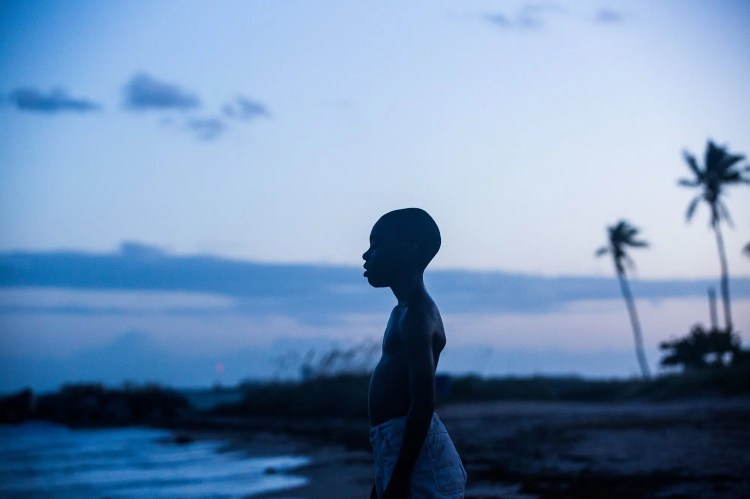
In Barry Jenkins’ Moonlight, deconstructionism of the masculine identity has gone beyond revolutionary, to the extent of creating a “gaze” unlike any other seen in cinema. We have the queer gaze, the hetero-male gaze and the female gaze, but to have a black queer gaze — that not only deconstructs identity, African-American stereotypes and typical portrayals of gay men on the screen in general — we have a winner in terms of cinematography, subject matter and narrative control.
When dealing with masculinity on the big screen, I have not seen such sensitivity and precision as depicted in Moonlight, except maybe in the films of Xavier Dolan, a Canadian filmmaker that has redefined and restructured male characters in cinema. As a director, Jenkins went further than any other straight filmmaker in capturing the sincerest, most intimate struggles a gay, Black man faces in an environment hostile to his own existence. Chiron, played masterfully in three stages by Alex Hibbert, Ashton Sanders and Trevante Rhodes, represents a freak amongst an unempowered group of individuals; a brave and brief commentary on the black experience. In one scene, adult Kevin (André Holland) tells Chiron that he was imprisoned for the “same stupid shit we always get sent up for,” and though it might seem forced for the viewer, Holland’s sincere and intense phrasing makes it apparent how difficult the characters’ lives have been. Bits and snippets of ghetto commentary transform Moonlight from a simple, timeless love story into one that has social, and even political, significance.

There’s something striking about Moonlight’s aversion to genre-ism. It’s not a romantic tale in the broader sense of the word. It’s not some coming-of-age drama where the protagonist comes out changed in the end. And that’s because Chiron hasn’t changed — not even a bit. Even with all the power he gained, and his fine, muscular physique, he’s still a stranger in a strange land.
Moonlight is feminist in its treatment of male subjects. In the way the camera almost revels in the male characters’ sexuality (despite the lack of nude scenes), Jenkins’ film not only defies the patriarchal gaze (and the masculine portrayal of men in love), but it also pays homage to thousands of scenes where a woman is followed by a straight man’s gaze. The camera follows Kevin around like he’s the most gorgeous human being out there, peeking and spying on his every move. Ultimately, Moonlight depicts Chiron rubbing his lower lip with his thumb, lustful and adrift with passion.

Jenkins’ script and direction feels powerful by featuring Kevin as the object of affection and seduction, without indulging in too many sex scenes. As far as queer films with similar aesthetics — Wong Kar-wai’s Happy Together, Dolan’s semi-autobiographical pieces I Killed my Mother and Heartbeats — Moonlight feels unique in how it relies more on feelings than the passion. It’s a swift tale of a lovelorn gay man, sans the sex.
By shooting Kevin in a way that allows his seductiveness and sex appeal to show, Moonlight maintains its underlying homoerotic subtext. In a scene where Chiron has a wet dream about Kevin, viewers get to see the latter like one of the sexy femme fatales men have been dreaming about in hetero-centric films ever since the dawn of time. If Dolan revolutionized the way male actors appear onscreen (in terms of camera angles, color and movement — slow motion used to perfection, baby), Terrell is shot like a hyena circling its prey, and Kevin is shot in a fetishistic way, with the cigarette smoke and the sultry looks — an eyebrow always arched higher than the other. And so, one may forget that a straight man is behind the camera. Viewers may feel totally immersed in the Lauren Bacall-ish male figure, looking directly at the camera, seducing Chiron in his dreams while letting the audiences in on the secret; he’s one hot man and he knows it. The audiences know it. And Chiron, the male ogling him, knows it as well.

Through its cinematography, Moonlight allows the black characters to shine (kudos to cinematographer James Laxton). Lighting is carefully monitored to avoid taking away from the characters’ pristine beauty and trueness, a testament to their presence and uniqueness. Though its a personal tale of a specific black man, Moonlight could be added to the classics of black film history, one that is meant to stay. Not only does it feel true to its origins, but it also speaks to viewers from different parts of the world.
I’m an Egyptian (feminist) film critic. Never in my life have I been to Liberty City, Miami. I might not know much about the “Black Lives Matter” movement or the struggles of being a queer, black man living in a tough neighborhood, but I do know that Chiron is a character meant to connect with lonely people all over the world; individuals who put on their shields every morning to face a world not necessarily welcoming of their existence.
Jaylan Salman (@Jaylan Salman) is a young, Egyptian feminist who believes firmly in gender equality and racial diversity. She is a film critic, poet, translator and a novelist. Her first short story collection “Thus spoke La Loba” was published in 2016 by the Egyptian Supreme Council of Culture after winning a national prize, coming first place and gaining critical acclaim. One of her poems “Poof, Vagina” won first prize in the “Bleed on the Page” competition held by “TheProse.com.” Her writing contributions include various international and local publications, including ZEALnyc, Africiné, Guardian Liberty Voice, Elephant Journal, Synchronized Chaos and many more. She was recently selected as part of the Official Selection Jury for Woman & Film Festival (Dona i Cinema) taking place in Valencia, Spain.
Categories: 2017 Film Essays, Featured, Film Essays
Great review!
Thierno (Africiné Magazine)