
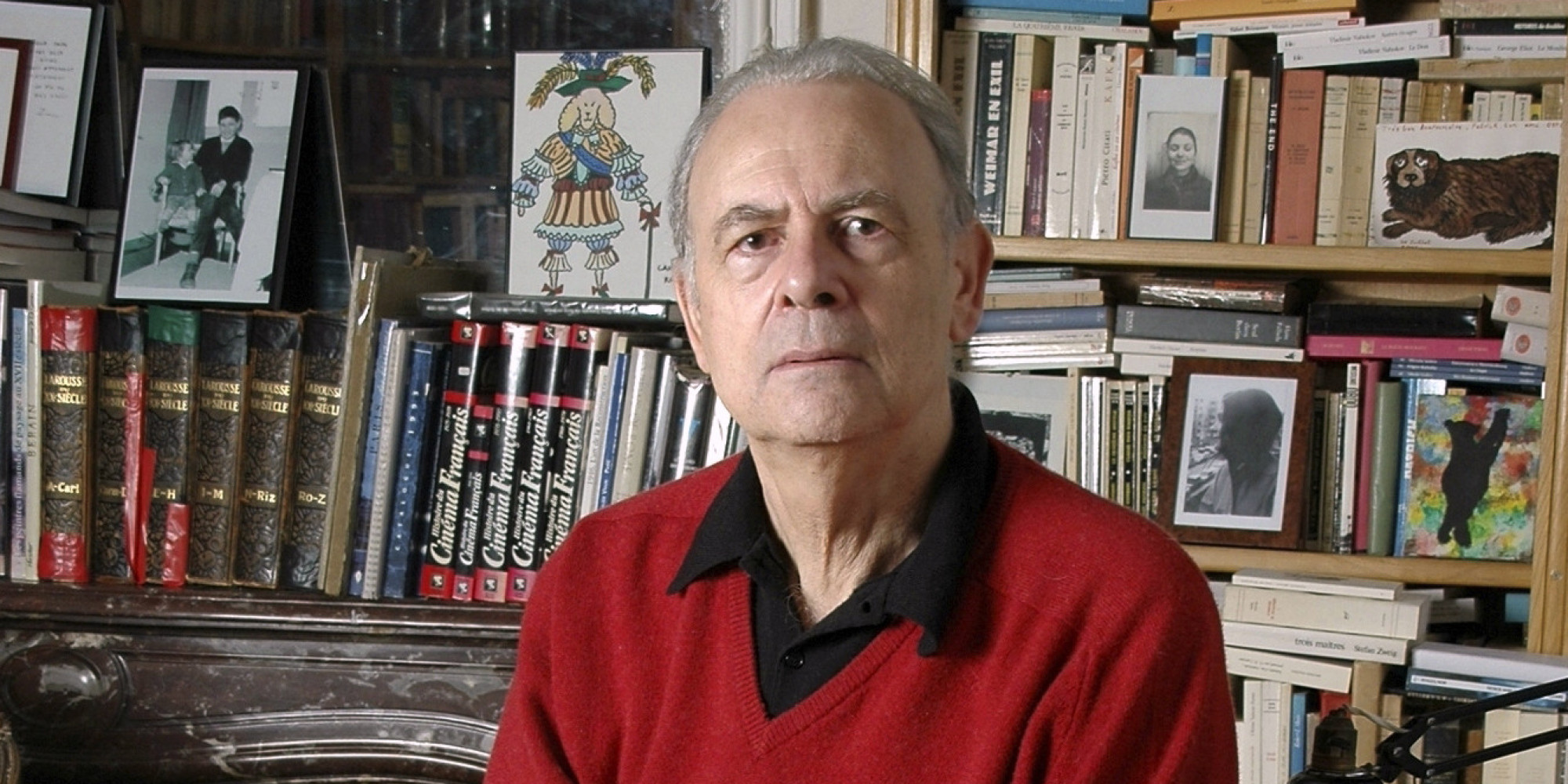
(AP Photo/Gallimard)
Editor’s Note: This is an extension of Jaime Grijalba’s four-part series “The Occupation Quadrilogy: ‘Lacombe, Lucien’ and the Early Novels of Patrick Modiano.”
Villa Triste is the fourth novel written by Patrick Modiano, the most recent winner of the Nobel Prize, and it opens with the description of a small village and its surroundings. The narrator-protagonist compares the state of the buildings and the way that they work to a past that we haven’t experienced yet. Enumerations follow: the cafes, the casinos, the trees and the hotels have disappeared, and we are living (through the words) in two places at the same time. Through a present that’s cold and lonely (almost as if the world had ended), we are provided glimpses of a nuclear winter, and a past that seems colorful and warm, yet with a sadness that permeates the whole narrative and that will only be explained in the last few pages of the book.
In contrast to his three first novels, Patrick Modiano looked forward with Villa Triste by exploring the psyche of young people when confronted with the history of France. Even though he was born after World War II and never lived during the occupation, Modiano now decides to address a problem that affected his generation while he was a young man (making this one of his first semi-autobiographical novels). But just like in his earlier works, he doesn’t approach the Algerian War itself, he just looks at it from a distance through the perspective of the young and fearful.
Modiano lived under the shadow of the Great War, but at the same time, he was raised under the constant threat of another one exploding at any moment. There wasn’t exactly a fear of a nuclear devastation (at least not yet), but given the problems with Algeria, it was a period of “constant danger” (according to Modiano). The novel stars a man that remembers the months he spent hiding away from Paris, running from the draft and getting to know a bon vivant; an up-and-coming actress named Yvonne who lived all her life in a nearby town. She now stays at a posh hotel, having dinners in fancy restaurants and driving around in cars near the villa. Though experts have pinpointed the location to Annecy, I prefer the mystery that the unspecified province has on the reader, as if the place didn’t really exist.
Villa Triste slowly but surely glazes over the lifestyle of the protagonist and Yvonne Jacquet, as it feels like they have everything they could ever want. Yet, there’s a sense of repetitiveness and a void; a sadness that something that can’t be filled for them. They have something together, but they don’t know what to do with it, and it all ends badly for our protagonist. But we’ve come to accept that from the start when he explains his sad present compared to what seemed to be a perfect and bright past. The film adaptation accomplishes to capture the same elements, and it has a lot of detail that’s worth discussing.
Yvonne’s Perfume (Le parfum d’Yvonne), a 1994 film adaptation of Villa Triste by Patrice Laconte, opens with a series of small vignettes of empty landscapes, a small village, big hotels, an empty hotel room and then a camera sweeping across a big lake. The scenery is bright, and it’s almost as if we were watching snapshots from a dreamy holiday; a collection of untouched elements pertaining to the “best years of our lives.” But the film quickly takes a shift after the opening credits. We see the face of Victor Chmara (Hippolyte Girardot), the protagonist. The sky is black and it’s cold out, but his face is fully lit. He’s looking downwards — fixated — and his narration describes the happenstance that brought him to the unnamed villa.
In a way, Yvonne’s Perfume serves as an expansion and an overstatement of the themes present in the novel. Death and sex become more important and are given a heavy turn in each segment. The film shifts from the present, where we see Chmara looking straight into a bright source of light. In a way, it seems as if he was looking into the events that happened 18 years before when he was running from the draft. Everything is exploited in the film, as it tries to convey the repression of France’s youth and their sadness. Laconte shows the ambulatory way in which they seem to not care about anything, driving around during long stretches of doing nothing but kissing and making love.
The film doesn’t have the introspection that the novel has, and it’s difficult for that to be translated, but nevertheless it’s one of the most faithful adaptations that I’ve seen in quite some time. The movie practically lifts dialogue and events page for page, and in the order in which they happen. The camera even imitates the movements of Modiano’s protagonist. One of the early passages of the novel describes a small café in which a character is named in passing, one that we won’t know until much later in the novel. The film shows a picture of the character on a wall, and I think that kind of commitment to the written word is a consideration towards the value of the novel itself and to its construction, as it leaves clues here and there of what happens in the future, and not only that, to what we might never see.
The ending of Yvonne’s Perfume is maybe the only big change compared to the novel, but I honestly think that while the violence might be blunt and even unnecessary (some might say ridiculous), it enforces Modiano’s point of view. I do have an issue with the film: I don’t think I would’ve been that interested if I hadn’t read the book. It certainly focuses too much on the relationship of Victor and Yvonne (and it even over-sexualizes it), which does happen a bunch in the novel itself, but not in the way that is portrayed in Yvonne’s Perfume. The film may be boring to those not willing to see beyond the medium, or to those without a chance to read the novel which has yet to receive an English translation — a sad fact.
Jaime Grijalba (@jaimegrijalba) is from Chile and has been writing about film, literature, videogames and culture for the past six years. He’s also preparing his first feature-length film, since he’s a filmmaker too (or wants to be at least).
Categories: 2015 Book Essays, Book Reviews, Featured
You must be logged in to post a comment.