
Last week in this space, I questioned whether or not the conclusion to “The Road” would justify its middling opening. Although “The Road Part 1” was far from unwatchable, its ostensibly simplistic message felt beneath the deep psychological probing Louie C.K. had achieved in the past. That being said, the numbered episode titles made it clear that this would be a two-part story, and I felt reluctant to dismiss the entire arc based on its mediocre beginning. As it turned out, “The Road Part 2” delivered a satisfying ending to the story and the season as a whole, and one which developed the shallow themes of “Part 1” to create a fascinating meditation on what makes people laugh.
At first, though, C.K. returns to the jokes of “Part 1,” opening the episode with a repeat of the visual gag of Louie getting hit by a stewardess on an airplane. Once he touches down in Oklahoma City, things don’t get much better for him, as the over-friendly Mike is replaced by the grumpy club owner’s daughter, April. As she drives him to his condo, she complains about “sickies” (Mexicans), refuses to look away from her phone and generally behaves like the sort of person with whom you wouldn’t want to be stuck in a car for an extended period of time.
Louie’s situation worsens when he arrive at the condo, where he’s greeted by his roommate and opening act, Kenny. He’s a crude comedian who harasses April, and his vulgarity continues as he gets on stage. Although Louie doesn’t enjoy the lowbrow humor, the audience disagrees, and a lengthy oner shows him following Kenny and receiving only tepid laughter for his jokes about the word “minority.”
The next day, Louie decides to shake off his failure by checking out a local flea market, where he meets a group of aspiring Civil War cosplayers who need a male participant to complete their act. After some hesitation, he agrees to take the role, and he ends up embracing his dance as the General Beauregard. At this point in the episode, it seems as if “Part 2” will rely on the same “hoity-toity comedian discovers the virtues of the working class” arc which bogs down “Part 1.”
Regardless, it soon becomes clear that C.K. has more on his mind. He plays another show at the club, prior to which the owner informs him that his set will be shortened to make more time for Kenny’s crude jokes. Their crudeness gets even worse this time, as he resorts to lighting his fart on fire. Despite Louie’s frustration, the audience gives their roaring approval, and they don’t find his jokes about aging quite as funny. They do begin to laugh once again when Kenny takes the stage, thanks to his unflattering impression of Louie.
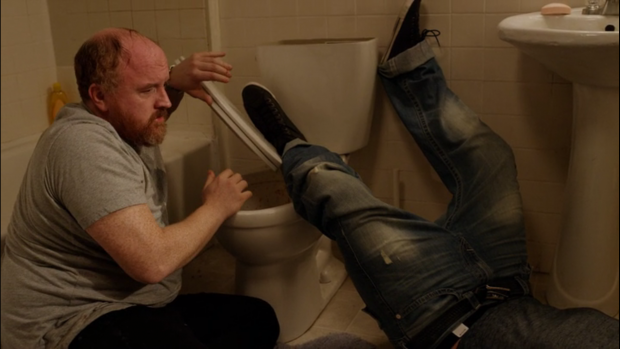
It’s at this point that the profundity of “Part 2” fully reveals itself. Kenny insults Louie’s snobbery while the two sit in their condo, and he responds by calling Kenny “a hack.” He defends himself by asking Louie whether or not he finds farts funny, to which he can’t help but break down in laughter, because “they make a little toot and they come out of your asshole, and they smell bad.” Having discovered this mutual comedic bond, the two share a bottle of liquor, which leads to Louie puking into the toilet and Kenny taking a fatal “upper decker” above his head.
Besides being one of the funniest slapstick gags that’s ever been on Louie, the scene provides a brilliant final take on the themes of “Part 2.” After spending the previous twenty minutes deriding Kenny’s bodily humor, C.K. ends the season with a poop joke that belongs in the show’s pantheon. As much as I appreciate the empathy and pathos he’s shown throughout the show’s run, the effectiveness of the “upper decker” gag reminds us, as Kenny’s comments remind Louie, just how funny a lowbrow joke can be.
In some sense, he’s not escaping the empathy of the show’s more overtly serious moments, since he puts us in the shoes of the audience members who laugh at Kenny’s fart jokes. Sure, it’s not exactly the same thing as giving a platform and a voice to an overweight woman or a struggling cop, but it still forces us to see the world from a perspective which we might otherwise be tempted to ignore (i.e. people who laugh at comedians who light their farts on fire). In many ways, this has been the strongest virtue of Louie throughout its run, making the “upper decker” scene a fitting conclusion to its fifth season.
Max Bledstein (@mbled210) is a Montreal-based writer, musician and world-renowned curmudgeon. He writes on all things culture for a variety of fine North American publications. His highly anticipated debut novel will write itself one of these days, he assumes.
Categories: Uncategorized
You must be logged in to post a comment.