
For critical writers, drawing from fiction can sometimes be far more valuable than non-fiction for enriching your work. If you’ve ever asked a writer that you admire for advice, almost without question, they will recommend you read more. Criticism, as I’ve previously discussed, exists between art and fact, and it becomes the subject of the pressures that come with writing fiction and nonfiction. Many writers lean on the latter, because at the end of the day, you need to root your criticism in the text: in film criticism, if you are not addressing what is on the screen, you might not be doing your job.
But just as painters are challenged with representing the world that has three-dimensional spatial components into something two-dimensional, writers are faced with representing an audio-visual world without audio or visuals. That’s where fiction steps in: faced with a Sisyphean task, you are forced to get creative. The writers that best navigate this absurd premise of film criticism are those that find a way to compromise between fiction and nonfiction.
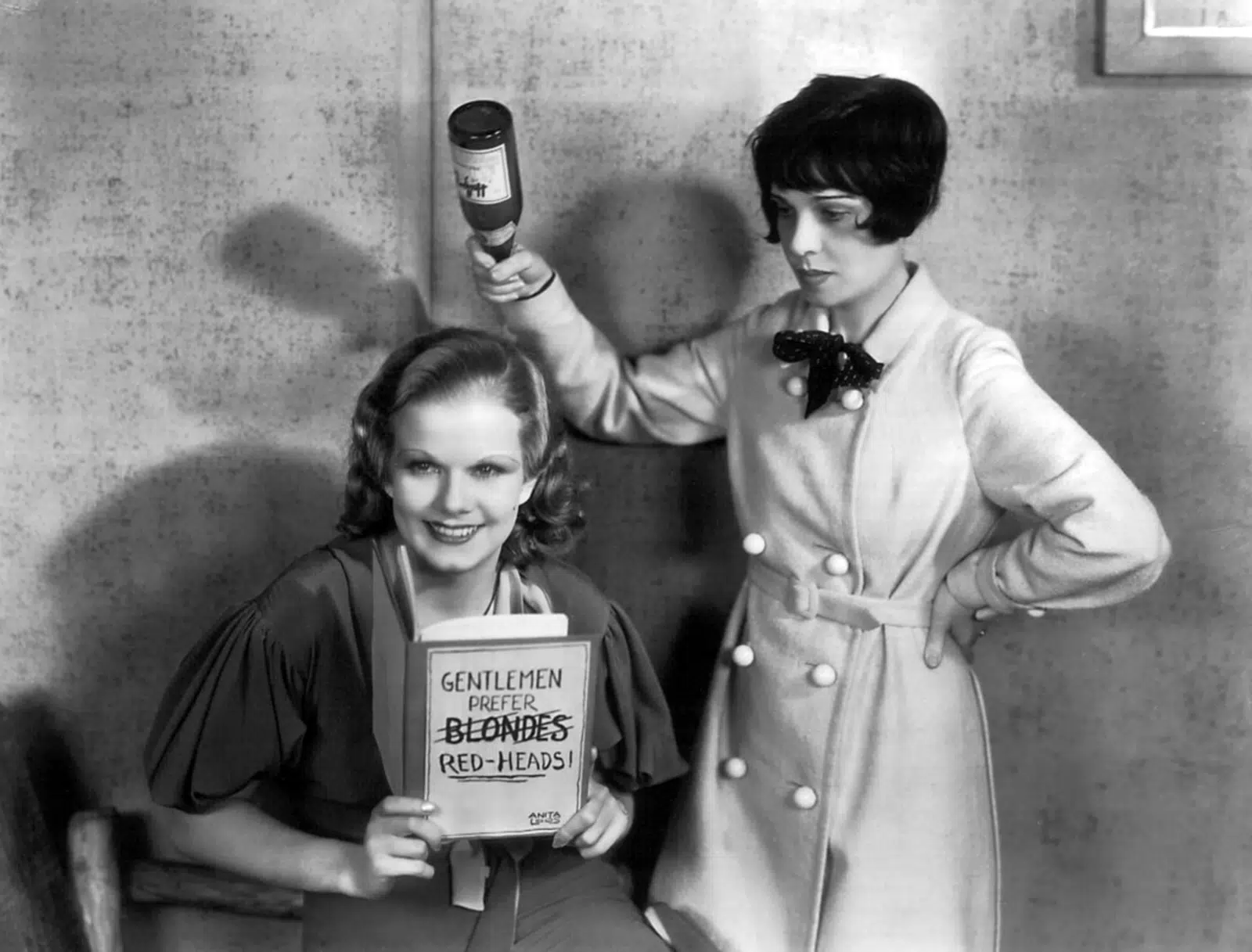
How do you explain Jean Harlow to someone who has never seen her in action? Sticking to the facts, you can easily rely on photographs. You can describe her iconic hair, her cherub face and her distinctive makeup. But with existing photos that don’t begin to translate her appeal to contemporary audiences, describing her physically seems insufficient. When writing about Jean Harlow and her relationship with writer Anita Loos for Fandor earlier this year, I was faced with a challenge of capturing who Jean Harlow was to people who might recognize her image but are not necessarily familiar with her appeal.

Overall, my experience writing that piece was conflicted, full of changes and doubt, but it was an interesting (if not, in my own esteem, failed) experiment. Part of my personal process in writing includes an extensive research phase, which includes watching as many relevant films as possible, delving into biographies, critical writing and news items. This time, though, a huge part of that initial process was also a sort of writing prompt: “capture in words, Jean Harlow’s screen presence.”
Through the number of drafts for this particular piece, the elements of Harlow I focused on shifted. Initially, it seemed obvious to zero in on her platinum hair, the mainstay of her appeal, but realizing that the article was about a writers relationship, that seemed insufficient. Her body seemed more integral, as both she and Anita Loos were selling sex but also subverting it. Before delving into Harlow’s personality and acting style, a description of her costume and body seemed more honest:
There is little working around the fact that much of Jean Harlow’s appeal was built around her body. Costume designers favored sheer and delicate materials when dressing Harlow, inspiring the illusion of nudity. Later as censorship became stricter, costumers seemed to struggle in how to dress her. The sweeping necklines remained, but they were disguised by synthetic materials, stiff underclothing and distracting patterns and adornments. Harlow’s body was a perfect match for Anita Loos words: her sexualized image a match made in heaven for the typical Loos protagonist, often a gold digging ingenue who treated her beauty like currency.
That was the image of Harlow that the whole world knew; it was something one can ascertain from photos, but ultimately doesn’t tell the whole story unless Harlow’s body is factored in from the precode era into the production code. It emphasized, at least in my mind, the confined stiffness of the production code, and how rather than targeting crime or harmful images, it silenced powerful and liberated women.
This was the strongest element of my writing prompt, as it told a story. The other elements I included were not necessarily bad, but merely descriptors: words that inspire images (barbarous, fiery, fierce) but ultimately don’t tell a story.
Reading more, especially fiction, has strengthened my resolve to use creative writing as a means of not only enhancing prose but my ideas. Compelling writing needs a thorough line, which often comes in the form of a thesis, but it should be bolstered by a story. While there are a number of non-fiction writers who are especially skilled at this, turning to fiction at this time can be infinitely more valuable as you search for new ways to convey criticism. The more you read, the more tools you have at your disposal and the better your writing will ultimately be.
On Criticism From Around the Web
Writing for Ploughshares, Veronica Fitzpatrick wrote “Our Ladies of Perpetual Sorrow” addressing Jason Guriel’s essay for The Walrus, “I Don’t Care About Your Life”
“Focusing on criticism lets us diagnose confessional crit as a specific stylistic epidemic, but the three main causes Guriel cites—1) declining belief in The Canon, 2) web publishing’s increasing demand for immediacy, and 3) an affinity for informality resulting from pop cultural immersion—suggest that this appeal is an expansive thing, of which criticism is just one arm. People write themselves into their criticism for the same reason others write themselves into their texts: to counteract their disappearance. (see: Guriel’s own inclusion of a response to Calvin Trillin’s poem.)
So, full disclosure: reading this piece I thought, this is odd, because there is a palpable zeitgeist of personal writing enjoying increasing cultural currency, but it’s so pervasive that resistance seems powerless, not to mention a little irrelevant. This “now” of art and criticism is a moment distinct from the new sincerity, and it is not, to my internet-drunk eyes, equally by and for everyone. It’s for sad girls.”
Be sure to check out this Storify, exploring what fiction critics and film writers believe have informed their work and what they recommend other critics seek out.
Justine Smith (@redroomrantings) lives and writes in Montreal, Quebec. She has a bachelor’s degree in Film Studies and a passionate hunger for all kinds of cinema. Along with writing for Vague Visages, she has written for Vice Canada, Cleo: A Feminist Journal and Little White Lies Magazine.
1 reply »