

Throughout Season Two, Fargo has maintained an impeccable balance between comedy and tragedy. Even as the bodies have piled up and the vises of tension have squeezed tighter and tighter on the ensemble, the series’ sense of humor has never waned, with Noah Hawley’s ability to laugh at the morbid becoming arguably the most salient evidence of the Coen brothers’ influence. In fact, comedy has often felt like the dominant mode in Season Two, as the most morbid moments and violent threats have been tempered by an underlying humorous touch.
By contrast, even if “Did You Do This? No, You Did It!” hardly abandons the laughs, the episode has a more tragic sensibility than the rest of the season. The opening montage of murder to the tune of Jethro Tull establishes the tone, with the potential black humor of a Big Lebowski-referencing toilet bowl torture being undercut by the sadness of the Gerhardts’ funeral for Otto and Rye. The murders are juxtaposed with close-ups of a shovel digging graves for the Gerhardt men, keeping the focus on death’s finality. Regardless, Simone doesn’t feel torn up about the situation, explaining that Otto and Rye are “just men” and earning Floyd’s reprimand. Simone’s flippancy ruptures the bond she once felt with her grandmother from their shared fight against the patriarchal dominance within the Gerhardt family, revealing the limits of their tenuous relationship. The bond gets destroyed even further as the two women head into different enemy territories, as Simone goes to express her anger towards Mike for his betrayal and Floyd goes into police custody.
There, we finally see a crack in Floyd’s steely demeanor. Even though she resolutely insists that “old-timers have it worse,” Hank and his partner appeal to the pain caused by her family’s suffering. Puffing away on her tobacco pipe, Floyd appears to ruminate on the violence her family has caused for themselves and others, even if the cops’ initial appeal doesn’t sway her.
Meanwhile, Simone’s emotions go unmitigated by Mike’s quoting of “the thesaurus” (i.e. Camus and Louis XVI). Bokeem Woodbine’s rhythmic delivery, spotlighted by last week’s recitation of Lewis Carrol’s “The Jabberwocky,” steals the scene once again in his smooth, musical transition between French and English, and even the entrance of the gun-pointing Lou and Ben can’t throw him off.

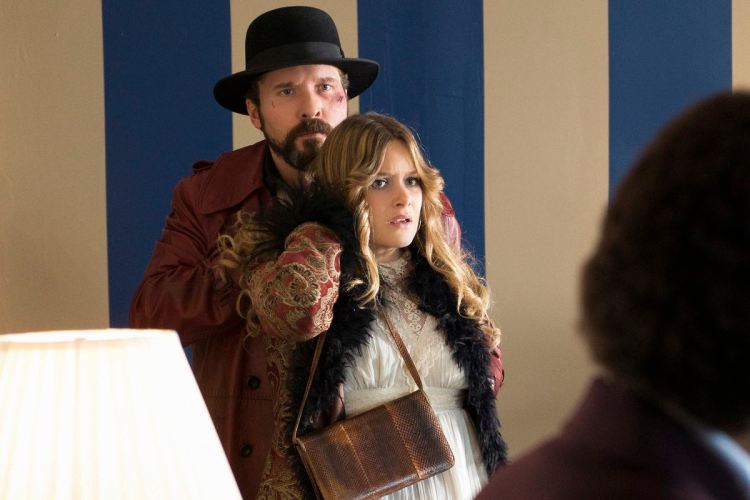
Ben, on the other hand, gets fazed rather easily by Simone’s seduction. In an act of rebuke to the male abuse she’s suffered from Mike and Dodd (and probably others), she knees him in the groin, asserting her authority and decision to stop “lying down for men.” Of course, she soon won’t have the choice to lie down for or stand up against anyone, as her momentary escape only leads her into Bear’s vicious clutches.
After the commercial break and a gorgeous establishing shot of the snowy Minnesota landscape, the extent of his viciousness becomes clear. Bear doesn’t even want to respond to Simone’s desperate pleas, let alone pardon her for turning against the family. As the two go further and further into the woods, Simone’s fate becomes more and more unavoidable, with director Keith Gordon’s heartbreaking close-ups emphasizing her desperation. There’s a deep pathos to the scene, drawing the viewer’s sympathy for Simone’s youthful ignorance (particularly due to her actions being a rebuke to Dodd’s abuse). Bear, by contrast, remains unmoved, dooming Simone to a brutal fate.

Hoping to save Betsy from a similar fate, Lou sends Karl and Sonny to the Solversons’ home. Unsurprisingly, Betsy doesn’t take too kindly to her husband’s decision, even if Karl is “the Breakfast King of Loyola.” Although her irritation doesn’t prevent the couple from having a tender moment, Betsy has no hesitation in expressing her feelings to Lou over the phone. Like Simone, Peggy, and Floyd, she wants to escape patriarchal control, even if the three women experience it in very different ways.
Floyd reacts by finally acquiescing to Hank’s request. A slowly encroaching zoom emphasizes the pressure, leading to her ultimate decision to inform on Mike and his crew. “None of you are mothers,” she tells the cops, justifying to both herself and them her decision to become a “snitch.” Of course, in relying on Floyd’s intel, the police ostensibly ally themselves with the Gerhardts, a fact which troubles Lou more than anyone else.

Then again, perhaps he could use their protection, as Karl’s presence doesn’t appear to amuse Floyd much. She certainly doesn’t take kindly to his analogy of her cancer to John McCain’s torture in Vietnam, distressed as she is by her premonition that the medical trial left her without a cure. Still, Floyd’s anger doesn’t keep her from accepting his embrace, forming a moving tableau rich with the emotions of both characters.
Conspicuously absent from all of this are the the increasingly complicit Blumquists, who don’t appear onscreen until the tag, in which Ed informs a blood-stained Mike of their possession of Dodd. Even if the couple’s involvement began as a matter of survival, the scene shows them becoming as violent and self-serving as their enemies, bringing “Did You Do This? No, You Did It!” to a gripping conclusion. The revelation provides yet another bit of tension for the final three episodes to resolve, further contributing to Fargo‘s dramatic landscape without approaching oversaturation.
Max Bledstein (@mbled210) is a Montreal-based writer, musician and world-renowned curmudgeon. He writes on all things culture for a variety of fine North American publications. His highly anticipated debut novel will write itself one of these days, he assumes.
Categories: Uncategorized
You must be logged in to post a comment.