
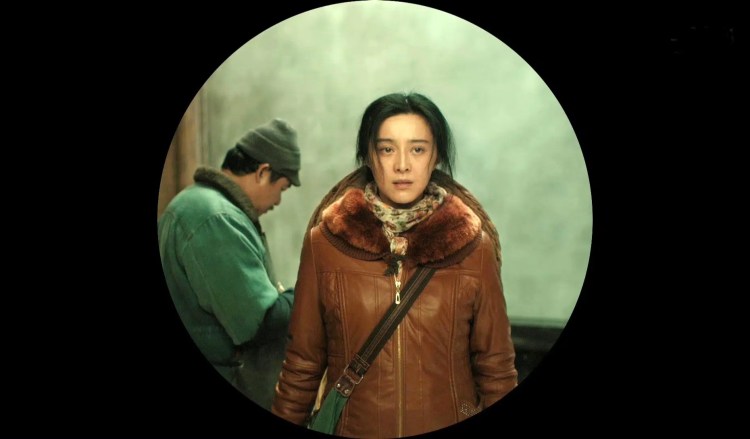
When we seek justice — public or private — against whom are we fighting? Is it simply the wrongdoer who is to be defeated? If the injustice has changed our state of being, is it against some metaphysical force which we contend? Or is that effort simply to bend the favor of the state and culture toward our cause? Whatever wrongs are righted in the proliferation of justice, there is no purity in the process itself, or so says Feng Xiaogang’s I Am Not Madame Bovary. If anything, it’s all just a tedious, soul-grinding fare.
A narrator opens the film with the fictional tale of Pan Jianlian, an adulteress killed because of her sexual promiscuity and betrayal. The story isn’t merely used as a cautionary tale within Chinese culture, it’s a curse against women who are thought to be sexual deviants. They are assigned the adulteress’ moniker like a scarlet letter. These are China’s Jezebels, its Madame Bovarys. This audacious film tells the plight of a modern woman scorned by the patriarchal rot of China’s social, governmental vision.

I Am Not Madame Bovary centers on the decade-long struggle of Li Xuelian (Fan Bingbing) to have her divorce reconsidered by the state. From the beginning, she claims that her divorce was fake, that it was a ruse to better her family’s situation. She and husband Qin Yuhe (Li Zonghan) were to separate so that he’d be able to move into the county and receive a better living space. Once he had moved in, they were to remarry. But Lian was betrayed by her husband when he married another woman upon the false pretense that Lian had been a “Pan Jianlian.” From county clerk to chief justice to mayor to the city officials in Beijing, Lian struggles against legal procedure and theory to have her reputation, name and livelihood redeemed. When she isn’t given the justice she deserves, Lian begins a series of lawsuits that span 10 years. Each year is just another abatement from the state. Justice is never appeased, just set aside.
Feng’s formal vision is a bold exercise in perception: 80% of the film is framed within a circle. All action taking place in Lian’s home county is seen in this limited scope, yet when she travels to Beijing to interrupt the gathering of the National People’s Congress, the frame expands to a rectangle. The peephole view of her local struggle mimics the limited vision of her leaders. She is run through the ringer of legal procedure, a track that reveals only the self-interest and inability of the leaders to regard the needs of the masses. The social promises of communist China are lost in its practitioners’ corruption and immorality. And though the city is represented by a more enlightened aesthetic, the expanded rectangular scope remains stilted. The greater officials possess a purer, more high-minded approach of how the state is to care for the people, yet that vertical knowledge is incapacitated as to ever move horizontal. Care and compassion is only actualized in implementation.

As Lian struggles against the state, so does the film’s aesthetic. I Am Not Madame Bovary brilliantly executes its high-concept, formal experimentation perfectly. In doing so, it embodies a vision that harmonizes the theoretical with the actual. (That Feng is able to encapsulate such a beautiful, wistful mise-en-scene in such limited space is a wonder.) Where China’s leaders failed Lian by fumbling over their ambition and intellectual purity, the accomplishment of Feng’s cinematic conceit is a testament to the ability of the artist and his role as a practitioner of social harmony. The film plays as a hilarious, unfortunate farce that leaves its female protagonist ever-struggling against an unmovable group of inept, impotent men. Is justice in the little details or the big picture? Throughout the film, men philosophize and belabor that question, often trivializing it with pithy sayings. Feng says it’s in the totality of vision; these planes of thought can’t be divorced. Here, women are relegated to society’s edges, given no space to ascend, but, in his final frames, Feng posits a vision of a future glory. The past may fade but hopefully it yields a better, more egalitarian future. There are no Pan Jianlians, no Madame Bovarys.
Colin Stacy (@bcolinstacy) is a writer, husband and father in Fort Worth, Texas. His writing has been featured at Reel Spirituality, Movie Mezzanine and 100 Films | 100 Scenes. He’s also the creator of the “Written and Directed by Elaine May” t-shirt.
Categories: 2017, 2017 Film Reviews, Featured, Film Reviews
You must be logged in to post a comment.