
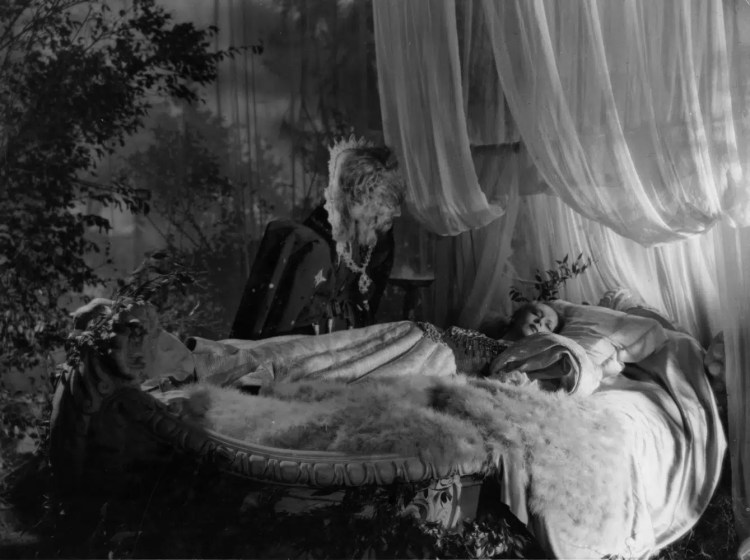
Jean Cocteau’s Beauty and the Beast (La belle et la bête), based on Jeanne-Marie Leprince de Beaumont’s 1756 fairy tale, is as multifaceted and elegant as its writer/director. Belle (Josette Day) falls for the pathetic, dangerous and sympathetic Beast (Jean Marais) after agreeing to live with him to spare her father’s life. Meanwhile, earthy melodrama dovetails from her family’s financial troubles, her Cinderella-like class-lusting sisters and the affections of her brother and his friend. Cocteau’s magical realism, with flight and cursed beasts side-by-side with the economic woes of an importer-exporter, gives his fantastic elements gravity while letting the humanist tale of greed lilt like music.
Cocteau wrote poetry, novels and everything in between, but film let his delicate princeliness manifest in the sumptuous production design. Bridging the gap between heady expressionism and the post-opium French New Wave, his adaptation’s trick shots, lavish sets, costumes and jewelry cast spells on the audience while a direct address preamble introduces the fairy tale by encouraging the adults to embrace a childlike wonder.

Interesting camerawork makes it easy to let go as shots zoom through carriage windows or end in character-approaching shadows. Foggy and foreboding, the Beast’s castle and grounds are drenched in darkness, only revealing a hidden beauty after the arrival of Belle. Cocteau’s mastery of visual space can generate hope, like a marble-white staircase, or dread, like a seemingly endless series of candlesticks catching flame in a dark hallway. Avant-garde morbidity saturates luxury into every frame as Roman sculptures (Diana and various related huntress/moon imagery), deceptive mirrors (showing those who gaze either their true forms or their true loves) and grotesque human furniture (disembodied arms grasping candlesticks and human-faced fireplace columns) outfit the Beast’s home.

The film blends the macabre body horror with a pansexuality, specifically in a scene where a wall seems to give birth to Belle back into the non-magic, human world. The bisexual Cocteau’s eye wanders from Belle and Beast’s relationship of dominance to a sweaty, shirtless Avenant (also played by Marais), whose swashbuckling handsomeness inspired Disney’s hypermasculine Gaston. This isn’t surprising, considering that Marais was Cocteau’s cinematic muse and that the pair were real-life lovers until Cocteau’s death. Marais’s short-lived marriage to Mila Parély (who plays one of the cruel sisters) adds an additional layer to the money-grubbing gender politics of the film. Vindictive women lead to the ruin of the family, overspending their father’s income and spurring Avenant to his doom. Aside from the raw sexuality, Marais’s dual melodramatic performances work well with his bluster as both human and Beast, emoting through the (excellent) makeup and costume that though his heart may be rash and impatient, it is still worthy of love.

Though the music sometimes has a mind of its own and the film often twiddles its thumbs, however beautifully, Beauty and the Beast still works its magic. Unexpectedly acerbic dialogue from Belle’s evil sisters’ repartee with their brother Ludovic, novel art direction and an absurdly enjoyable fairy-tale ending make this essential viewing for fantasy romantics.
From AAA TV to Z-movies, Oklahoma City-based critic Jacob Oller (@JacobOller) would like to bring the world together through entertainment, writing about it for publications like The Guardian, the Oklahoma Gazette, and his own blog. He’s a decent impressionist, semi-decent karaoke participant, and terrible dancer, although you’ll have to get a few drinks in him first.
Categories: 2016 Film Essays, Featured, Film Essays
You must be logged in to post a comment.