
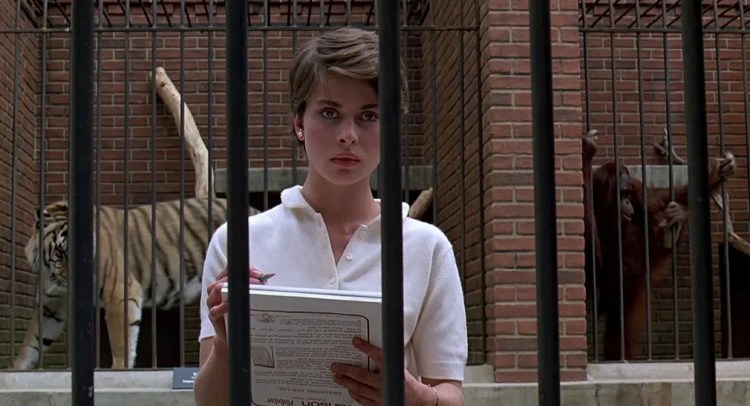
Transplanting Val Lewton’s Cat People (1942) from New York City to New Orleans and integrating an incestuous b-story, Paul Schrader’s Cat People vibrates with repressed sensuality. Sex holds out as the film’s main thrust, and the impetus towards animalistic destruction threatens the integrity of love and family. Daring to be an outright exploitation film, Schrader’s production doesn’t hold back on primal sexual imagery and reaching into the annals of human memory, as Cat People begins in a red desert where man and beast meet in an ancient human sacrifice.
Animal sounds crackle in the background and a wailing loon pierces through the film. Giorgio Moroder and David Bowie’s soundtrack, a pulsing anthem of fire, ignites the energy of the characters and, almost singlehandedly, the rhythmic beat drives Cat People forward. As darkened swamps, claustrophobic zoos and decrepit mansions become the stomping grounds for the unfolding narrative, the richness of atmosphere often makes up for the overwrought dramatics of the plot. Narratively, Cat People doesn’t quite come together, but the humid locale feels infused with a heavy longing and destructive desire.

Unlike transformation films centered on a male protagonist, Cat People is centered on a sexual awakening when women turn into beasts. Nastassja Kinski’s Irena has never been with a man before she arrives in America, and little does she know her family line has been cursed. Unless she makes love with a family member, sex will transform her into a panther. This equation of lust with violence was not new in 1982, but it does seem radical when it comes from a woman. Nearly two decades later in Ginger Snaps (a teen werewolf film), the titular Ginger says to her sister (in the midst of her transformation), “I get this ache… and I, I thought it was for sex, but it’s to tear everything to fucking pieces.” In part addressing the demonization of feminine passion, these films also translate the unspeakable intensity of their lust as well. Transcending the trite eroticism targeted to love-starved housewives, both Cat People and Ginger Snaps portray the violence of desire that still seems taboo on screen.

Central to this interpretation is the perceived innocence of Kinski’s Irena. Her child-like demeanor suggests a kind of infantilization of women before their sexual awakening. While leaning towards a certain angle of fetishization, it reveals a social inclination to treat women as incapable of taking hold of their sexual wants. Throughout the film, Irena’s thirst will be guided by the men who surround her, and any autonomy she exhibits seems to be a symptom of misguided innocence rather than independence. In the last act, her destructive sexuality must once again be contained by a man who loves her since she has lost control. These somewhat trite constraints on Irena’s lust, however, do little to impact to the power of her appetite on screen. Just like the old school gangster films that opened with empty warnings about the fact that crime doesn’t pay, the narrative limits do little to discount the expression of liberated and violent feminine desire.
Justine Smith (@redroomrantings) lives and writes in Montreal, Quebec. She has a bachelor’s degree in Film Studies and a passionate hunger for all kinds of cinema. Along with writing for Vague Visages, she has written for Vice Canada, Cleo: A Feminist Journal and Little White Lies Magazine.
Categories: 2016 Film Essays, Featured, Film Essays
You must be logged in to post a comment.