

Outside of Bollywood, movie musicals are a hard enough sell in the contemporary film climate, yet alone one made in 3D. Yet alone one from a director with no prior experience in the genre, albeit someone who is much respected when it comes to the sort of stuff he is known for. Yet alone a 3D musical set just prior to and during the 2008 financial crash, with its settings largely restricted to an office and the homes of its employees. Still, Johnnie To’s Office somehow got made, and we should be glad that it was.
The on-screen talent assembled probably helped. Various stars with international fame beyond Asia are peppered throughout the cast of Office, Tang Wei (Blackhat; Lust, Caution) and Chow Yun-fat among them. The key star is Sylvia Chang, who’s the arguable female lead of the film’s big ensemble, and Office is an adaptation of her own stage play, Design for Living (nothing to do with the Ernst Lubitsch film of the same name, as some might be hoping). The myriad threads and intricacies of Office’s plot would take up far too much space to go into here, but let’s just say that among the players we follow for a little over two hours are a slick chairman (Fat), a ruthless CEO (Chang), an arrogant advisor who’s cheating on multiple women among the cast (Eason Chan), an accountant who gets caught up in crime (Wei), the chairman’s daughter posing as a regular new employee (Lang Yueting), and the new upstart who starts off as a relative innocent and ends up compromising his morals and relationships (Wang Ziyi).

Songs range from slow ballads to electric guitar-fuelled bursts of satire regarding the monotony and spiritual sacrifices of working for the machine. (Sample lyric: “Even diligent pigs want to live a decent life.”) This is admittedly not the sort of musical where the songs are likely to become earworms racking your brain weeks after seeing the film, but then catchiness isn’t always a sure sign of quality with movie musicals. Les Miserables has a host of earworm tunes, but as adapted for film, it’s a rancid endurance test.
No, the most endearing aspect of Office is how To and production designer William Chang (a regular Wong Kar-wai collaborator) bring the play to the screen. The sets have this seemingly incompatible blend of both bare-bones structures and towering, complex cubist sights. Half of it feels befitting of the source’s stage origins (or even Lars von Trier’s Dogville), while half can’t help but recall the iconic modernist leanings of Jacques Tati’s Playtime.
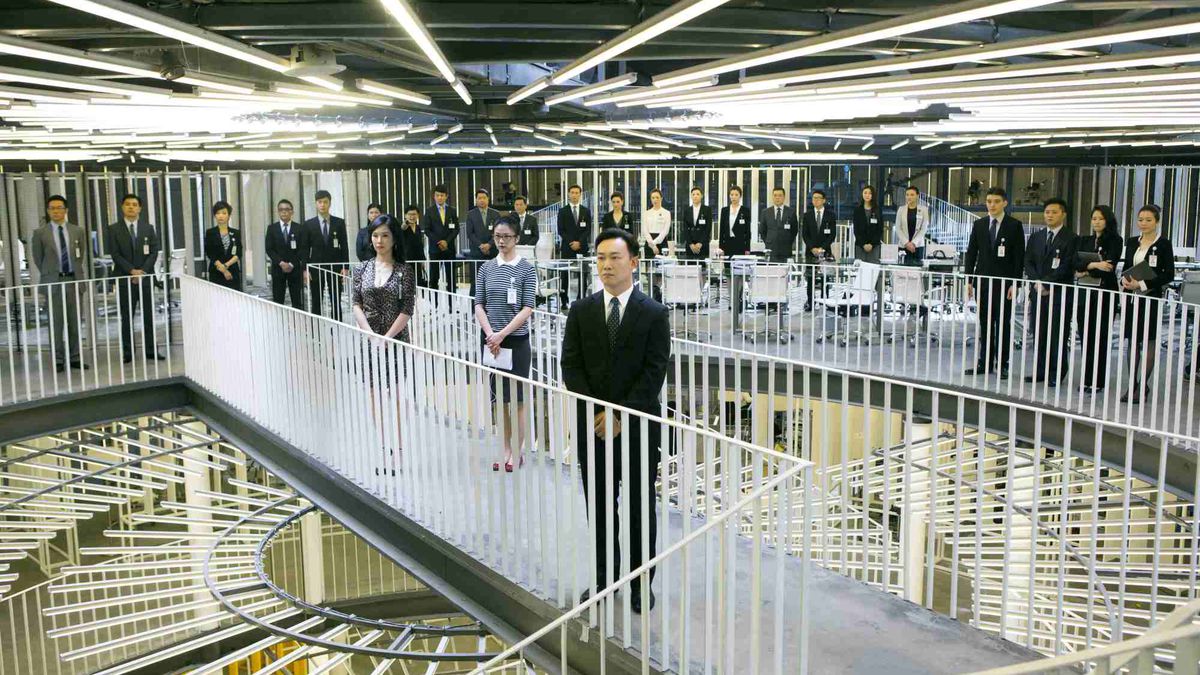
Indeed, that captivating oddity of Tati’s is the film Office most resembles, rather than any existing musical. Playtime and Office are both distilled versions of their directors’ key interests within the framework of observing the weird worlds of capitalism and consumerism (as someone says in To’s film, “We shouldn’t neglect the buying power of teenage girls”) with wild sets and fine-tuned, rhythmic movement through them by the often baffled individuals who worm their way in. To may never have made a musical before, but Office honestly doesn’t feel at all out of place with works like Life Without Principle in his filmography.
Office makes you wonder if more thriller-leaning filmmakers should make a foray into the musical genre. Michael Mann’s Gypsy, anyone?
Josh Slater-Williams (@jslaterwilliams) is a freelance writer based in England. Alongside writing for Vague Visages, he is currently a contributing editor at PopOptiq, a writer for VODzilla.co, and a regular contributor to independent British magazine The Skinny.
Categories: 2015 Film Reviews, Film Reviews
You must be logged in to post a comment.